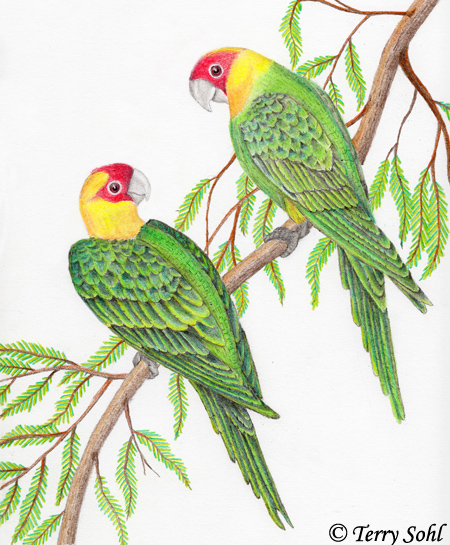
The Carolina Parakeet was the only parrot native to the continental United States. They once ranged from eastern Texas through the Gulf States, commonly reaching southern Virigina and Arkansas, and less commonly being found further north, even as far north as South Dakota. They preferred deciduous forests and forest edges, and loss of this habitat undoubtedly contributed to their ultimate demise. They fed on fruits, berries, and seeds, and unfortunately were strongly attracted to agricultural fields and orchards. Farmers who considered them as agricultural pests shot them on sight. Traveling in flocks, Carolina Parakeets would often return to the body of an individual bird that had been shot, a habit which contributed to their demise. The last definite records in the wild were in 1904, and the last captive bird died in the Cincinnati Zoo in 1918, although there were unconfirmed reports of wild birds through the 1920s..
Habitat
The Carolina Parakeet inhabited a variety of forested and semi-open habitats across the eastern and central United States. It was most strongly associated with bottomland hardwood forests, swamp forests, river floodplains, wooded wetlands, and forest edges, particularly along major river systems such as the Mississippi, Ohio, and Missouri. Historical accounts also describe the species using agricultural areas, orchards, and open woodlands where food resources were abundant. Its reliance on mature forests with cavity-bearing trees likely made it vulnerable to widespread habitat loss.
Diet
The Carolina Parakeet fed on a variety of seeds, fruits, nuts, berries, flower buds, and other plant materials. One of its best-known foods was the seed of cocklebur , a plant that contains toxins tolerated by the parakeet but avoided by many other animals. Historical accounts also indicate that it consumed sycamore seeds, cypress seeds, fruits from forest trees and shrubs, and occasionally cultivated fruits from orchards. Considered an agricultural pest as they often fed on planted crops.
Breeding
Wasn't a known breeder in South Dakota. Relatively little is known about the nesting biology of the extinct Carolina Parakeet, but historical accounts suggest that it nested in tree cavities within mature forests, particularly in bottomland woodlands and swamp forests. Nests were likely placed in natural hollows of large trees, similar to many modern parrots. Some reports indicate that the species may have nested in loose colonies or small groups, although details remain uncertain because few observations were documented before the bird's extinction in the early 20th century.
Migration
The Carolina Parakeet was not considered a true long-distance migrant. Historical records suggest that populations made seasonal local movements in response to food availability, weather, and fruiting cycles, but most birds likely remained within broad regions of the eastern and central United States year-round. Northern populations may have shifted southward during severe winters, while southern populations probably remained relatively sedentary. Because the species became extinct before detailed studies could be conducted, the extent of its seasonal movements is not fully known.
Similar Species
Was distinctive in U.S. range.
Conservation Status
Extinct. The last positive record of a wild bird was 1904, and the last one in captivity died in the Cincinnati Zoo in 1918. There were unconfirmed reports of sightings through the 1920s.
Image Information
Colored pencil drawing - Terry Sohl - December 2011. Click here for a larger view of the drawing.
