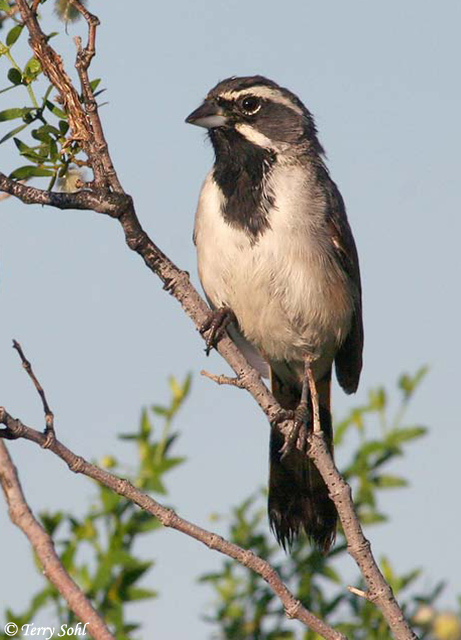
The Black-throated Sparrow is primarily a bird of arid regions in the West, where they can be quite common even in areas with very sparse vegetation. While not shy when approached by humans, they do not adapt well to the intrusion of human development in their native habitats. To ensure adequate water supplies for young, timing of the nesting season usually coincides with the timing of rains.
Habitat
Diet
Behavior
Song
The song of a Black-throated Sparrow is two or three bell-like notes followed by a rapid trill. Calls of a Black-throated Sparrow include a ringing peek, often repeated incessently.
- Click here to hear the song of a Black-throated Sparrow1
- Click here to hear the peek call of a Black-throated Sparrow2
- Click here to hear interaction vocalizations of three Black-throated Sparrows3
Nesting
Non-breeder in South Dakota. In their breeding range, Black-throated Sparrows nest in shrubs, typically within a foot or two of the ground. The nest is a small cup, constructed by the female and built of grasses, rootlets, and weed steams, and lined with hair and/or finer grasses. The female lays 2 to 4 eggs, and she alone incubates them. The young hatch after about 12 days, and fledge from the nest 10 to 12 days after hatching.
Migration
Feeders
On occasion, Black-throated Sparrows will visit feeder complexes for sunflower seeds and other offerings.
Similar Species
Black-throated Sparrows could potentially be confused with other sparrow species found in their range:
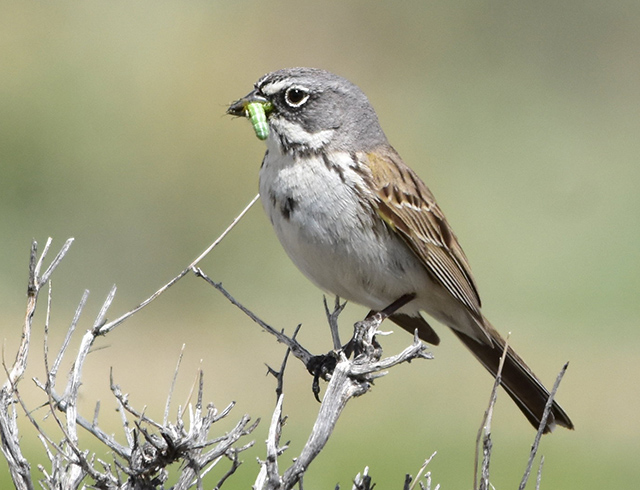
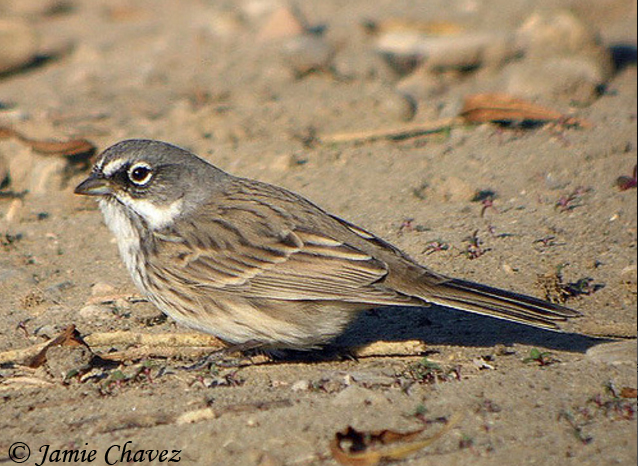
- Sagebrush Sparrow - Sagebrush Sparrow could be found in similar habitat, and have a similar size and structure as a Black-throated Sparrow. However, they lack the namesake black throat of a Black-throated Sparrow. Sagebrush sparrow have a bold white eye-ring that's lacking from Black-throated Sparrow, while Black-throated Sparrow have a bold white eyebrow lacking from Sagebrush Sparrow.
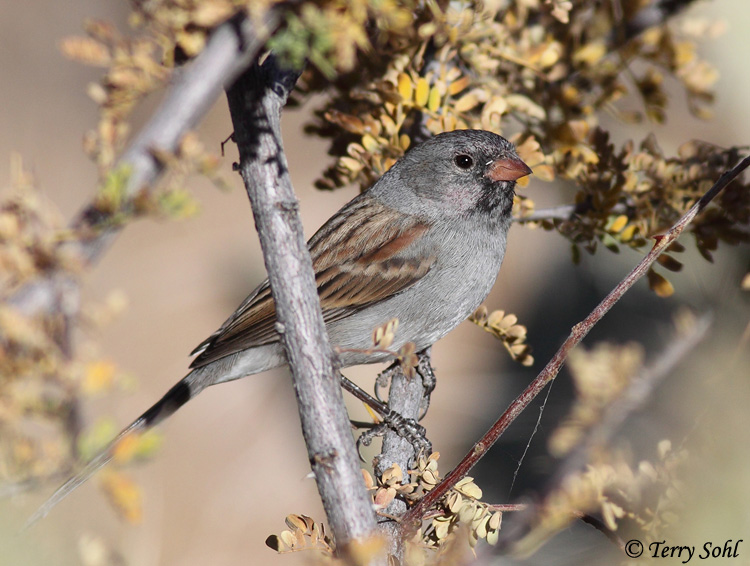
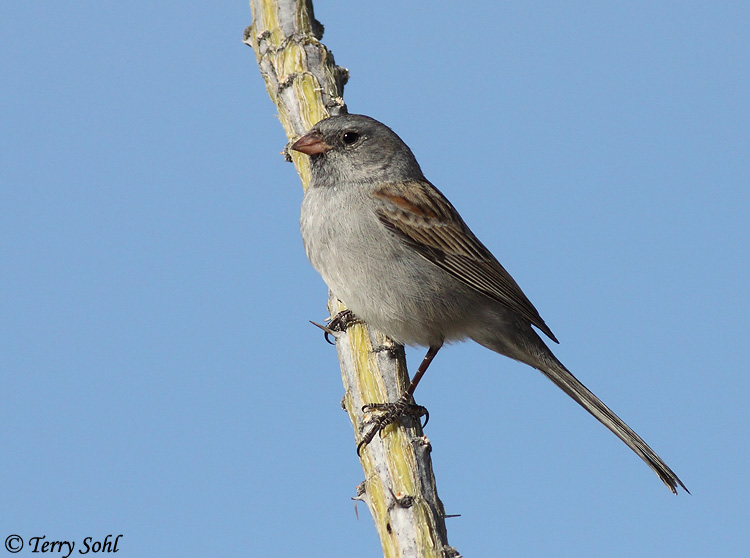
- Black-chinned Sparrow - Black-chinned Sparrows are found in similar habitat and overlap in range with Black-throated Sparrows. However, while they share the trait of a black throat, it's much less extensive on a Black-chinned Sparrow. Black-chinned Sparrows are also more gray all over, unlike the much lighter underparts of a Black-throated Sparrow. Black-chinned Sparrows also lack the white-brow of a Black-throated Sparrow.
- Bell's Sparrow - Bell's Sparrow are similar to Sagebrush Sparrow, but with a limited range primarily in California and Baha California. They lack the black throat and bold white eyebrow of a Black-throated Sparrow. Conversely, Black-throated Sparrow lack the white eye-ring of a Bell's Sparrow.
 |
 |
 |
 |
| Sagebrush Sparrow | Black-chinned Sparrow | Black-chinned Sparrow | Bell's Sparrow |
Conservation Status
Interactive eBird Map
Further Information
- eBird - Black-throated Sparrow
- Audubon Field Guide - Black-throated Sparrow
- Cornell Lab of Ornithology - All About Birds: Black-throated Sparrow
Photo Information
- 1Paul Marvin. Recorded in Pima County, Arizona on August 2nd, 2019. Original recording and information available from xeno-canto.
- 2Frank Lambert. Recorded in Mesa County, Colorado on April 23rd, 2015. Original recording and information available from xeno-canto.
- 3Richard E. Webster. Recorded in Cochise County, Arizona on May 23rd, 2015. Original recording and information available from xeno-canto.
