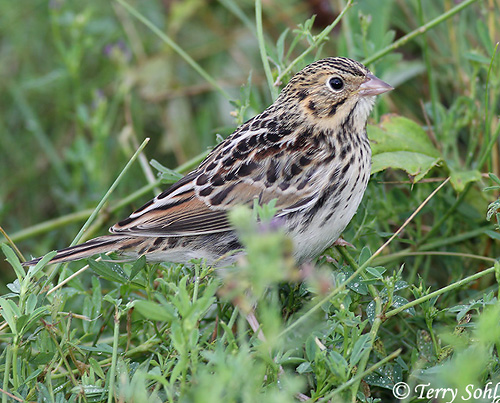
Baird's Sparrows only inhabit a small portion of their former range, due to their strong preference for native prairie for nesting. As with other closely-related species, they are often difficult to observe, as they prefer to run along the ground rather than flush. Baird's Sparrows have beautiful melodic songs compared to their close relatives such as the Grasshopper Sparrow.
Habitat
Breeds in native prairies of tall grasses and scattered weeds and brush. Will occasionally nest in wheat fields. Found in agricultural fields, grasslands, and prairies during migration.
Diet
Primarily feeds on insects and spiders in the summer, along with seeds. Winter diet is primarily seeds of weeds and grasses.
Behavior
Usually stays on the ground, foraging alone. They are only rarely found in the open, primarily only males when singing during the breeding season.
Nesting
June and July in South Dakota. Baird’s Sparrows breed locally in northern and central South Dakota, particularly in large expanses of native mixed-grass prairie with moderate grass height and scattered litter that provide concealment for nesting. Females build well-hidden cup nests on the ground beneath grasses or low vegetation, typically laying 3–5 eggs while males sing persistently from fence posts or grass stems to defend territories. Successful breeding is closely tied to healthy native prairie conditions, making the species sensitive to heavy grazing, early haying, and conversion of grasslands to cropland.
Interactive eBird Map
Click here for an interactive eBird map of Baird's Sparrow sightings
Song
The song of the Baird’s Sparrow is a soft, musical series of tinkling and buzzing notes that often begins with a faint introductory trill before ending in clearer, sweeter tones. Males typically deliver this distinctive prairie song from grass stems, fence posts, or low shrubs during the breeding season, especially at dawn and dusk across open grasslands.
Migration
Baird’s Sparrows breed during summer across the northern Great Plains and southern Canadian prairies, including portions of South Dakota, where they depend on large tracts of native grassland for nesting. In fall they migrate south to wintering areas in the southwestern United States and northern Mexico, returning north again in spring to establish breeding territories on the prairies.
Similar Species
The species most often confused with Baird’s Sparrow in South Dakota are the Grasshopper Sparrow, Savannah Sparrow, and Le Conte’s Sparrow. Grasshopper Sparrows are plainer overall, with little breast streaking, a bold white eye ring, and a simpler insect-like buzzing song, while Baird’s Sparrow shows a buffy face, fine streaking, and a sweeter, more musical song. Savannah Sparrows usually have heavier breast streaking and often show yellow in front of the eye, giving them a sharper facial pattern than the softer-looking Baird’s Sparrow. Le Conte’s Sparrows are smaller, brighter orange-buff in the face, and far more secretive, typically staying hidden low in dense grasses instead of singing from exposed perches.
Conservation Status
Baird’s Sparrow is considered a species of potential conservation concern because its population has experienced substantial long-term declines tied largely to the loss and fragmentation of native prairie habitat across the northern Great Plains. Remaining populations are especially vulnerable to grassland conversion, intensive grazing, haying during the nesting season, and other changes that reduce the large expanses of undisturbed prairie the species requires for successful breeding. However, populations currently do not warrant any listed status, and the IUCN considers the Baird's Sparrow to be a species of "Least Concern" overall.
Further Information
- eBird - Baird's Sparrow
- Audubon Field Guide - Baird's Sparrow
- Cornell Lab of Ornithology - All About Birds: Baird's Sparrow
Photo Information
July 23rd, 2011 - Grand River National Grasslands, South Dakota - Terry Sohl
