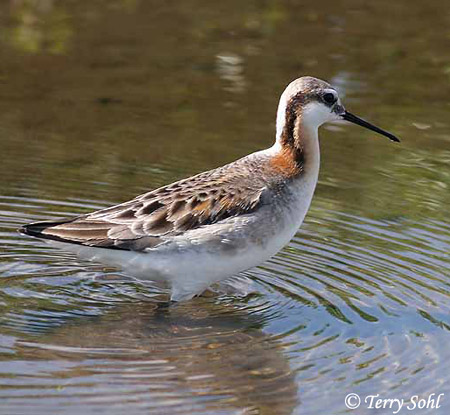
The Wilson's Phalarope is the largest of the phalarope species, and is usually quite tame and approachable within the state. They feed like many phalaropes, spinning in circles on the water to bring food items to the surface. Also like the other phalaropes, sex roles are somewhat reversed. Female phalaropes are the more brightly plumaged of the two sexes, and after the females lay eggs, they begin migrating southward, leaving incubation of eggs to the male. This is the only phalarope that leads its entire life on the interior of the continent.
Habitat
The Wilson's Phalarope prefers shallow prairie wetlands, marshes, alkali lakes, and flooded grasslands, especially in open landscapes with abundant aquatic insects and other small invertebrates. During migration it often gathers in large flocks on saline lakes and mudflats, where it feeds by spinning rapidly on the water surface to stir up prey.
Diet
Mostly aquatic insects and crustaceans. Also some vegetable matter.
Behavior
Primarily forages with the phalarope surface-spinning technique, but they also will often wade in search of food, plucking food items from the water's surface, or sometimes probing in the mud.
Nesting
Late May through June. The nest of a Wilson's Phalarope is a depression on the ground, with a bit of grass lining. The female lays 3 or 4 eggs, and the male alone incubates the eggs. When the eggs hatch, the young soon leave the nest. The young find their own food, but the male remains with them and protects them.
Song
The most frequently heard call of a Wilson's Phalarope is a muted honking-like call. They also have other peeping and whistling-like calls.
1Click here to hear a quiet honking-like call of a female Wilson's Phalarope
2Click here to hear the calls of multiple male Wilson's Phalarope
Migration
Summers throughout much of the Northern Plains, western U.S., and southern Canada. May fly non-stop to wintering grounds in South America. They are very fond of saline environments on the interior, with very large numbers stopping to feed in places like the Great Salt Lake in Utah.
Interactive eBird map
Click here to access an interactive eBird map of Wilson's Phalarope sightings
Similar Species
Wilson's Phalarope are by far the most likely phalarope species to be seen in South Dakota, as they migrate through the region as well as breed during the summer months. However, there are other phalarope species that have been found in South Dakota during migration.
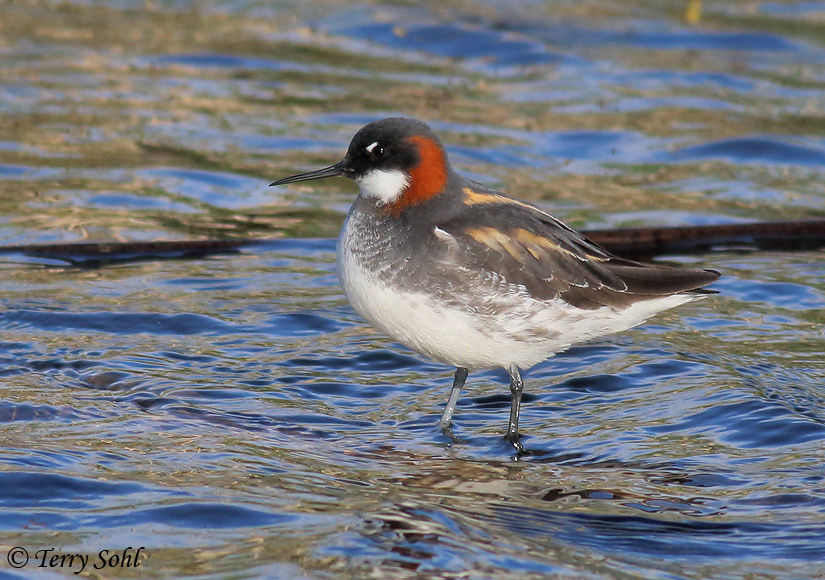
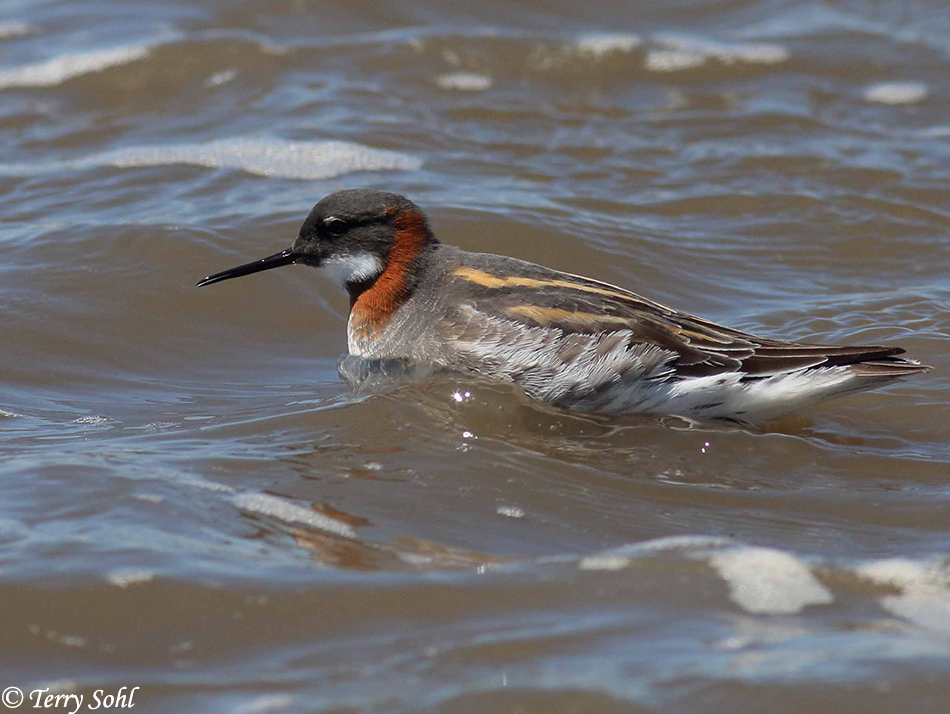
- Red-Necked Phalarope
- Red-necked Phalarope breed in the Arctic, and are uncommon migrants in
South Dakota. They are sometimes found in mixed groups with Wilson's
Phalarope, with the Wilson's typically far outnumbering Red-necked
Phalaropes. In breeding plumage, Red-necked Phalaropes have similar
plumage for males and females, but females are the ones who are more
brightly colored. They have dark gray upperparts, light underparts, with
a rusty swoosh on their neck and a white chin. Breeding plumage Wilson's
Phalarope have dark upperparts (grayish on female, a bit more brownish
on males), light underparts, and a black stripe through the eye and down
the neck. They also have a white eyebrow lacking on a breeding plumaged
Red-necked Phalarope.
Non-breeding Red-necked Phalaropes have slate gray upperparts and white underparts.with a black patch behind the eye. Non-breeding Wilson's Phalaropes lose the neck striping and are darker above and light below, but the upperparts are more of a brownish color instead of the Red-necked Phalarope's gray. - Red Phalarope - Red Phalarope are an extremely rare migrant through the state and thus less likely to cause identification issues. Breeding Red Phalarope are easy to differentiate, as they have a rich rufous color on their entire underparts and neck, with a bold black cap and white face.
 |
 |
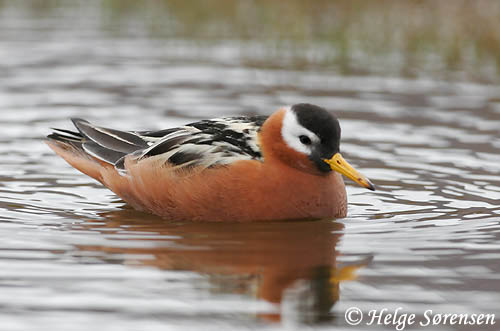 |
| Red-necked Phalarope | Red-necked Phalarope | Red Phalarope |
Conservation Status
Numbers of Wilson's Phalarope declined in the 19th century as did many shorebirds, and habitat loss continues to be an issue in local parts of their range. However, systematic surveys in recent decades suggest increasing populations now. They are found across a very broad geographic range, and are quite common in parts of that range. The IUCN lists the Wilson's Phalarope as a species of "Least Concern".
Photo Information
May 20th, 2005 - Lake Thompson, Kingsbury County, South Dakota - Terry Sohl
Audio File Credits
1Paul Marvin. Recorded in Philips County, Montana on June 3rd, 2015. Original recording and information available on xeno-canto.
2Andrew Spencer. Recorded in Rio Grande County, Colorado on June 28th, 2012. Original recording and information available on xeno-canto.
