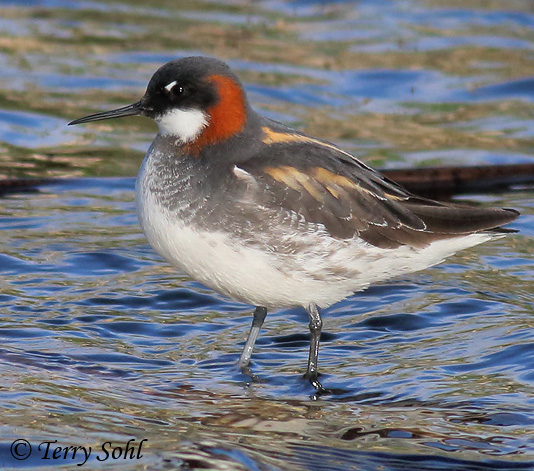
The
Red-necked Phalarope are primarily birds of the northern tundra in the summer,
and of the open ocean in the winter. As breeding birds, they are found
both in North America, and in Europe and Asia. With migration habits that bring
them into the southern Hemisphere for (the Northern Hemisphere) winter,
Red-necked Phalaropes are thus one of the more widely spread birds in the world.
While migration usually occurs along coastlines, there are small numbers that
migrate through the interior of the country, and they are thus considered
uncommon visitors to South Dakota.
Like other phalaropes, they can often be seen spinning on the surface as they
feed. Like other phalaropes, there also is something of a reversal of roles
between male and female birds. It is the female birds that are more brightly
colored, the females are the aggressors during courtship, and it is the male
birds that incubate and raise the young.
Habitat
Breeds on marshy tundra. In migration inland, they are most common on ponds or lakes with abundant insects, a preference that also includes sewage ponds. During winter, most winter well offshore, concentrating on areas of upwelling water.
Diet
Primarily feeds on insects on its summer breeding grounds. During migration and in winter, will also feed on small crustaceans and mollusks, as well as plankton.
Behavior
Feeds in typical phalarope fashion, swimming and picking food items from the surface or just below. As with other phalaropes, open spins while foraging, bringing food items closer to the surface.
Breeding
Non-breeder in South Dakota. On their breeding grounds, females are the ones that actively court the males, displaying and circling around the male to try to capture his attention. The nest of a Red-necked Phalarope is a small depression placed in a clump of grass or other vegetation on the marshy tundra, usually close to a water source. The female lays 3 to 6 eggs, but then leaves the male to incubate them, and she may mate with other males and populate other nests as well. The young hatch after about 20 days.
Song
Makes a soft twip flight call, sometimes given in series.
1Click here to hear the single note calls of a Red-necked Phalarope
2Click to hear the multi-note calls of a male Red-necked Phalarope
Migration
Summers in northern Canada and Alaska. Primarily winters in the Southern Hemisphere, with large numbers well off coast to the west of South America. They are also found in Eastern Hemisphere.
Interactive eBird Map
Click here to access an interactive eBird map of Red-necked Phalarope sightings in South Dakota
Similar Species
Red-necked Phalaropes can potentially be confused with 2 other phalarope species that could potentially be found in South Dakota, particularly when birds are in their non-breeding, winter plumage:
- Wilson's Phalarope - Wilson's Phalarope are the commonly seen phalarope species in South Dakota, here both in migration and as a summer breeding bird. In breeding pluimage, Wilson's Phalarope's have a white throat, as does a Red-necked Phalarope, but it's accompanied by a white stripe above the eye, giving the Wilson's Phalarope the appearance of having a white face with a black line through the eye. Red-necked Phalaropes have a small white dot above the eye, but the top half of the head is more uniformly dark than a Wilson's Phalarope. Breeding plumaged Wilson's Phalarope have rusty color on the sides of the neck and towards the throat (more richly colored on females than males), accompanied by a dark stripe down the side of the neck on female birds. In contrast, Red-necked phalaropes have a richer, deeper reddish mark on the side of the neck and head, extending backwards towards the nape. In non-breeding plumage, both species are much duller in appearance, with white underparts and darker upperparts. However, Wilson's Phalarope have a darker cap, with the same appearance of a white "eyelash" and darker eyestripe as seen in breeding plumaged birds. Non-breeding Red-necked Phalaropes appear to have a lighter-colored head with a dark mark behind the eye.
- Red Phalarope - The Red Phalarope is a rarity in South Dakota, with just a handful of records. In breeding plumage they are easily distinguished from the other two phalarope species, as their underparts are a rich rusty red color (compared to white on both Wilson's and Red-necked Phalaropes). They also have a broad white facial mask that sharply contrasts with a dark cap and lores, and a yellow bill. In non-breeding plumage, they can easily be confused with Red-necked Phalaropes. They share the same white underparts, gray upperparts, and a black mark through and behind the eye. However, on a Red Phalarope, the upperparts are more uniformly colored, while the upperparts of a non-breeding plumaged Red-necked Phalarope are more streaky.
Status
Overall populations globally appear to be decreasing. There are likely multiple reasons behind the decline, including habitat disturbance on parts of its breeding grounds. One major factor for declines in the Western Hemisphere may be El Nino-Southern Oscillation (ENSO) events. They rely on coastal plankton on their wintering grounds off the coast of South America, and abnormal temperature events disrupt plankton populations. As noted by the IUCN, some populations of Red-necked Phalaropes in the past have crashed after ENSO events, and with increased ENSO activity predicted as part of climate change, the impact may increase in the future. Overall, however, Red-necked Phalaropes still have a very broad geographic range, being found in both the Eastern and Western Hemispheres, and they are common in parts of that range. As a result, the IUCN currently considers the Red-necked Phalarope to be a species of "Least Concern".
Photo Information
May 20th, 2014 - Potter's Marsh, near Anchorage, Alaska - Terry Sohl
Audio File Credits
1Timo Janhonen. Recorded in Greenland on July 5th, 2018. Original recording and information from xeno-canto.
2Stein Nilsen. Recorded in Svalbard, Norway on June 9th, 2018. Original recording and information from xeno-canto.
