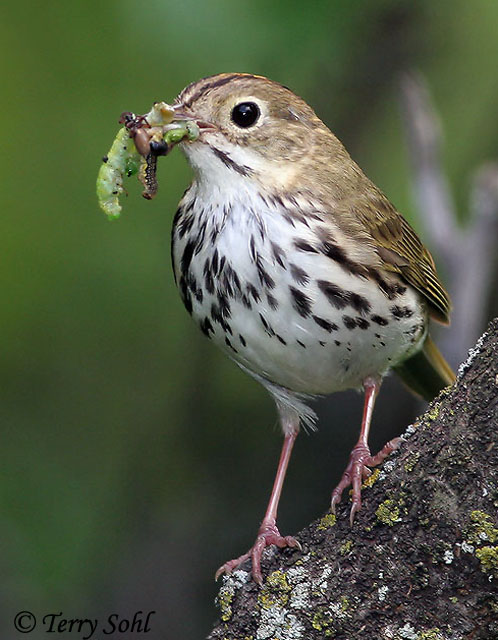
Ovenbirds are found in mature forests of eastern and central North America. They are named after their nest, a domed structure with a side entrance which resembles old wood ovens. They are most often encountered walking on the forest floor, searching the leaf litter and rotten wood for insects. However, they are probably heard more often than seen, having a very bold and distinctive song.
Habitat
The Ovenbird inhabits mature deciduous and mixed forests with dense leaf litter and a well-developed understory. It favors shady woodland interiors, wooded ravines, riparian forests, and mature oak or maple forests where it forages mainly on the ground.
Diet
Primarily feeds on insects. They will also take earthworms, spiders, small amphibians and snails, and occasionally, fruits, berries, and seeds.
Behavior
The Ovenbird spends much of its time walking on the forest floor while flipping leaves and probing for insects and other small prey. Although often difficult to see in dense woods, males frequently perch high in trees to deliver their loud repetitive song during the breeding season.
Nesting
June and July in South Dakota. The nest is a dome of dead leaves, grasses, and other vegetation, built on the ground in a protected location, with an entrance on the side. The female lays 3-6 eggs, and she alone incubates them. The eggs hatch after about 2 weeks.
Breeding
The nest is an open cup of leafs, mosses, twigs, pine needles, and other vegative material, placed in a protected spot near or on a tree stump, among tree roots, or under a cut bank. The female lays 4 or 5 eggs, and she alone incubates them. Both parents help feed the young after the eggs hatch. The young leave the nest after about 10 days.
Song
Loud repeating call, getting stronger towards the end...TEAcher-TEAcher-TEAcher-TEACHER.
Migration
Summers throughout central and southeastern Canada, locally in the northern Great plains, and throughout most of the northeastern quarter of the United States. Winters in Florida, Mexico, Central America, and the Caribbean.
Interactive eBird Map
Click here to access an interactive eBird map of Ovenbird sightings
Similar Species
Ovenbirds have relatively unique plumages for North American warbler species, but there are a few other brownish, striped species that could cause confusion if not seen well.
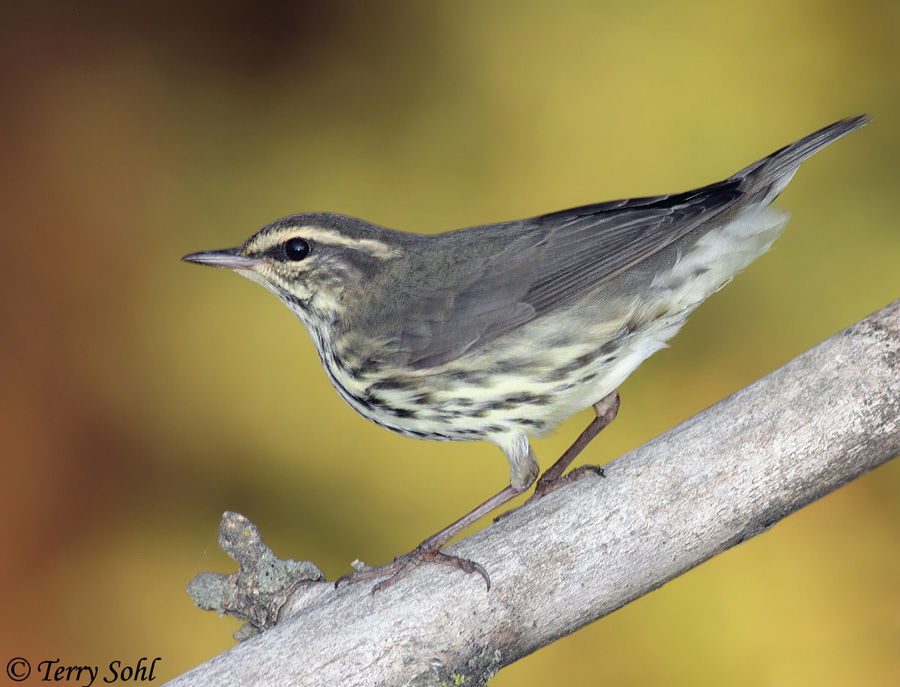
- Northern Waterthrush - Northern Waterthrush are a migrant in South Dakota, but sometimes cross paths with Ovenbirds, in similar forested habitats. Both are small warbler species with brownish tones above, and a lighter underside with streaks. However, Northern Waterthrush lack the black-bordered orangish crown stripe of an Ovenbird. They also typically have a more dull, darker brownish color overall, while Ovenbirds appear to be a warmer, lighter, richer brown. Northern Waterthrush also have an obvious white "eyebrow" that's lacking on an Ovenbird, and lack the light eye-ring of an Ovenbird.
- Louisiana Waterthrush - Louisiana Waterthrush are but a very rare migrant in South Dakota, and thus don't typically cause any identification challenges in the state. In terms of appearance, Louisiana Waterthrush are very similar to Northern Waterthrush, and the same ID keys can be used to differentiate them from Ovenbirds.
 |
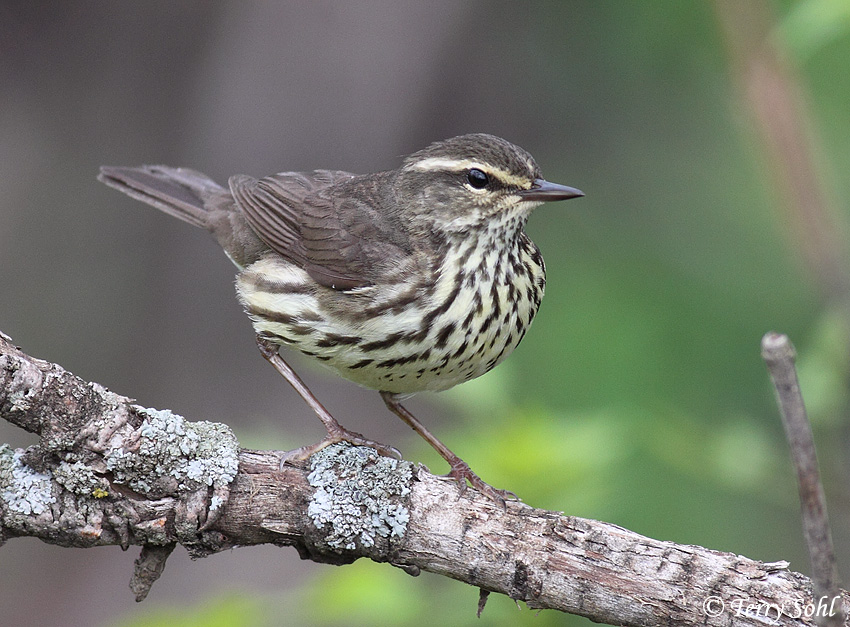 |
| Northern Waterthrush | Northern Waterthrush |
Conservation Status
The Ovenbird remains widespread and fairly common across much of its eastern North American forest range and is generally considered a species of low conservation concern. However, habitat fragmentation, forest loss, and brood parasitism by Brown-headed Cowbird can negatively affect some breeding populations. The IUCN lists the Ovenbird as a species of "Least Concern".
South Dakota "Hotspot"
Ovenbirds are easily found at Newton Hills State Park in Lincoln County (southeastern part of the state) in the spring. Good numbers breed there, and the sound of Ovenbirds singing is very common in the park in May and early June.
Photo Information
June 5th, 2007 -- Newton Hills State Park -- Terry Sohl
Audio File Credits
- 1Jacob Saucier. Recorded in Stafford County, Virginia on May 14th, 2017. Original recording and information available from xeno-canto.
- 2JL Guerra. Recorded in Cotorra, in Cuba on September 21st, 2017. Original recording and information available from xeno-canto.
