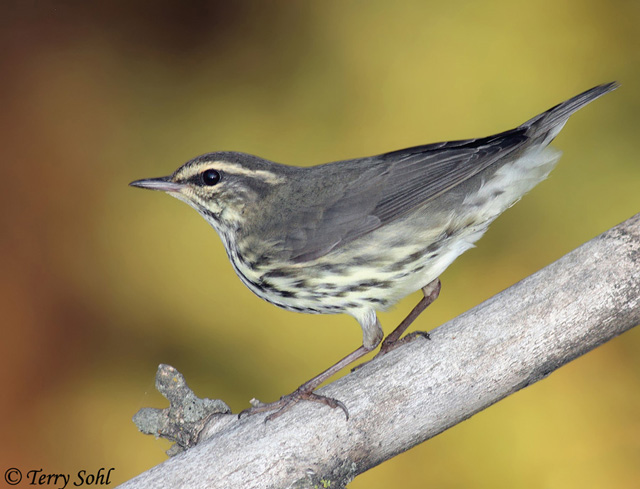
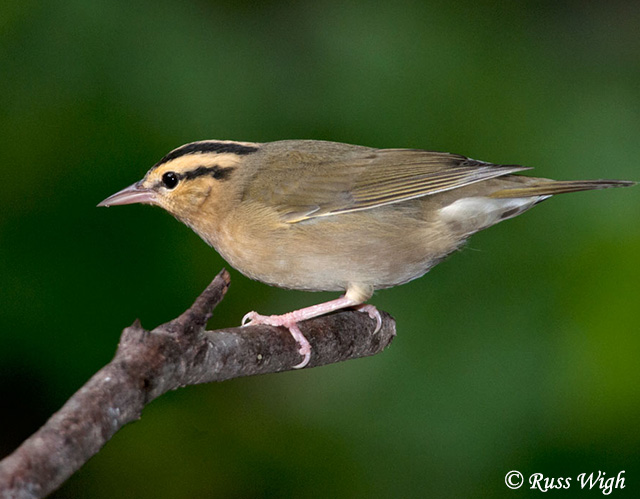
A shy bird normally found in thickets around streams and ponds, the Northern Waterthrush can often be seen bobbing its hindquarters up and down as it searches for food. In South Dakota, they are found as migrants, with sightings possible in both the spring and fall seasons. One of the earliest fall migrants, some Northern Waterthrush may start their southward movements as early as the middle of July.
Habitat
The Northern Waterthrush inhabits wooded wetlands, bogs, swamps, marsh edges, riparian thickets, and densely vegetated shorelines. During migration it is especially common along muddy pond edges, flooded woods, and stream corridors where dense cover and shallow water are available.
Diet
The Northern Waterthrush feeds mainly on aquatic and terrestrial insects, spiders, snails, small crustaceans, and other invertebrates gathered along muddy shorelines and shallow water.
Behavior
The Northern Waterthrush typically walks rather than hops, constantly bobbing its tail as it forages along muddy shorelines, streams, and wet forest floors. It is usually solitary and secretive, moving through dense vegetation while searching for insects and other small prey near water.
Breeding
Non-breeder in South Dakota. On breeding grounds, the nest is a open cup of leaves, mosses, twigs, and bark, placed in a protected area such as in a stump or in an area protected by tree roots. The female lays 4 or 5 eggs, with the female alone incubating them. Upon hatching, both parents feed the young, which leave the nest after about 10 days.
Song
Northern Waterthrush have multiple songs and call notes. The most frequently heard song is a musical suite of three distinct elements, often described as sweet-sweet-sweet swee- swee-swee chew- chew- chew. Another song begins with a few high-pitched notes, followed by a jumbled mix of short musical notes and phrases. Calls include a loud zink.
- Click here to hear the song of a Northern Waterthrush1
- Click here to hear the short call notes of a Northern Waterthrush2
- Click here to hear another song of a Northern Waterthrush3
Migration
Summers throughout Canada and the northern and northeastern United States. Winters in Florida, Mexico, and points south. In South Dakota, they are migrants, seen in both the spring and fall seasons.
Interactive eBird Map
Click here to access an interactive eBird map of Northern Waterthrush sightings
Similar Species
Northern Waterthrush lack the brilliant colors of many warbler species that migrate through the state, but there are a few other species they could potentially be confused with, particularly one very close relative:
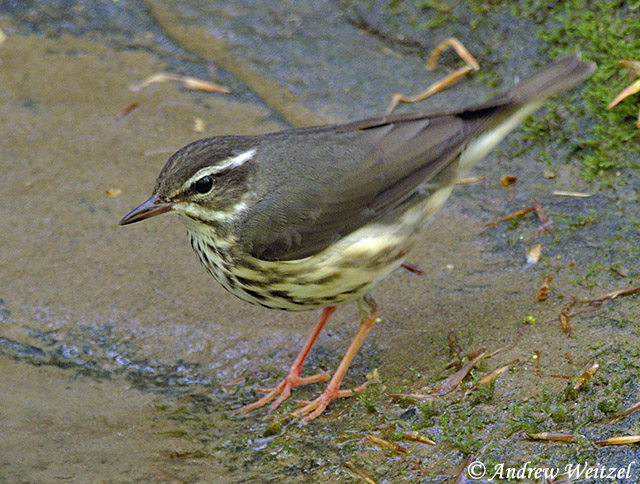
- Louisiana Waterthrush - Louisiana Waterthrush are far less common in South Dakota than Northern Waterthrush, as they are considered rare migrants. The two are very similar in appearance, but Louisiana Waterthrush appear to have more white in their base plumage than the more buffy Northern Waterthrush. The eyebrow is noticeably white on a Louisiana Waterthrush, and is typically broader at the rear of the eyebrow stripe than is the more buffy, thinner stripe of a Northern Waterthrush. Northern Waterthrush have denser striping on their underparts than does a Louisiana Waterthrush. The underparts also appear whiter than the buffier underparts of a Northern Waterthrush.
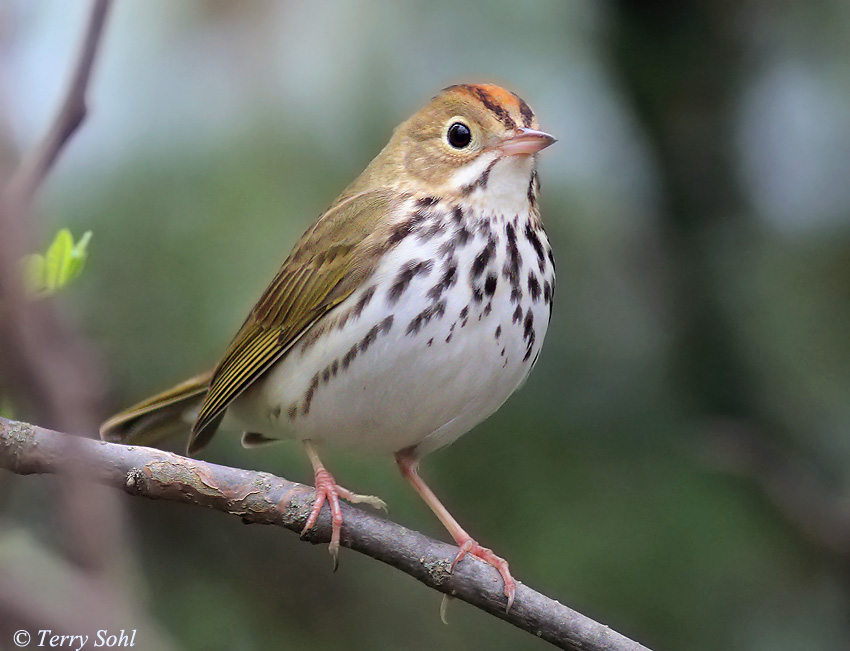
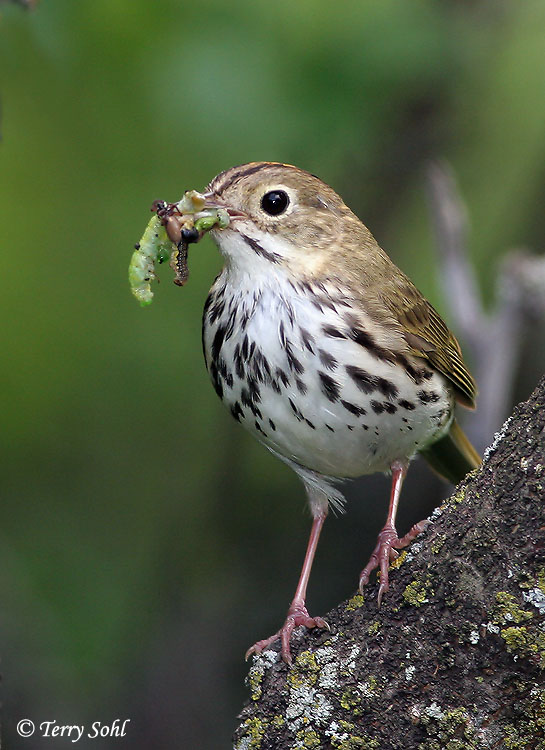
- Ovenbird - A common migrant and summer resident in parts of South Dakota, Ovenbirds make the list because they're another brownish, striped warblers that stay low to the forest floor. Ovenbirds are a richer, reddish brown color, while Northern Waterthrush are a grayish-brown on their upperparts. Ovenbirds have a white eyering and an orange and black-bordered crown stripe that are lacking on a Northern Waterthrush, while the Northern Waterthrush has an eyebrow that's lacking on the Ovenbird.
- Worm-eating Warbler - Worm-eating Warbler makes the list as it's another brownish warbler that stays low to the ground and has an obvious eyebrow. They are very rare migrants in South Dakota, however, and lack the striping and their underparts that are so characteristic of a Northern Waterthrush. They also have a stronger buffier color on their head than the plainer Northern Waterthrush.
 |
 |
 |
 |
| Louisiana Waterthrush | Ovenbird | Ovenbird | Worm-eating Warbler |
South Dakota "Hotspot"
Northern Waterthrush are most often seen near the edges of water bodies, in forested areas. Great locations to look for them in spring migration include areas like the oxbows around the Outdoor Campus in Sioux Falls, creekside at Beaver Creek Nature Area, or the area along Sergeant Creek at Newton Hills State Park.
Conservation Status
Numbers appear to be stable, they are common in many parts of their normal range, and they are found over a wide geographic range. The IUCN lists the Northern Waterthrush as a species of "Least Concern".
Image Information
Photo taken on September 2nd, 2012 - Minnehaha County, South Dakota - Terry Sohl
Audio File Credits
- 1Christopher McPherson. Recorded in Hillsborough County, New Hampshire on May 2nd, 2020. Original recording and information available from xeno-canto.
- 2Manuel Grosselet. Recorded in Sinaloa, Mexico on July 8th, 2020. Original recording and information available from xeno-canto.
- 3Frank Lambert. Recorded near Nome, Alaska on June 1st, 2015. Original recording and information available from xeno-canto.
