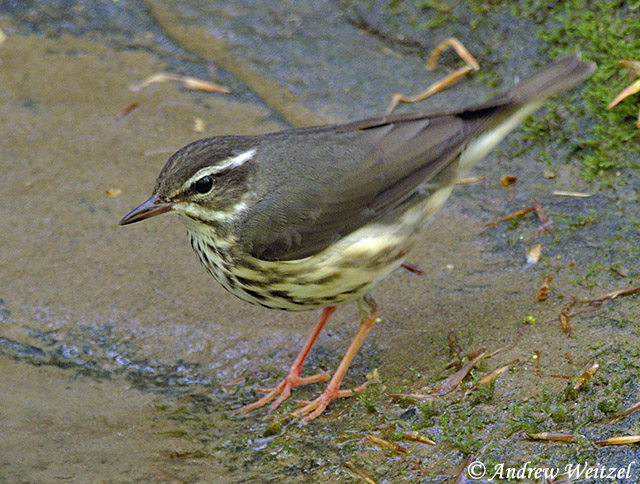
ID Keys: White eyebrow, white underparts with buffy-pinkish
flanks, olive striping on breast and sides, olive-brownish upperparts.
The Louisiana Waterthrush is
the less widespread and common of the two Waterthrushes (the Northern
Waterthrush being the other). They have a characteristic rear bobbing
action as they forage in and around water They usually flush into
the surrounding forest when alarmed, with a sharp call note as they go.
Habitat
Nearly
always found in and around aquatic habitats, primarily in forested
environments. This includes bottomland swamps and lagoons, riparian areas,
and hilly brooks and streams. In winter in the tropics, they also prefer
forested areas in and around water, even sometimes using coastal mangrove
swamps.
Diet
Feeds on both
aquatic and terrestrial insects, as well as small crustaceans and mollusks, tiny
fish, and occasionally seeds.
Behavior
Usually
forages by walking along the ground, often along the edge of water or even in
it, as they turn over stones and vegetation in search of food. They will
also catch flying insects in midair.
Current populations are probably stable,
but overall, numbers are much lower than historical levels due to habitat
loss in the Southeastern United States.