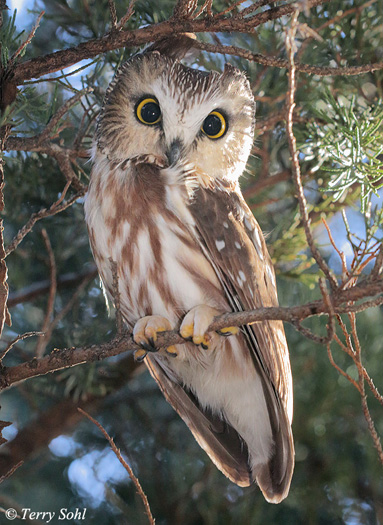
ID Keys: Lack of ear tufts, small size, pale facial disks, brownish
spotted upperparts
Northern
Saw-whet Owls are a very small owl of conifer forests. They are named for
their loud,
persistent night-time song during breeding season, which may carry on for hours
at a time. They are often extremely tame, allowing for very close
approaches. This behavior can also make them somewhat difficult to locate,
as they likely won't move or flush upon approach. The difficulty in seeing
Northern Saw-whet Owls is also complicated by their choice of habitat, as
they're typically found in dense conifer stands on their daylight roosts.
Habitat
Prefers coniferous forest during summer breeding season. May winter in any forested habitat, although more commonly in conifer groves. In South Dakota, I've had the best luck finding their roosts in stands of dense, relatively young eastern red cedar trees. The young trees often are spaced quite close together and have denser foliage, providing more cover for Northern Saw-whet Owls than older conifer trees.
Diet
Mostly small mammals, occasionally small birds and large insects. Given their small size, even a mouse or a mole is sometimes too large of a prey item for a Northern Saw-whet Owl to consume at one sitting. They will often consume half of their prey, caching the other half the crook of a tree branch for later consumption. Given the cold environments they're often found in, those cached items often freeze solid, leading to Northern Saw-whet Owls "incubating" cached prey to thaw it prior to consumption (see photos below).
Behavior
Almost completely nocturnal, hunting only at night. Capable of finding prey both by sight and by sound, they primarily observe from a perch, swooping down to capture prey as its located.
Nesting
May and June. The nest of a Northern Saw-whet Owl is placed in a cavity, historically in a tree cavity such as an old woodpecker hole, but they will also use nest boxes of the appropriate size. No new material is added to the nesting cavity, although they will use existing debris or nesting material from the species that previously occupied the nest. The female lays 4 to 7 eggs, with the female alone incubating them. The male delivers food during the roughly 4-week incubation period. The young leave the nest after about 4 to 5 weeks, but the parents may continue to defend and feed the young for up to another 2 months after fledging.
Song
Long series of single toots. They primarily vocalize during the breeding season. Click here to hear the advertising song of a male . Click here to hear an alarm call , more of a series of moaning calls. ( Both audio files by Lance A.M. Benner, from Los Angeles County in California) .
Migration
Semi-permanent resident in higher elevations of North America. Some move south and to lower elevations in winter, but movements are irregular and somewhat unpredictable. In winter in South Dakota, they may be present in good numbers one year, and almost completely absent in subsequent years.
Boreal Owl , Eastern Screech Owl. The Northern Saw-whet Owl is a tiny, round-headed brown owl with no ear tufts, a pale facial disk, and fine vertical streaking below. Boreal Owl is slightly larger with a broader white facial disk, a squarer head, heavier spotting on the crown, and a more stern expression, while Eastern Screech-Owl is chunkier, shows obvious ear tufts, and has a more intricately mottled gray or reddish plumage pattern. Saw-whets also tend to look softer-faced and more delicate than either of these other small owls. In short...they're freaking adorable!!
Will use appropriately sized nest boxes. Northern Saw-whet Owls are commonly found as nesting birds in nest boxes placed for them in the far western part of the state.
South Dakota "Hotspot"
Birders in the Pierre area have found Northern Saw-whet Owls overwintering in cedar/juniper trees near the Missouri River and Lake Oahe near Pierre. They may be more widespread in South Dakota in winter though. My recent searches of similar cedar thickets in the southeastern part of the state have also found several Saw-whet owls. I have found several in the cedar stands at Newton Hills State Park and elsewhere in the southeastern part of the state.. Given the dense habitat they prefer for daytime roosts and the difficulty in visually locating one, they may be around in significant numbers.
Photo Information
January 27th, 2015 - Lincoln County, South Dakota - Terry Sohl