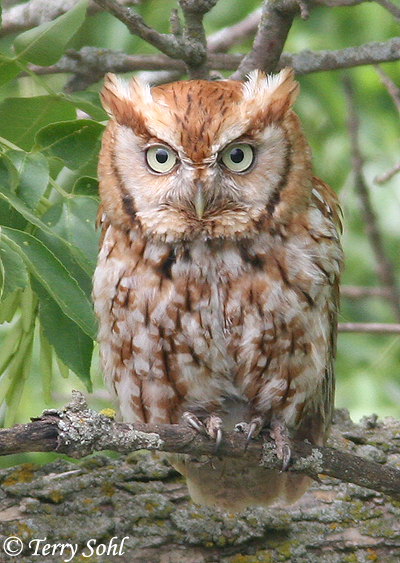
Eastern Screech Owls are a common little owl often found in residential areas and parks, where their haunting calls are often the only indication of their presence. They are nocturnal, but can occasionally be spotted on perches in thick tree canopies during the day. Their presence is also often given away by birds that are "mobbing", with mixed groups of songbirds aggressively pestering an Eastern Screech Owl found outside during daylight hours.
There are various color morphs, but the gray morph is generally the most common in the state. Photos of both the gray and red morph can be seen in the photo links at the bottom of the page.
Habitat
The Eastern Screech-Owl inhabits woodlands, forest edges, riparian corridors, orchards, parks, suburban neighborhoods, farmsteads, and residential areas with mature trees. It favors habitats that provide tree cavities for nesting and roosting, often occurring surprisingly close to human activity. In South Dakota, it is most common in the eastern and southeastern parts of the state, particularly in wooded river valleys, shelterbelts, and urban areas with suitable tree cover.
Diet
The Eastern Screech-Owl has a highly varied diet that includes insects, spiders, earthworms, crayfish, frogs, lizards, small snakes, mice, voles, shrews, bats, and small birds. It hunts primarily at night, using perch-and-pounce techniques to capture prey on the ground, in vegetation, or in the air. Large insects and other invertebrates often make up a substantial portion of the diet, especially during warmer months.
Behavior
The Eastern Screech-Owl is a nocturnal predator that spends daylight hours roosting in tree cavities, dense foliage, or other sheltered locations. It typically hunts from a perch, silently dropping onto prey or making short flights to capture insects, small mammals, birds, and other animals. Despite being common in many areas, it is often overlooked because of its excellent camouflage and secretive habits. Individuals frequently remain in the same territory year-round and readily use nest boxes where suitable cavities are limited.
Nesting
April and May in South Dakota. The nest of an Eastern Screech Owl is a cavity in a tree, often an old woodpecker hole. They also have become well adapted to the use of nest boxes specially sized for screech owls. The female alone incubates the eggs, but the male will bring food to her during incubation. Both parents will help to raise the young.
Song
Eastern Screech Owls have multiple vocalizations, with one of the most frequent being a haunting descending whinny. Another frequently heard call is an even pitched trilling call. Other shorter barking or hooting calls are also given.
- 1Click here to hear the descending whinnying call of an Eastern Screech Owl
- 2Click here to hear one alarm call of an Eastern Screech Owl
- 3Click here to hear a series of vocalizations of an Eastern Screech Owl, with both the descending whinnies and the even trilling
- 4Click here to hear short calls of an Eastern Screech Owl
Migration
The Eastern Screech-Owl is a nonmigratory species that remains within its territory throughout the year. Most individuals make only short local movements in response to food availability or weather conditions and do not undertake regular seasonal migrations. In South Dakota and elsewhere across its range, it is considered a permanent resident.
Interactive eBird Map
Click here to access an interactive eBird map of Eastern Screech Owl sightings
Similar Species
The difficulty in identifying an Eastern Screech Owl often lies more with their habits than their visual appearance, as they're relatively distinctive if seen well. "Seeing them well" is the challenge, however, and thus they could potentially be confused with other small owl species:
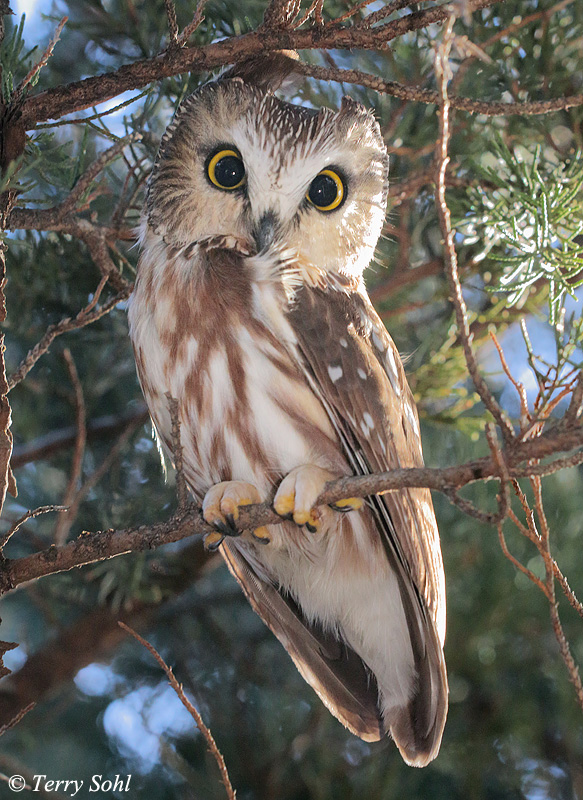
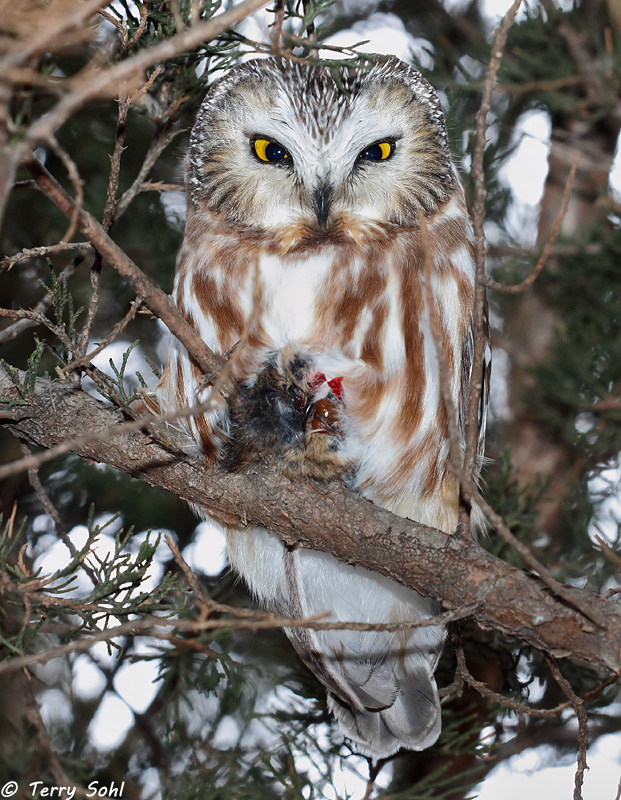
- Northern Saw-whet Owl - Another small owl species, Northern Saw-whet Owls are permanent breeding residents in select locations of far western South Dakota, while they're winter visitors and migrants elsewhere. They're smaller than an Eastern Screech Owl, and lack ear tufts. Both have barred/striping on their underparts, but with notably different patterns. Northern Saw-whet Owls have "cleaner", more sleek striping, while Eastern Screech Owls have a very fragmented and complex barred pattern.
- Western Screech Owl - The western North American counterpart of the Eastern Screech Owl, range is the primary way to tell the two species apart, as Western Screech Owls have very little if any range overlap with Eastern Screech Owls. Visually they're almost identical, but voice is another way to tell them apart. Each is capable of multiple vocalizations, but one of the most common Eastern Screech Owl calls is a unique whinny that descends in pitch, while a Western Screech Owl is often giving a series of hoots that increase in pace towards the end.
 |
 |
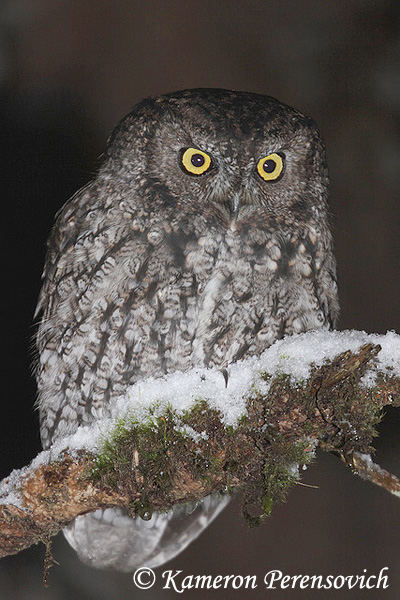 |
| Northern Saw-whet Owl | Northern Saw-whet Owl | Western Screech Owl |
Nestboxes
Will use artificial nest boxes of appropriate size. Except the one in my back yard. They'll use a friend's nest box. They'll use a neighbor's nest box up the street. They know I'm an avid birder, however, and are thus actively avoiding my yard just as one big cosmic joke. Eastern Screech Owls are known comedians.
Conservation Status
Eastern Screech Owls have adapted well to a human presence, as they're perfectly comfortable nesting and hunting in urban parks and suburban areas. However, systematic surveys in recent years have shown substantial declines in US populations. Habitat loss is probably contributing to the declines. However, they are found across a very broad geographic area, and are still relatively common in many parts of that range. The IUCN currently lists the Eastern Screech Owl as a species of "Least Concern".
Photo Information
June 11th, 2006 - Beaver Creek Nature Area, Minnehaha County, South Dakota- Terry Sohl
Audio File Credits
- 1Nick Komar. Recorded in Larimer County, Colorado on January 1st, 2021. Original recording and information available on xeno-canto.
- 2Russ Wigh. Recorded in Chatham County, Georgia on December 26th, 2019. Original recording and information available on xeno-canto.
- 3Lance A.M. Benner. Recorded in Barnstable County, Massachusetts on December 22nd, 2019 . Original recording and information available on xeno-canto.
- 4Manuel Grosselet. Recorded in Mexico on July 24th, 2017. Original recording and information available on xeno-canto
