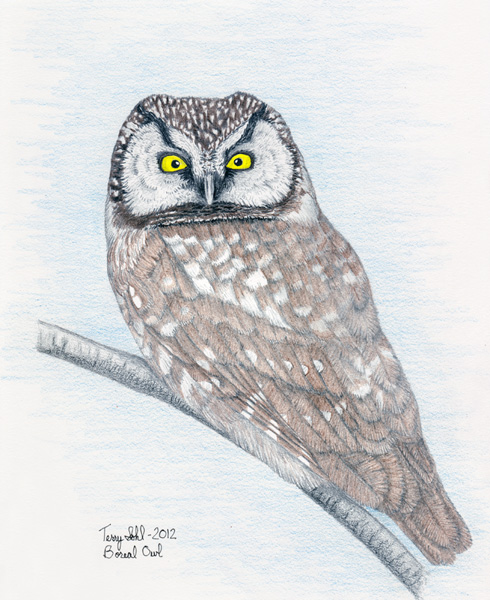
The Boreal Owl is a reclusive owl rarely seen by humans in North America, as they prefer boreal forests of Canada and Alaska and upper-elevation mixed conifer forests of the western U.S. In addition, they are highly nocturnal, and generally are only vocal during the early spring. Prior to the 1970s, it was thought they only bred in Canada, until populations started to be discovered at higher elevations in the western U.S. They can also be found in Eurasia.
Habitat
Prefers mixed coniferous forest for breeding, especially spruce or fir mixed with aspen or birch. These habitats can be found at lower elevations throughout much of its range in Canada and Alaska. In the southern part of its range, they are primarily found in higher elevations.
Diet
Primarily feeds on small mammals. Will also eat small birds and insects.
Behavior
Nocturnal, doing nearly all its hunting at night. Hunts by observing from a perch, swooping down to snag prey in its talons when spotted. Capable of hunting with a bare minimum of light, hunting by sound alone.
Breeding
Non-breeder in South Dakota. In breeding range, the nest of a Boreal Owl is a cavity in a tree. The female usually lays 3 or 4 eggs, with the female alone incubating them. When the eggs hatch, the female stays with the young most of the time, with the male bringing food. The young leave the nest after about one month, but are fed by the parents for another couple of weeks.
Song
Series of short rising ringing notes.
Migration
Populations are generally non-migratory, but there are occasional southward irruptions during winters when prey is scarce in their normal range.
Interactive eBird Map
Click to access an interactive eBird map of Boreal Owl sightings
Similar Species
Northern Saw-whet Owl , Northern Pygmy-Owl. These three small, ear-tuftless owls are distinguished by size, facial patterns, and behavior. The Boreal Owl is largest with a white, black-bordered facial disk. The Northern Saw-whet Owl is smaller with a buff-tinged face. The Northern Pygmy-Owl is the smallest (6-7"), has a long tail, and is active by day much more than the other two.
Conservation Status
It's difficult to identify trends in populations due to their normal habitat and reclusive nature, but it's believed their numbers are generally stable. The IUCN lists the Boreal Owl as a species of "Least Concern".
Further Information
- eBird - Boreal Owl
- Audubon Field Guide - Boreal Owl
- Cornell Lab of Ornithology - All About Birds: Boreal Owl
Image Information
Colored pencil drawing by Terry Sohl