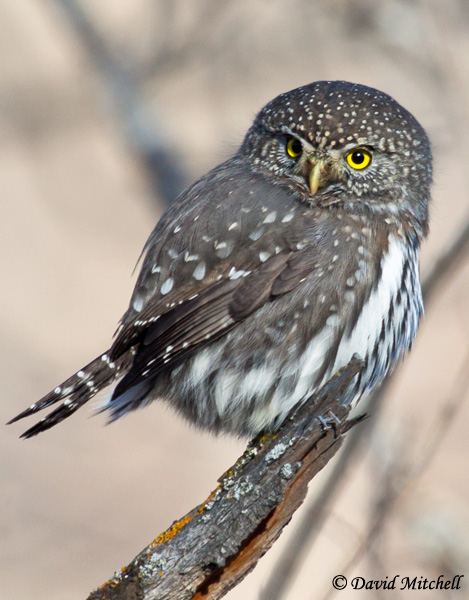
ID Keys: Dark brown or grayish-brown overall, thin dark streaks on
belly, spots on crown
The
Northern Pygmy-Owl is a small owl of forested lands in western North America.
They are often active during the daylight hours, and are often relatively
fearless of a human presence. Nonetheless, they are relatively
uncommon in most locations and are not frequently observed. They are
aggressive towards most intruders into their range, particularly during the
nesting season, when the tiny owls will often drive away intruders that are
much larger than themselves. They are more accomplished hunters of birds
than most owls. As such, flocks of small birds will often react to the
presence of a Northern Pygmy-Owl by "mobbing" the owl en masse in an attempt
to drive the owl away.
Habitat
Found in a variety of forest habitats, typically in open forest areas or near forest edges and clearings.
Diet
Feeds on a variety of small prey items, including small rodents such as mice and voles, small birds, large insects, and small lizards.
Behavior
Hunts by observing from a perch, and then flying out quickly to catch prey in its talons when prey is spotted. They most often hunt near dusk or dawn, but are sometimes active during the day.
Nesting
The nest of a Northern Pygmy-Owl is in a cavity in a tree, often an old woodpecker hole. The female alone incubates the eggs, but both the male and the female will help to raise the young. Typically the male does much of the hunting and brings the prey back to the nest, where the female accepts it and feeds it to the young.
Song
Song of the Northern Pygmy-Owl is a series of repeated toots.
Migration
Considered a permanent resident through its range. However, young birds may disperse short distances in the fall, while some populations that live at higher elevations may move to lower elevations for the winter.
Interactive eBird Map
Click here to access an interactive eBird map of Northern Pygmy Owl sightings
The IUCN currently lists the Northern Pygmy-Owl as a species of "Least Concern" . Much of its range is in areas with little human interference, and there are no indications of any systematic population decline.
Image Information
Photo taken by David Mitchell - Photo licensed under Creative Commons Attribution 2.0 Generic licence .