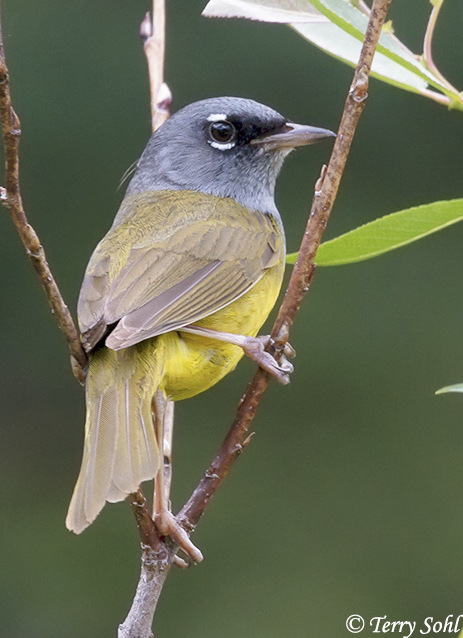
MacGillivray's Warbler is a close relative of the Mourning Warbler, generally taking it's ecological niche in the western part of the continent. They can be locally abundant during migration through the western United States, especially in the Southwest U.S. They often skulk low among dense thickets except during the breeding season, when males will often sing exuberantly from a high exposed perch.
Habitat
During the summer breeding season, they prefer thickets and dense forest undergrowth, usually near clearings or forest edges, and along stream bottoms. They can often be found in burned areas or short brushy second-growth forest. They are also usually found in forest undergrowth during the winter in the tropics.
Diet
The MacGillivray's Warbler feeds mainly on insects and spiders gathered from dense shrubs and understory vegetation. Its diet includes caterpillars, beetles, flies, ants, and other small arthropods, with occasional berries eaten during migration and late summer. They also are known to feed at sapsucker drill wells.
Behavior
Forages in brush and forest undergrowth, typically close to the ground, looking for insects in the foliage. Will also hop around on the ground in pursuit of insects.
Nesting
June and July. The nest of a MacGillivray's Warbler is a small cup of grasses, leaves, bark, and weed stems, lined with finer grasses, hair, rootlets, and moss. The female lays between 3 and 5 eggs, and she alone incubates them. The young hatch after 11 to 14 days, with both parents helping to feed them. The young fledge from the nest about 10 days after hatching, with parents continuing to feed the fledglings for another 7 to 10 days.
Song
Usually a 2-part song, with 3 to 5 short notes followed by 2 or 3 notes at a lower pitch.
1Click here to hear the song of a MacGillivray's Warbler
2Click here to hear the call of a MacGillivray's Warbler
Migration
Summers throughout much of the western United States and western Canada. Winters in Mexico and Central America.
Interactive eBird map
Click here to access an interactive eBird map of MacGillivray's Warbler sightingsSimilar Species
Similar in appearance to a pair of other "dark-hooded" Warbler species:
- Mourning Warbler - Range generally distinguishes Mourning Warblers from MacGillivray's Warblers, as MacGillivray's Warblers are birds of the western part of North America, while Mourning Warblers are primarily found in the East. In terms of appearance, they are very similar, but the Mourning Warbler lacks the white crescents around the eyes of a MacGillivray's Warbler.
- Connecticut Warbler - Another species primarily found in the eastern US during migration, and with a summer breeding range that generally doesn't overlap with MacGillivray's Warbler. In terms of appearance, note Connecticut Warbler has a complete eyering, compared to the split, two-part eye-ring of a MacGillivray's Warbler.
Conservation Status
Populations have evidently declined slightly in recent decades, based on survey accounts such as the Breeding Bird Survey. However, MacGillivray's Warblers are still found across a broad geographic area, and are relatively common in parts of their normal range. The IUCN considers MacGillivray's Warbler to be a species of "Least Concern".
South Dakota Hotspot
MacGillivray's Warblers breed in the Black Hills, and can often be found in the Spearfish Canyon area.
Photo Information
July 12th, 2019 - Hell's Canyon, Black Hills of South Dakota -- Terry Sohl
Audio File Credits
1Ed Pandolfino. Recorded in El Dorado County, California on July 9th, 2018. Original file and recording from xeno-canto.
2Richard E. Webster. Recorded in Sinaloa, Mexico on April 20th, 2019. Original file and recording from xeno-canto.
