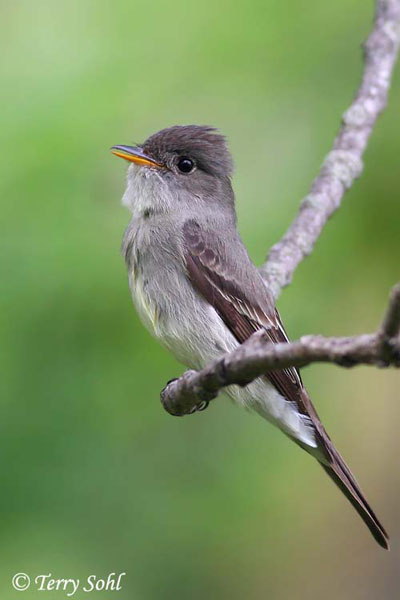
The Eastern Wood-Pewee is a relatively plain gray bird with few distinguishing marks, and is often only safely identified from similar Flycatchers by it's voice and range. The Western equivalent, the Western Wood-Pewee, looks almost exactly alike. Fortunately, Wood-pewees are typically quite vocal, more often heard than seen, but the vocal nature of the species greatly aids identification in comparison to other flycatchers. Eastern Wood-pewees are normally only found in the eastern part of South Dakota, with Western Wood-Pewees in the west, so location is also an excellent method for distinguishing species in South Dakota.
Habitat
The Eastern Wood-Pewee inhabits deciduous forests, mixed woodlands, forest edges, open woods, riparian forests, parks, and wooded suburban areas. It favors habitats with a relatively open understory and scattered perches from which it can watch for flying insects. In South Dakota, it is most common in the eastern part of the state, especially in mature woodlands, river corridors, and wooded parks.
Diet
The Eastern Wood-Pewee feeds primarily on flying insects, including flies, mosquitoes, beetles, moths, wasps, bees, ants, and other aerial arthropods. It typically hunts from an exposed perch, making short flights to capture insects in midair before returning to the same perch. Small berries and fruits may occasionally be eaten, particularly during migration and late summer.
Behavior
The Eastern Wood-Pewee is a quiet, deliberate flycatcher that spends long periods perched motionless on exposed branches within the forest canopy or along woodland edges. It hunts by making short aerial sallies to capture flying insects, usually returning to the same perch afterward. Males frequently sing from prominent perches during the breeding season, and the species is often detected by voice before it is seen. Unlike many more active flycatchers, it typically forages with a calm, patient hunting style.
Nesting
June and July. The nest of an Eastern Wood-Pewee is a cup of grasses, sedges, and spider webs, with the outside sometimes covered with lichens. The female usually lays 3 eggs, and she alone incubates them. When the eggs hatch, both parents help to feed the young. The young fledge after a little more than 2 weeks.
Song
Distinctive slow pee-a-wee with pitch that typical starts high, drops suddenly, and then slowly rises again. This distinctive, slurred whistle is one of the characteristic sounds of eastern woodlands during summer. Calls include sharp pip and peet notes used for communication and territorial interactions.
1Click here to hear the song of an Eastern Wood-pewee
Migration
The Eastern Wood-Pewee is a long-distance migrant that breeds across eastern North America, including eastern South Dakota. After breeding, it migrates south through Central America and the Caribbean to winter primarily in northern and central South America. Most migration occurs at night, with birds returning to breeding grounds in spring and departing again in late summer and fall.
Interactive eBird Map
Click here to access an interactive eBird map of Eastern Wood Pewee sightings
Similar Species
Flycatcher species in general can be confusing, and there are multiple species that provide an identification challenge:
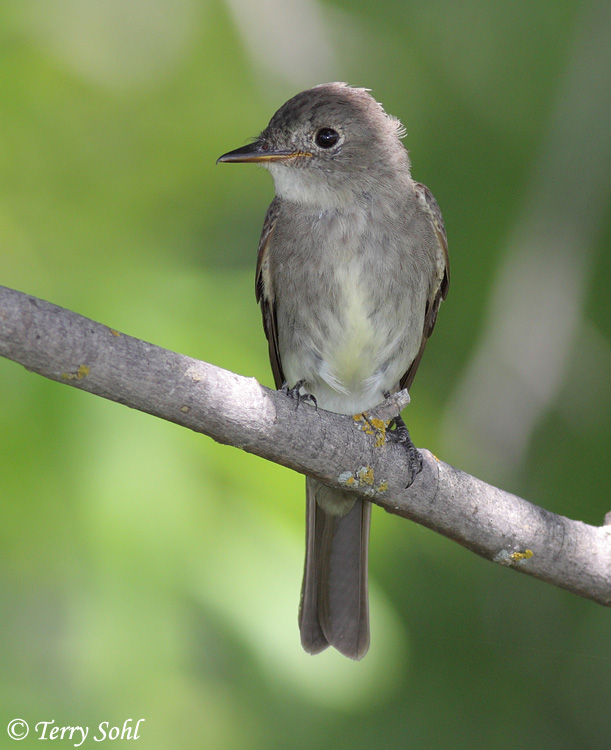
- Western Wood-Pewee - Western Wood-pewees are the western North America equivalent to the Eastern Wood-pewee. They are virtually impossible to differentiate by appearance. Their ranges generally don't overlap, and thus the location of a sighting is the best way to tell them apart. In South Dakota, a Wood-pewee in the eastern half of South Dakota is almost certainly an eastern Wood-Pewee, while one in the Black Hills is a Western Wood-pewee. Voice is another way to differentiate the two if a bird is heard vocalizing.
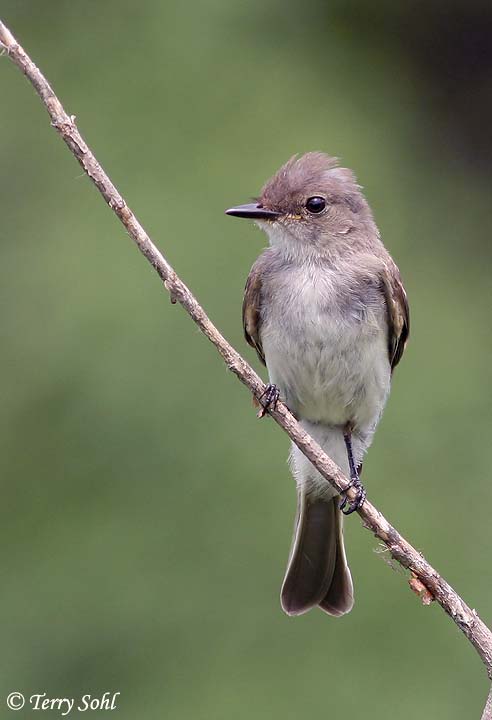
- Eastern Phoebe - Another flycatcher that can be found in South Dakota in migration and in the summer months, they are similar to Eastern Wood-pewee in structure and size. However, Eastern Phoebe are generally darker on their upperparts, and lack the (admittedly sometimes weak) wingbars that are present on an Eastern Wood-pewee. Eastern Phoebe's also tend to have more uniformly colored, light underparts, while an Eastern Wood-pewee is often described as having a "vested" look, with grayer flanks separated by a whitish streak down the belly (often with a yellowish tinge on the lower belly). Habitat is also a clue, as Eastern Phoebes are more apt to be found in open or semi-open habitats than are Eastern Wood-pewees.
- Olive-sided Flycatcher - Olive-sided Flycatchers are migrants through South Dakota. They are known for their "vested" look, with an even more pronounced and obvious vest appearance than an Eastern Wood-pewee. Olive-sided Flycatchers are also slightly larger than an Eastern Wood-pewee (although size can be difficult to judge in the field). Behavior is sometimes a clue for differentiating the two species, as Olive-sided Flycatchers are often found on the tallest perch on the edge of a forest clearing, while Eastern Wood-pewees are generally less found in such an open setting.
- Willow Flycatcher - Each of the small Empidonax flycatchers could potentially be confused with an Eastern Wood-pewee. Given the similarity in appearance and size among all the Empidonax, here I'll only list one, the Willow Flycatcher, as like the Eastern Wood-pewee, it's a species that can be found in South Dakota as not only a migrant, but as a summer breeding bird. Willow Flycatchers are smaller than Eastern Wood-pewee, but size is difficult to judge in the field. Willow Flycatchers tend to have more of a yellowish-green on their head and back than the more gray color of an Eastern Wood-pewee. They also have shorter wings and tail compared to an Eastern Wood-pewee.
 |
 |
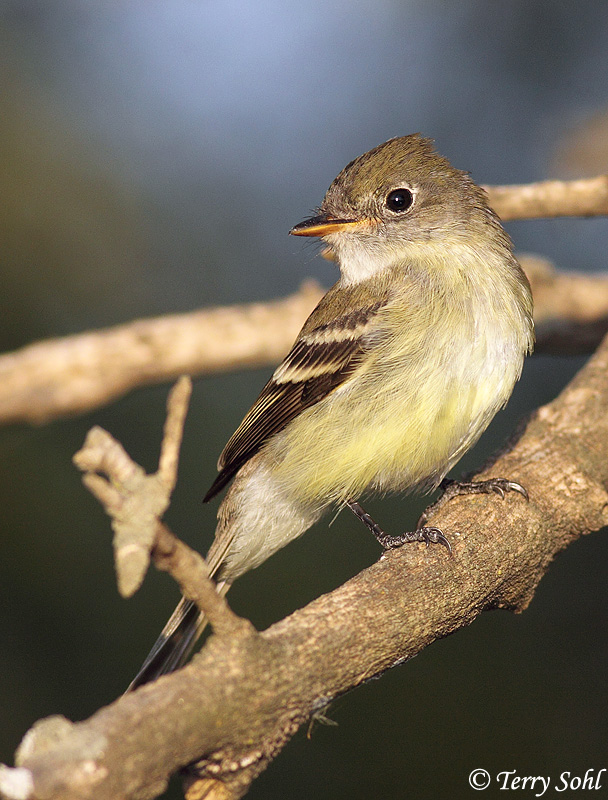 |
| Western Wood-pewee | Eastern Phoebe | Willow Flycatcher |
Conservation Status
The Eastern Wood-Pewee has experienced gradual long-term population declines across parts of its range and is considered a species of conservation concern in some regions. Potential causes include habitat loss and fragmentation, changes in forest structure, collisions during migration, and declines in flying insect populations. Despite these trends, the species remains widespread across eastern North America and is still a common breeder in many suitable woodland habitats. At the present the IUCN lists the Eastern Wood-Pewee as a species of "Least Concern".
Photo Information
June 2nd, 2005 -- Perry Nature area just east of Sioux Falls -- Terry L. Sohl
Audio File Credits
1Christopher McPherson. Recorded in Hillsborough County, New Hampshire on June 13th, 2020. Original recording and information available on xeno-canto.
