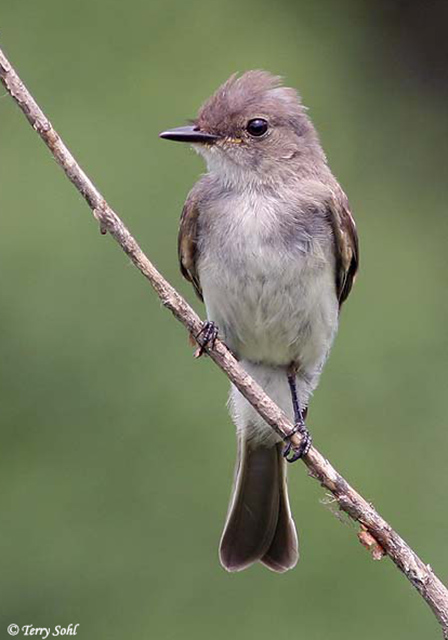
The Eastern Phoebe is one of the earliest songbird migrants in much of the eastern United States, including in South Dakota. While primarily insectivorous like other flycatcher species, they also may feed on fruits and berries, enabling their arrival on the summer breeding grounds before insects may be readily available. Unlike most of the Empidonax flycatchers, they are generally easy to identify, due to a well-known fee-bee song and their habit of repeatedly wagging its tail up and down. They are often quite tame, and have greatly benefited by the presence of humans since they will often use buildings and bridges for nesting.
Habitat
During the summer breeding season, they are most often found in semi-open country or open woodlands, primarily near water. In migration and during the winter, they are generally found around woodland edges, woodland clearings, and brushy fields.
Diet
Primarily feeds on insects, especially during the summer breeding season, as well as spiders and millipedes. Small fruits and berries make up an important component of the winter diet.
Behavior
Eastern Phoebes will often pump their tail while perched, similar to some other flycatchers. They are generally a solitary species, with even mated pairs not associating very closely immediately after breeding. Much of its foraging is done through flying out from a perch to catch flying insects, but they will also hover near vegetation to glean insects from foliage and branches.
Nesting
May through July in South Dakota. The nest is placed in a protected, relatively dry location, historically on a rocky outcrop with a protected overhang, or a vertical rocky area along a riparian area. Now many nests are built on man-made structures, with protected areas under bridges now a favored location. The nest is built of mud, built on a shelf or adhered to the side of a hard surface, and augmented with vegetated material such as leaves, grasses, or moss. The inside of the nest is lined with finer grasses or hair. The female builds the nest herself, and lays between 3 and 7 eggs. Both parents help to incubate the eggs, which hatch after about 14-16 days. The young fledge from the nest after 2 to 2 1/2 weeks.
Song
The classic song of an Eastern Pheobe is a soft fee-bee, with second note lower. They also have chip calls (given by both males and females) and other chattering vocalizations.
- Click here to hear a singing Eastern Pheobe, recorded in Riley County, Kansas1
- Click here to hear typical chip calls of an Eastern Phoebe, recorded in Brown County, Indiana2
Migration
Summers throughout the eastern half of the United States, and into much of central and southeastern Canada. Winters in the southeastern United States and Mexico. Eastern Phoebes are relatively early to migrate northward in the Spring, and late to migrate southward in the Fall. Given their ability to feed on fruits and berries, they may appear in South Dakota before the weather warms up enough for many insects to be available.
Interactive eBird Map
Click here to access an interactive eBird map of Eastern Phoebe sightings
Similar Species
Possibly confused with multiple small flycatcher species, but perhaps easier to differentiate than some species. Behavior is one clue, given the tendency of Eastern Phoebes to wag their tail up and down while perched. Voice is another differentiating feature. Similar species and differences include the followi
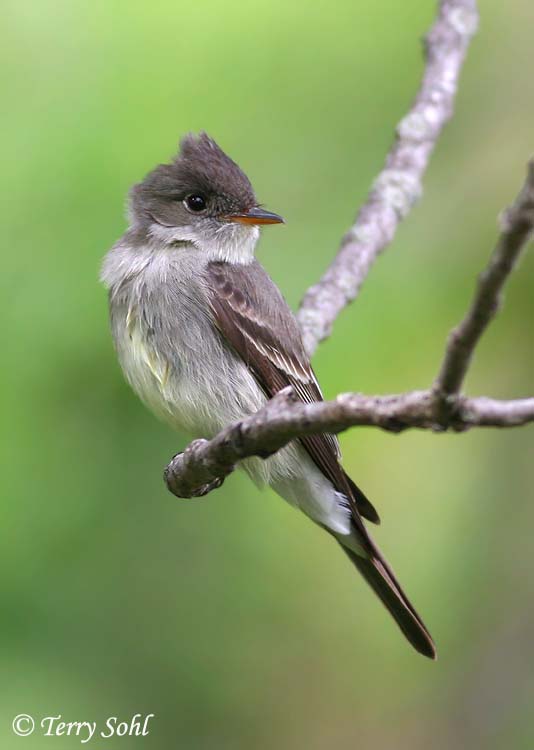
- Eastern Wood-Pewee - Eastern Wood-pewees have yellowish lower bills (black on Eastern Phoebe), more obvious wingbars than Eastern Phoebe, and more uniform gray coloring on the head and back (Eastern Phoebe's tend to have darker plumage on their heads).
- Willow Flycatcher - Eastern Phoebe could potentially be confused with several of the small Empidonax flycatchers, including Willow Flycatcher. However, Eastern Phoebes are larger, and have darker head coloring that contrasts with lighter colored feathering on the body, while Empidonax flycatchers tend to have more even head and body coloring. Empidonax flycatchers also tend to have more obvious wingbars.
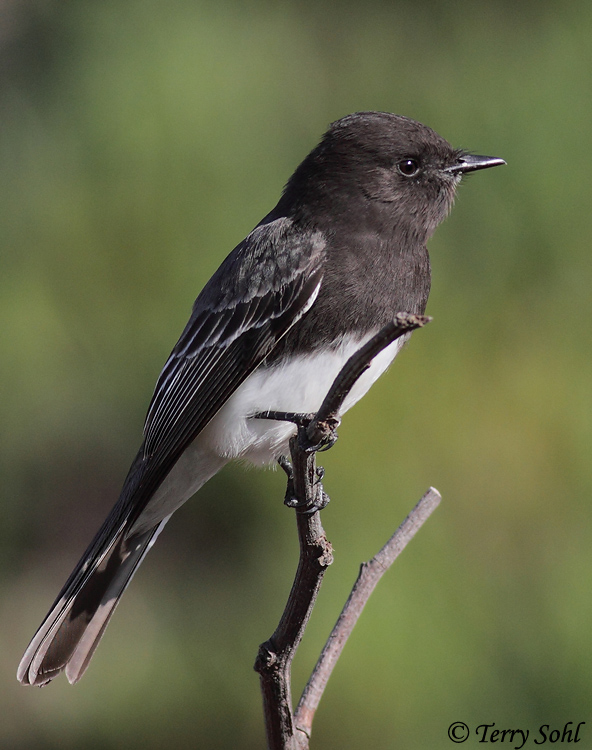
- Black Phoebe - Black Phoebe's have a much more obvious black coloring on the body and head. They also have black that extends onto the breast, while Eastern Phoebe has a white breast.
- Say's Phoebe - Say's Phoebe have warmer peachy tones on their underparts, compared to lighter, whiter coloring on an Eastern Phoebe. Say's Phoebe also have gray on their upper breast, compared to white on an Eastern Phoebe.
 |
 |
 |
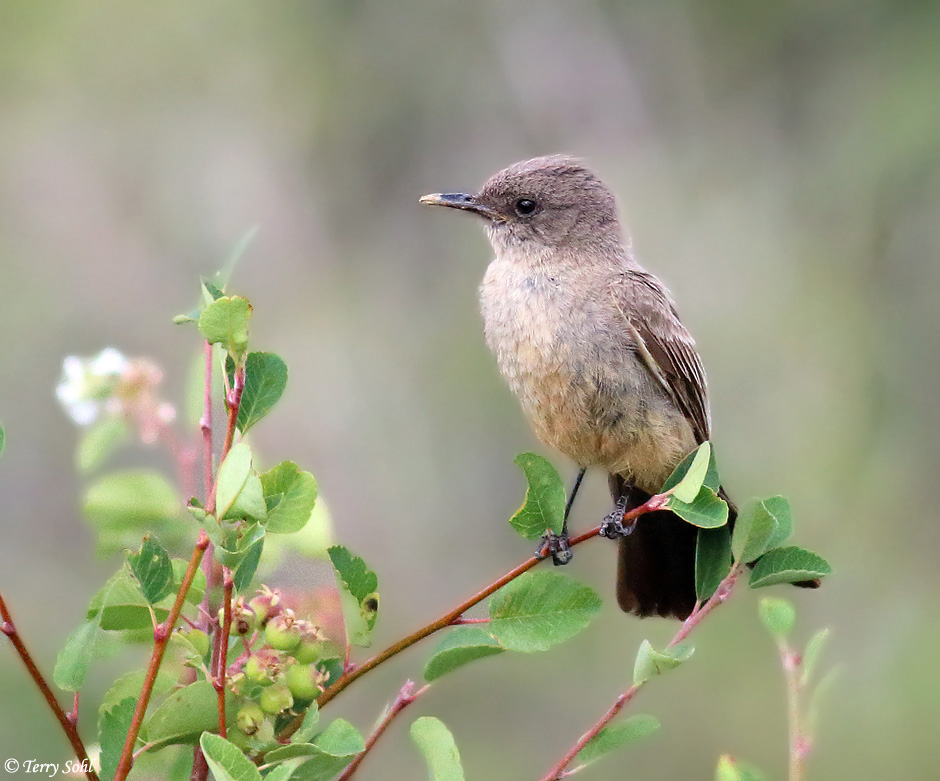 |
| Eastern Wood-pewee | Willow Flycatcher | Black Phoebe | Say's Phoebe |
Conservation Status
Numbers are probably higher than in pre-settlement times, as man-made structures have greatly increased potential nesting sites. Numbers are currently stable overall, and possibly increasing. The IUCN currently considers the Eastern Phoebe to be a species of "least concern".
Photo Information
September 30th, 2008 - Newton Hills State Park, South Dakota - Terry Sohl
Audio Clip Credits
- 1Eric DeFonso, XC370485. Accessible at www.xeno-canto.org/370485
- 2Matt Wistrand, XC378993. Accessible at www.xeno-canto.org/378993
