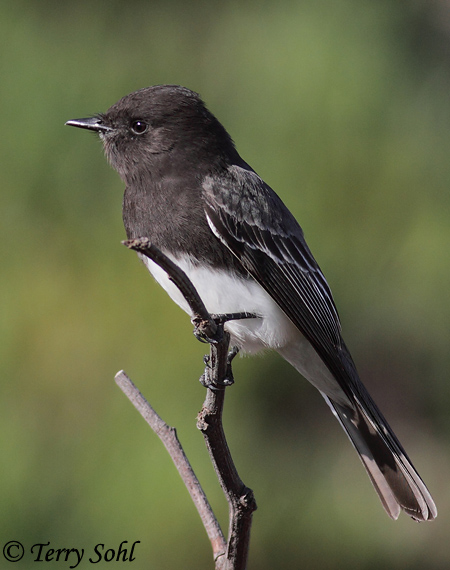
The Black Phoebe is a distinctive flycatcher with a crisp black and white pattern. They are almost always found near sources of water, presumably due to the need for a source of mud to build their nests. They are often seen sitting on a high perch, occasionally pumping their tail, as they search for an insect. When an insect is spotted, they will fly out from their perch to grab it, often in mid-air, and then often returns to the same perch to consume its meal.
Habitat:
Black Phoebes can be found in a variety of open habitats, but they are almost always found near a water source. They have adapted well to a human presence and often will nest and forage in and around urban parks and other favorable locations.
Diet:
The diet is almost exclusively insects and spiders. They have also been known to sometimes eat minnows and other small fish.
Behavior:
Catches much of its food by flycatching (flying out from a perch to grab insects in mid-air). They will also glean insects from plant foliage, or skim the water's surface to pick up aquatic insects or small fish.
Nesting:
The nest is built of mud mixed with plant material, and placed on a sheltered location such as under a bridge, on a cliff, or under the eaves of a building. Nests are often used for multiple years. The female alone incubates the eggs, but both parents will help to raise the young.
Interactive eBird Map:
Click to access an interactive eBird map of Black Phoebe sightings
Song:
The song of the Black Phoebe is a simple, alternating series of notes. Sung mostly by males to defend territory and attract mates, this sharp, whistled song is typically delivered from a low, exposed perch near water. They also have basic clear call notes with a sweet tone.
Migration:
They are a permanent resident throughout much of their range, but birds at higher elevations and those at the northern edge of their range will migrate to more hospitable climates for the winter.
Similar Species:
Eastern Phoebe. The Black Phoebe is characterized by its almost entirely soot-black plumage with a contrasting white belly and a preference for staying near water in the West. In contrast, the Eastern Phoebe is mostly grayish-brown above with a whitish, dingy underpart, typically found in more diverse, drier, and eastern habitats.
Conservation Status:
The IUCN currently shows the Black Phoebe as a species of "Least Concern". Populations appear to be stable and may even be increasing.
Photo Information:
December 9th, 2011 - Pacific coast near San Francisco - Terry Sohl
