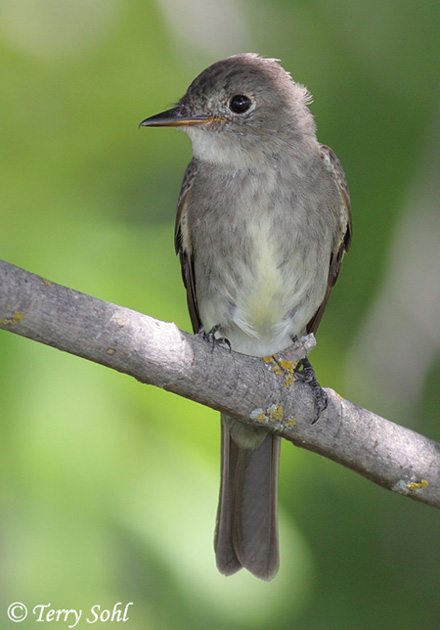
ID Keys: Plain, with very faint wing-bars, and no eye-ring.
Most safely identified by range and voice.
The Western Wood-Pewee is a very plain gray bird with few
distinguishing marks, and is often only safely identified from similar
Flycatchers by it's voice and range. The eastern equivalent, the Eastern
Wood-Pewee, looks almost exactly alike. While they do overlap in range
in a narrow band in the center of the country, it has never been shown that the
two species interbreed with each other. They are normally only found in
the western part of South Dakota.
Habitat
Can
be found in a wide variety of open wooded habitats during the summer breeding
season, especially cottonwood riparian areas along rivers and streams, groves of
aspen and willow, and pine-oak woodlands. Spends the winter months along
forest edges and in second-growth forest in the tropics.
Diet
Feeds almost exclusively on insects, especially flying
insects. Will also occasionally eat berries.
Behavior
Does most foraging by flycatching, sitting on a perch and flying out to catch flying insects.
Does most of its singing at dawn and at dusk.
Nesting
June and July
Song
Soft peeer
whistle given year round. Alternates clear notes with a descending bzeeyeeer
on summer breeding grounds.
Migration
Summers throughout the western half of North America, up through southwest
Alaska. Winters in South America.