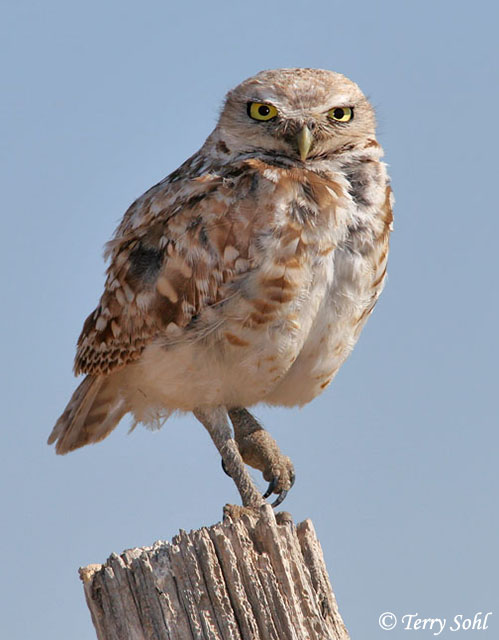
The Burrowing Owl is a unique owl species, nesting underground in (surprisingly!) burrows. In South Dakota they are most often found in conjunction with prairie dog towns, as they use the prairie dog burrows as nesting sites. Farmers and ranchers often dislike prairie dog colonies, fearing the honeycombs of holes and burrows pose a threat to livestock grazing in the area. Prairie dog extermination efforts have had a major impact on Burrowing Owl populations on a local level, although overall populations are still not threatened.
Habitat
Grassland and rangeland, farmland, open urban grassy areas such as airports, golf courses, and empty lots. In South Dakota, they are most often found in conjunction with Prairie Dog towns, using the burrows for nesting. They can also sometimes be found using isolated badger holes.
Diet
Mostly large insects and small mammals. Occasionally will eat small birds, amphibians, and reptiles.
Behavior
May hunt by hovering over fields, swooping down from a perch, or even running along the ground. They will also fly out from perches to grab insects from mid-air. Most of the hunting is done near sundown and at night, but they will also actively feed during the day during the summer breeding season.
Nesting
May through July. The nest is in a burrow in the ground, in barren areas or areas with sparse vegetation. Some birds build their own burrows (particularly those in Florida, in areas of loose, sandy soil), but most rely on burrows built by other animals. The burrows may be 6-10 feet long, with a nest chamber at the end. No nest is built, but sometimes the nest chamber is lined with manure. The female usually lays between 4 and 10 eggs, and she alone incubates them. The male brings food for the female during the incubation period. Once the eggs hatch, the male feeds the family for a time. After a week or two, the female also starts to hunt. The young fledge after about 6 weeks
Song
Burrowing Owls can make a variety of sounds, but typically they are silent. The most often heard call is a haunting cooo-hoooooo. Vocalizations are most often done near the nesting site, or when a bird feels threatened.
- Click here to hear the two-part coo-hoooo call of a Burrowing Owl1
- Click here to hear the alarm calls of a Burrowing Owl that feels threatened2
- Click here to hear more of the two-part song of a Burrowing Owl3
- Click here to hear alarm calls of a Burrowing Owl4
Migration
South Dakota populations migrate south in the fall, moving as far as Mexico and Central America. Some populations in the southern U.S. are probably permanent residents.
Interactive eBird Map
Click to access an interactive eBird map of Burrowing Owl sightings
Similar Species
Size, geographic range, and habitat are definite clues for identifying Burrowing Owls, as no other owl species in North America extensively uses ground burrows such as Burrowing Owls. However, there are other owl species that may utilize the same habitat, and there are other owls that are somewhat similar in appearance. Here are other owl species that may commonly be found in South Dakota, and are similar in size, or use the same habitat.
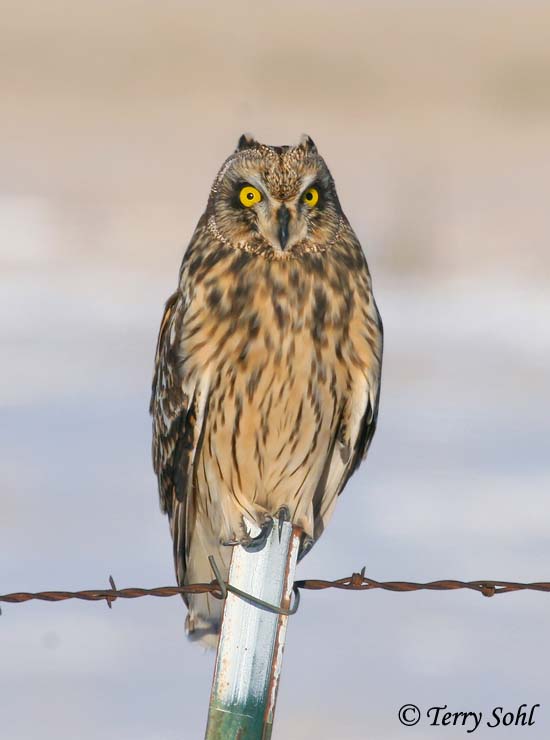
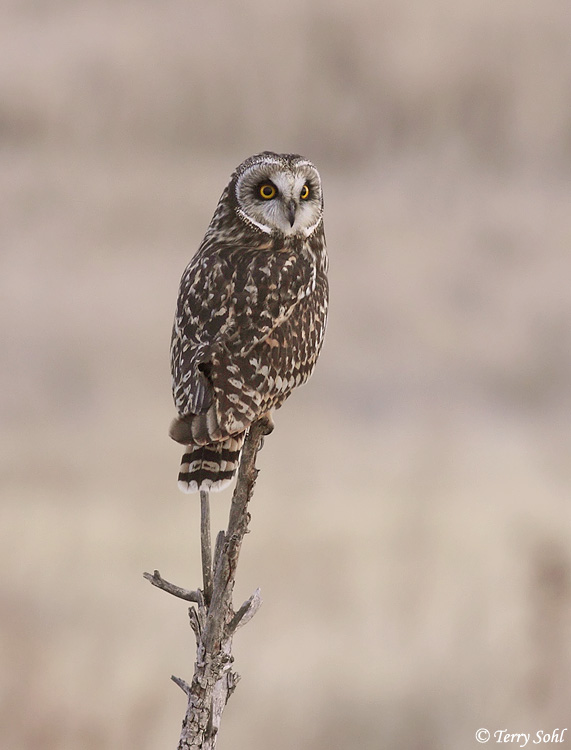
- Short-eared Owl - Short-eared Owls are listed here as they are another species that may be found utilizing the same general habitat, and they are often found sitting on the ground (or on fence posts and other short perches) as do Burrowing Owls. Short-eared Owls are substantially larger than Burrowing Owls, but size alone can sometimes be difficult to judge. Short-eared Owls do have short ear tufts that are sometimes visible (but not always), while Burrowing Owls have none. The underside of a Short-eared Owl has thin vertical striping, while Burrowing Owls have brown blotches.
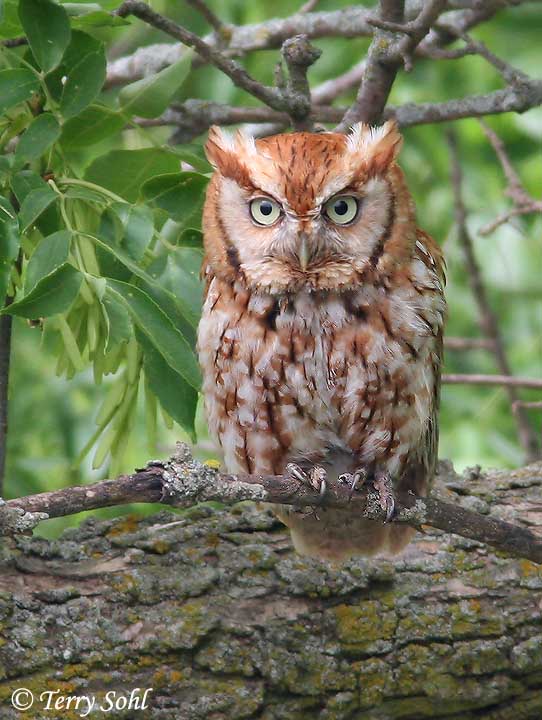
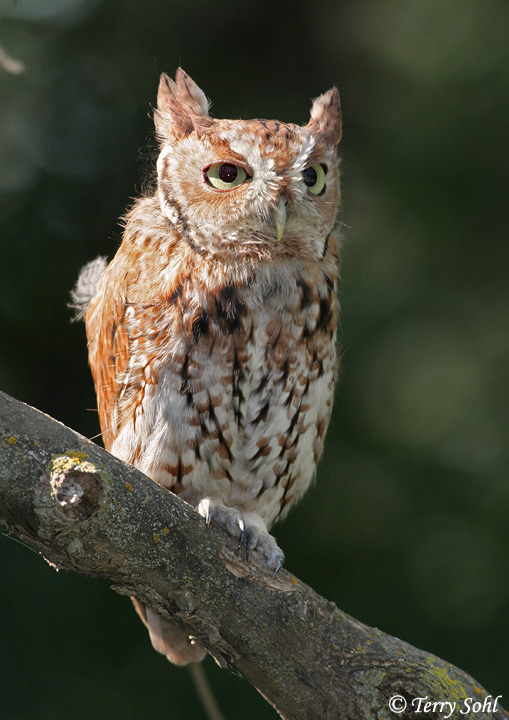
- Eastern Screech Owl - A small owl species that's very common in South Dakota, habitat alone will typically differentiate the, as Eastern Screen Owls prefer forested habitats, and Burrowing Owls prefer open habitats.Eastern Screech Owls have two color phases, a gray morph, and a red morph, and the red-morph version could be confused with the general coloring of a Burrowing Owl. However, Eastern Screech Owls have short ear tufts (lacking on a Burrowing Owl), and have a unique, more complex textural pattern on their underside than a Burrowing Owl.
 |
 |
 |
 |
| Short-eared Owl | Short-eared Owl | Eastern Screech Owl | Eastern Screech Owl |
Birdhouses
In an attempt to bolster populations, artificial burrows have been placed in some locations. Burrowing Owls will use these man-made burrows.
South Dakota "Hotspot"
Prairie dog towns in South Dakota are excellent places to look for Burrowing Owls, as the two species often co-exist. The Fort Pierre National Grasslands and Buffalo Gap National Grasslands both have extensive prairie dog towns, and the larger towns almost always also have Burrowing Owls in the summer months. Native American lands in the western half of South Dakota also tend to have large prairie dog towns that hold Burrowing Owls.
Conservation Status
Systematic surveys have shown modest population declines in recent decades. Burrowing Owls are usually associated with colonies of prairie dogs or ground squirrels. Prairie dog control practiced by many ranchers thus has the effect of lowering burrowing owl populations, so local declines are very high in some parts of their range. They have also been extirpated in parts of their former range, particularly in the eastern Great Plains where large swaths of grassland have been converted to cropland.
However, the range of Burrowing Owls is still very large, and they are relatively common in parts of that range. The IUCN considers the Burrowing Owl to be a species of "Least Concern".
Further Information
- eBird - Burrowing Owl
- Audubon Field Guide - Burrowing Owl
- Cornell Lab of Ornithology - All About Birds: Burrowing Owl
Photo Information
July 29th, 2007 - Fort Pierre National Grasslands, South Dakota -- Terry Sohl
Audio File Credits
- 1Peter Ward and Ken Hall. Recorded in British Columbia on April 20th, 1990. Original recording and information available from xeno-canto.
- 2Edison Ocana. Recorded near Chimbarazo, Ecuardo on December 25th, 2019. Original recording and information available from xeno-canto.
- 3Jayrson Araujo De Oliveira. Recorded in Brazil on September 23rd, 2018. Original recording and information available from xeno-canto.
- 4Fabrice Schmitt. Recorded in Chicauma, Chile on October 25th, 2014. Original recording and information available from xeno-canto.
