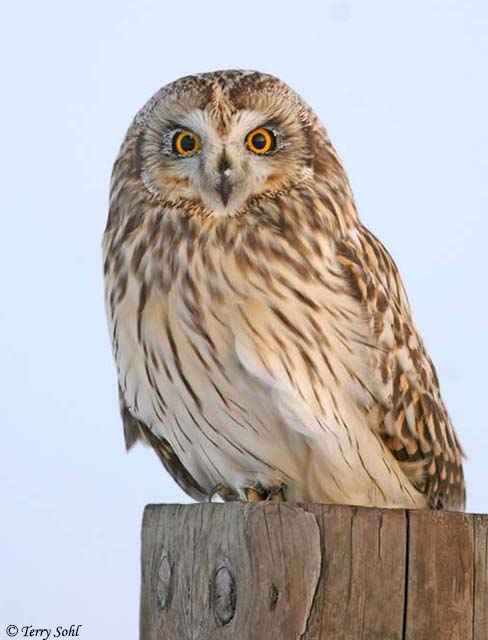
The Short-eared Owl is an owl of open terrain such as prairies and farmland, and is also often active during daylight (particularly right around sunrise and sunset), making it a more observable owl than many. They often be seen in low flight over fields and grasslands as they search for prey.
Other than North America, nesting populations can also be found in Eurasia, South America, and even many oceanic islands such as Hawaii. In Hawaii they are locally known as "Pueo" (some photos from below are from Hawaii).They are often rather nomadic in nature, with loose breeding colonies appearing in response to favorable breeding and foraging opportunities, and then disappearing in subsequent years.
Habitat
Can be found in a variety of open habitats, dependent upon the availability of small rodents. This may include prairies, large marshes, farmland, shrubby fields, and even tundra.
Diet
Primarily feeds on small rodents, up to the size of rabbits and muskrats. Will also feed on small birds if available.
Behavior
They hunt by flying low over fields, hovering and then dropping on their prey upon locating it. Much of the hunting is done by sound alone, but they are also capable of hunting by sight. They are most active at dawn and dusk, but do hunt during the daytime as well. Multiple Short-eared Owls are often found utilizing the same fields for hunting, offering the birder the opportunity to see several in a relatively small area.
Nesting
May through June in South Dakota. Short-eared Owls often form small, loose nesting colonies with multiple nesting pairs widely spaced across a given area. Nesting is generally proceeded by courtship display flights from the males, with elaborate flights, "singing", and wing-clapping sounds. They nest in open vegetated habitats, with the nest site placed in a dry location with vegetation that protects and hides the nesting site, such as a clump of grassy vegetation. They construct a nest by developing a shallow scrape on the ground and lining it with grasses and feathers. Females will lay between 2 and 12 eggs, and she alone incubates them. Males however will hang around the nest site, defending it from predators, or using distraction displays to draw predators away. Incubation takes about four weeks.
Song
Generally quiet, but sometimes gives a barking alarm call. Other vocalizations are often heard in and around nesting sites.
- Click to hear the barking alarm call of a Short-eared Owl disturbed by a dog1
- Click to hear calls of a male Short-eared Owl2
- Click to hear the clicking begging calls of nestlings3
- Click to hear courtship songs and wing noises from a courting male4
Migration
Some birds throughout the northern half of the U.S. are year-round residents. However, those summering in Canada are strongly migratory, and other populations may be nomadic, depending upon populations of small rodents. In any one given location, Short-eared Owls may be present in strong numbers one year, and be conspicuously absent for many subsequent years.
Interactive eBird map
Click here to access an interactive eBird map of Short-eared Owl sightings
South Dakota "Hotspot"
Given their nomadic behavior, Short-eared Owls are often present one year and absent the next in a specific location. However, the National Grassland areas of South Dakota are areas where I've always had good luck finding Short-eared Owls, with many sightings documented in the photographs below coming from the Fort Pierre National Grasslands, Buffalo Gap National Grasslands, and Grand River National Grasslands.
Similar Species
With a preference for open habitats and a unique appearance if seen well, Short-eared Owls are generally distinctive. However, they could potentially be confused with the following species if viewing conditions are not ideal
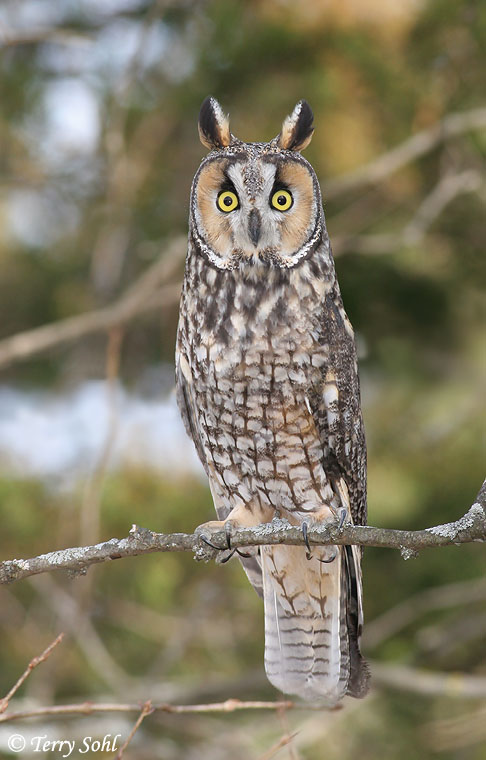
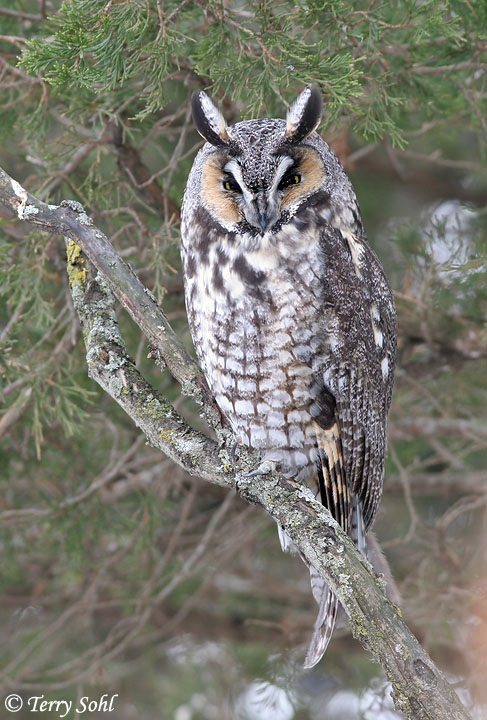
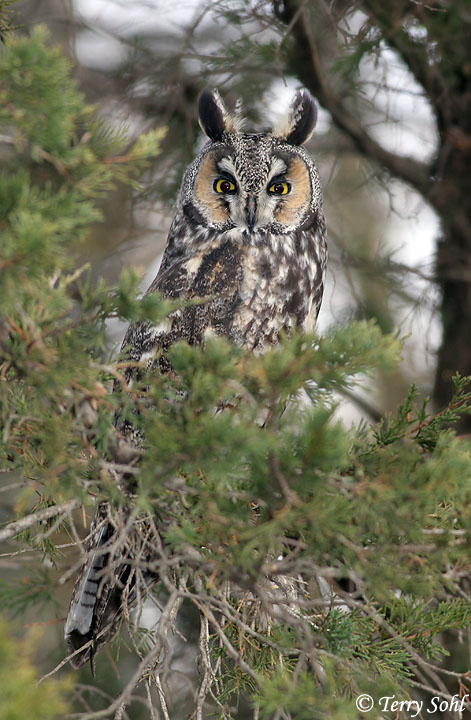
- Long-eared Owl - Another widespread owl species, Long-eared Owls typically prefer areas with more tree cover than Short-eared Owls, using woodland edges and forests for roosting, and hunting in adjacent open areas. In terms of appearance, as the names suggest, Long-eared Owls have much more prominent and obvious ear tufts, while those on a Short-eared Owl are often difficult to see, and are much less prominent. Shape of the facial discs is also different, with Long-eared Owls having rich cinnamon-colored facial disks, and Short-eared Owls having more white on the face, particularly in the central part of the face near the bill.
- Barn Owl - Not a common sight in South Dakota, Barn Owls can sometimes be found in similar open habitats as Short-eared Owls. Barn Owls are more whitish in appearance overall, with whitish underparts with spotting, while underparts of Short-eared Owls are usually heavily streaked and often have warmer buffy tones.The facial disk of a Barn Owl is white, which contrasts strongly with the Barn Owl's dark eyes. Short-eared Owls have whitish tones on the central part of the facial disks but much more color (brownish and blackish tones) around the eyes and edges of the facial disk. Short-eared Owls also have obvious yellow eyes.
 |
 |
 |
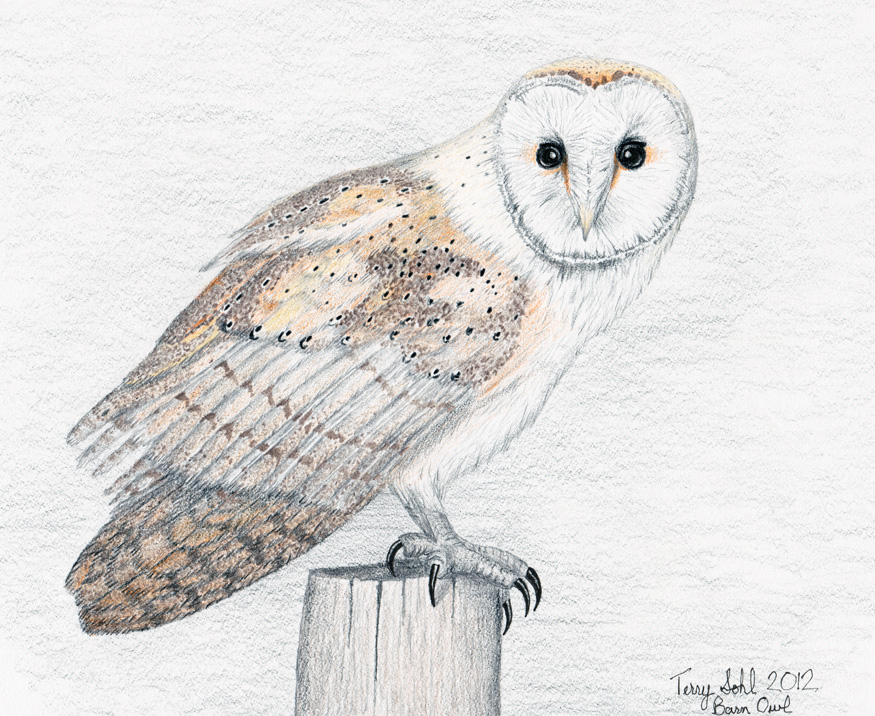 |
| Long-eared Owl | Long-eared Owl | Long-eared Owl | Barn Owl |
Conservation Status
Has disappeared from many former nesting areas in the southern part of its range, probably due to habitat loss. Overall populations in North America also appear to be in decline. However, they are still extremely widespread and are found in good numbers in some areas. The IUCN considers the Short-eared Owl to be a species of "Least Concern".
Photo Information (top of page)
December 5th, 2005 - Minnehaha County, South Dakota - Terry Sohl
Audio File Credits
- 1Simon Elliott - From Newcastle upon Tyne in England on December 25th, 1987 - Original information and recording available on xeno-canto.
- 2Karl-Birger Strann - From Bardu Municipality, Troms, Norway, on May 19th, 2018 - Original information and recording available on xeno-canto
- 3Simon Elliott - June 16th, 1990 from Kielder Forest, Northumberland, England - Original information and recording available on xeno-canto.
- 4Jarek Matusiak - From Poland on May 12th, 2020 - Original information and recording available on xeno-canto.
