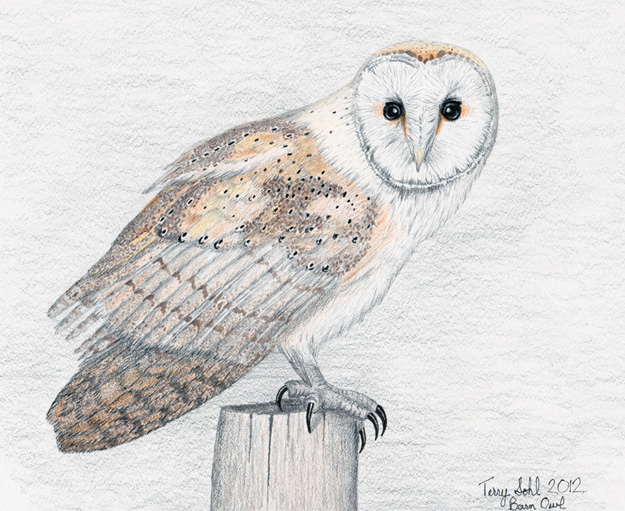
Rather unique in appearance among the owls, South Dakota represents the northern part of the Barn Owl's range. Barn Owls are among the most widespread of all land-based birds, and can be found on every continent except Antarctica. Roosting by day and active by night, the Barn Owl's raspy shrieking call can occasionally be heard as it flies overhead. Significant populations have recently been found roosting and raising young in cavities dug into the sides of bluffs lining the Missouri River near Pierre. Recent winter sightings also suggest that some Barn Owls may indeed attempt to overwinter in the state.
Habitat:
Generally found in open to semi-open country. Can be found nesting in rural buildings such as barns, abandoned farm houses, and other agricultural and rural buildings.
Diet:
Primarily feeds on rodents and other small mammals. May occasionally feed on birds, large insects, lizards, and rarely fish and frogs.
Behavior:
Hunts almost exclusively at night, only very rarely during the day. Usually hunts by flowing low and slow over the ground, finding prey by both vision and with its acute hearing. Studies in controlled environments in complete darkness have shown Barn Owls can capture prey in the complete absence of light.
Nesting:
May through August in South Dakota. Barn owls typically nest in dark, secluded cavities such as tree hollows, church steeples, old barns, or man-made nest boxes. They do not build traditional nests, but instead, the female arranges her own regurgitated pellets into a simple, compacted cup to lay 3 to 11 white eggs. Often reusing the same site for years, they often breed in spring, though they may nest anytime if food is abundant.
Interactive eBird Map:
Click to access an interactive eBird map of Barn Owl sightings
Song:
American Barn Owls do not hoot; they produce eerie, harsh, and raspy sounds. Their primary call is a long, 2-second, high-pitched shriek or scream. They also produce loud, 3-4 second hisses to threaten intruders and use rapid bill-snapping to show agitation.
Migration:
South Dakota represents the northern edge of the Barn Owl's range. Birds in the northern portion of their U.S. range generally migrate southward in the fall. Some recent sightings during winter months indicate that some may attempt to overwinter in the state, however.
Similar Species:
Generally a distinctive look compared to other owls.
Conservation Status:
The American Barn Owl is generally classified as a species of Least Concern globally due to its wide distribution, although it faces significant localized population declines, particularly in the Midwestern U.S.. Their numbers are primarily threatened by habitat loss, modernization of agricultural structures, and rodenticide exposure, prompting conservation efforts focused on installing nest boxesNumbers appear to be decreasing in parts of its range in the United States.
Image Information:
Colored pencil drawing by Terry Sohl - September 2012
