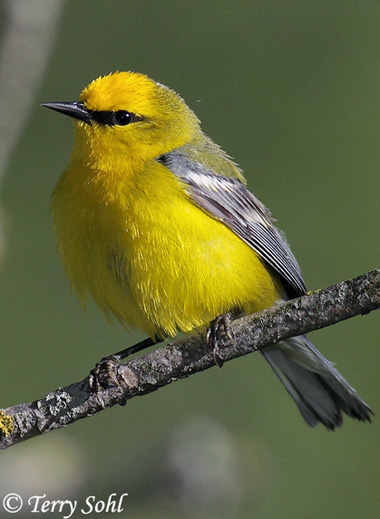
The Blue-winged Warbler is a close relative of the Golden-winged Warbler. The Blue-winged Warbler has slowly expanded its range to the north in recent decades, encroaching on the breeding grounds of the Golden-winged Warbler. Where the two species coexist, they may interbreed, producing the intermediate hybrids sometimes called "Lawrence's Warbler" or "Brewster's Warbler". It appears that the Blue-winged Warbler is outcompeting the Golden-winged Warbler and is causing a decline in the latter species.
South Dakota is is on the far northwestern edge of their breeding range. In general they're considered "casual" summer breeding residents, but they can almost always be found at one favored breeding location in Newton Hills State Park.
Habitat
During the summer breeding season, they are found in brushy fields, fencerows, open forest with a shrubby undergrowth, and woodland edges. Usually found in similar habitat during migration and in winter.
Diet
The Blue-winged Warbler feeds primarily on insects and spiders, including caterpillars, beetles, ants, flies, and leafhoppers gathered from shrubs and low tree branches. It occasionally supplements its diet with berries and other small fruits during migration and late summer.
Behavior
Climbs and flies through foliage, gleaning insects from foliage and tree branches, and probing with its bill in crevices and leaves. They will often hang upside down from a perch while probing for insects, similar to the foraging behavior of a chickadee.
Breeding
May and June. The nest is typically built on the ground at the base of a protective piece of vegetation, such as a small shrub, clump of grass, or other herbaceous cover. The female constructs the nest of grasses, leaves, mosses, and other vegetative material. She lays 2 to 6 eggs, which hatch in about 10 days. The young fledge about 10 days after hatching.
Song
A dry beee-buzzzzzz song that sounds a bit like an insect, and a sharp tisk call note. They also have alternative songs that riff off the same buzzy notes.
- Clik here to hear the song of a Blue-winged Warbler1
- Click here to hear an alternative song of a Blue-winged Warbler2
- Click here to hear the call of a Blue-winged Warbler3
Migration
Summers the the eastern United States from southern Wisconsin down through northern Arkansas, and eastward to the Atlantic coast. Migrates to the tropics for the winter. In South Dakota, they are generally considered rare migrants, but there is a breeding population in the summer in Newton Hills State Park.
Interactive eBird Map
Click to access an interactive eBird map of Blue-winged Warbler sightings
Similar Species
Blue-winged Warblers could potentially be confused with multiple other small, yellow songbird species:
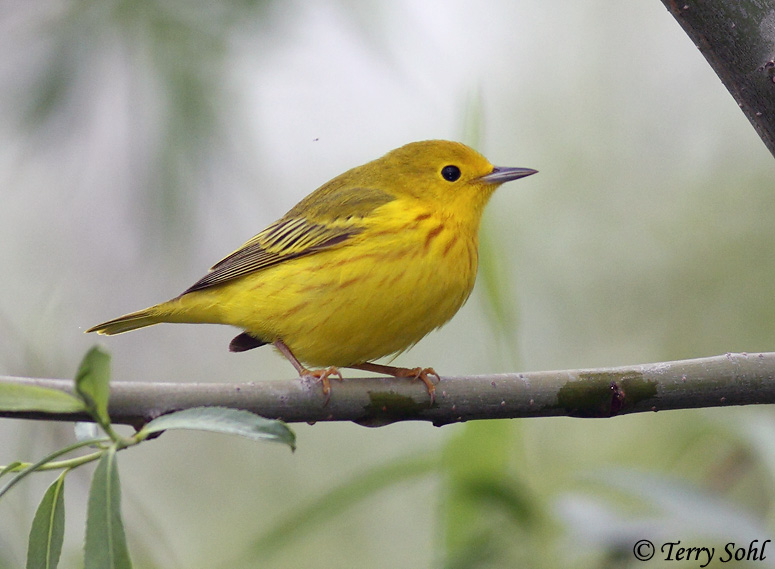
- Yellow Warbler - Yellow Warblers are a very common species in South Dakota in migration, and in the summer months in some locations. They also are very common in Newton Hills State Park, the one location in South Dakota where you're most likely to run into a Blue-winged Warbler. Yellow Warblers are indeed yellow all over, but they lack the black eyeline of the Blue-winged Warbler, have diffuse striping on their undersides (primarily males), and have less contrast between the wings and body than does a Blue-winged Warbler.
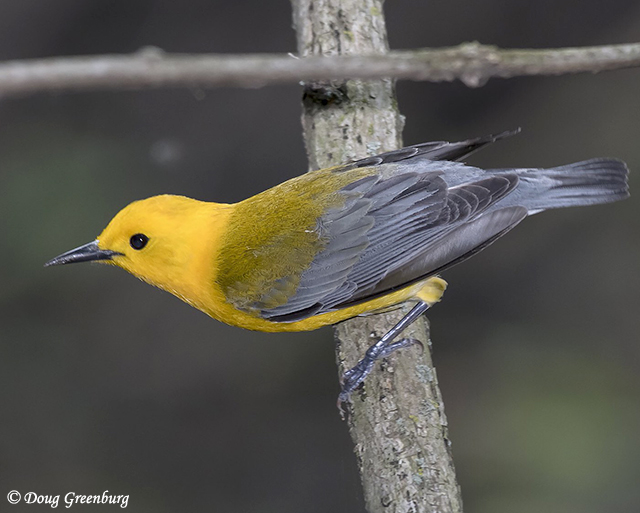
- Prothonotary Warbler - A rare visitor to South Dakota, a Prothonotary Warbler shares the same general plumage characteristics as a Blue-winged Warbler, with a yellow body and grayish contrasting wings. However, a Prothonotary Warbler lacks the black eyeline and the white wingbars of a Blue-winged Warbler.
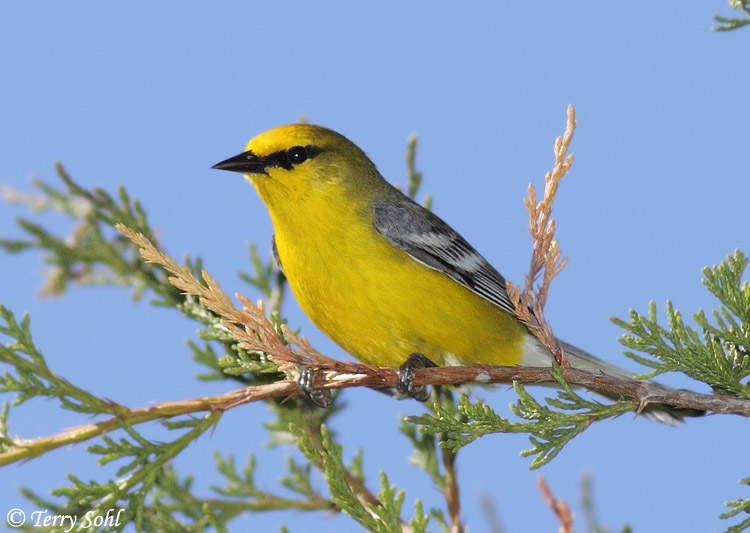
- Golden-winged Warbler - Golden-winged Warblers don't make the list because they look like Blue-winged Warblers, but because they're such close relatives. Golden-winged Warblers (males) are mostly gray, with a black throat, black facial mask, and yellow on the cap and wing. They're clearly different than Blue-winged Warblers, and their yellow overall appearance. However, the two are very close relatives, and do interbreed, and intermediate plumaged birds are sometimes found.
- Wilson's Warbler (Female) - Wilson's Warbler females lack the black cap of the males, and with their yellowish overall appearance and duller-colored wings, they could be confused with a Blue-winged Warbler. However, the yellow on a female Wilson's Warbler tends to have more of an olivish cast to it than the bright yellow Blue-winged Warbler. They also lack the black eyeline and the white wing patches of a Blue-winged Warbler.
 |
 |
 |
 |
| Yellow Warbler | Prothonotary Warbler | Golden-winged Warbler | Wilson's Warbler (Female) |
South Dakota "Hotspot"
The area along Sergeant Creek, in Newton Hills State Park in Lincoln County, has hosted breeding Blue-winged Warblers nearly every summer in recent years. They can be found by parking in the "Horse Camp" area and following the streamside trail towards the picnic area.
Conservation Status
Blue-winged Warblers don't have as big a range as many songbirds in the US, but they're still found across a breeding area that covers much of the Midwest, Appalachia, and northeastern US. They are relatively common within parts of that range. Systematic surveys in recent decades indicate a relatively small decline in overall numbers, but overall population numbers are strong. The IUCN considers the Blue-winged Warbler to be a species of "Least Concern".
Further Information
- eBird - Blue-winged Warbler
- Audubon Field Guide - Blue-winged Warbler
- Cornell Lab of Ornithology - All About Birds: Blue-winged Warbler
Photo Information
Newton Hills State Park - May 16th, 2011 - Terry L. Sohl
Audio File Credits
- 1Matt Wistrand. Recorded in DuPage County, Illinois on May 13th, 2020. Original recording and information available on xeno-canto.
- 2Todd Wilson. Recorded on the John Muir Hiking and Biking trail west of Milwaukee, Wisconsin on May 30th, 2010. Original recording and information available on xeno-canto.
- 3Manuel Grosselet. Recorded in Quintana Roo, Mexico on December 4th, 2018. Original recording and information available on xeno-canto.
