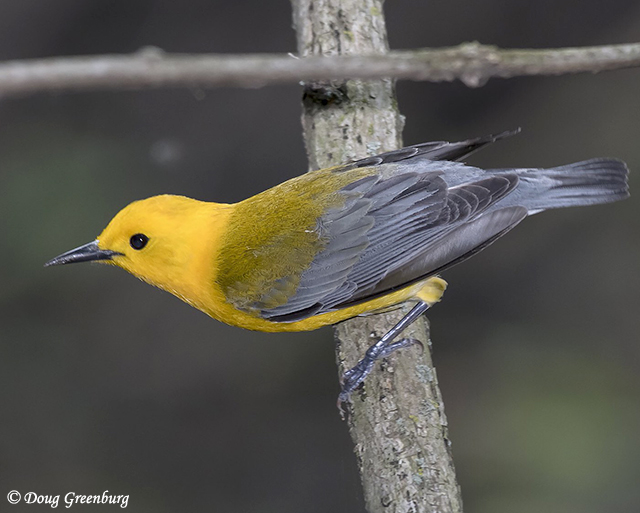
ID Keys: (Male): Golden-yellow head and breast, white undertail coverts,
blue-gray wings. ID Keys (Female): Females duller but with similar pattern as males.
The Prothonotary Warbler is
so named because their bright yellow "hoods" are reminiscent of those
of a historical group of official scribes of the Catholic Church. Unlike
nearly every other warbler, they nest in tree holes and sometimes in bird
houses. With the large scale cutting of bottomland hardwoods in the
southeastern United States, numbers of the Prothonotary Warbler fell sharply by
the early 1900s. Numbers are rebounding today, and are helped by
conservationists placing birdhouses in their preferred swampy habitats.
Habitat
Found in flooded deciduous forests of the eastern U.S. during the summer breeding months, especially around black willow, sweetgum, river birch, ash, and near cypress swamps. They can also be found along forested lakeshores or riparian areas near still or very slowly moving water. They winter in lowland forests and swamps in the tropics.
Diet
Primarily feeds on insects, especially aquatic insects. Will also feed on spiders, seeds, and snails.
Behavior
Usually forages fairly low in vegetation, very often above water. Will also hop along floating vegetation and logs, poking in crevices for food items.
Breeding
Non-breeder in South Dakota.
Song
Clear monotone wheat-wheat-wheat-wheat-wheat . Click here to listen to the Prothonotary Warbler's song.
Migration
Summers throughout much of the eastern half of the United States except for the extreme north. Winters in the tropics.
Interactive eBird Map
Click here to access an interactive eBird map of Prothonotary Warbler sightings
Numbers are far less than historical numbers due to massive loss of forested wetland habitat. Numbers in remaining habitat appear to be generally stable, and may actually be increasing in part due to the placement of birdhouses in prime habitat.