| Length: 5.25 inches | Wingspan: 7.25 inches | Seasonality: Migrant |
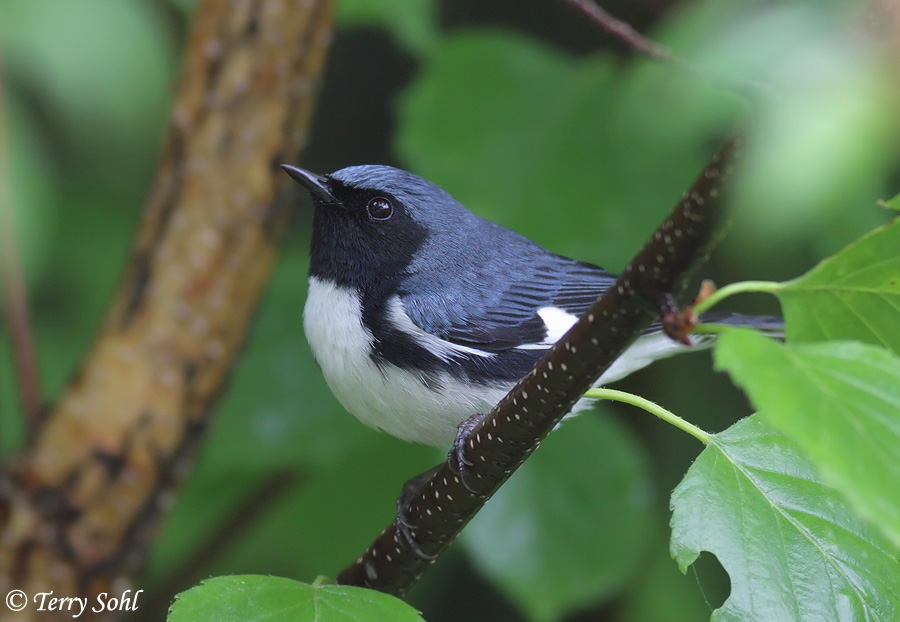
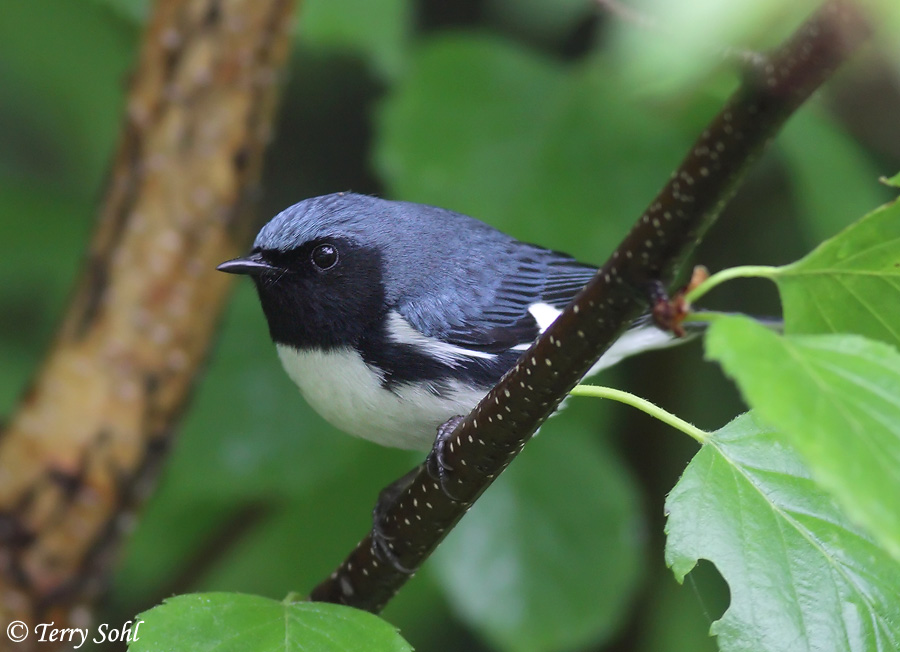
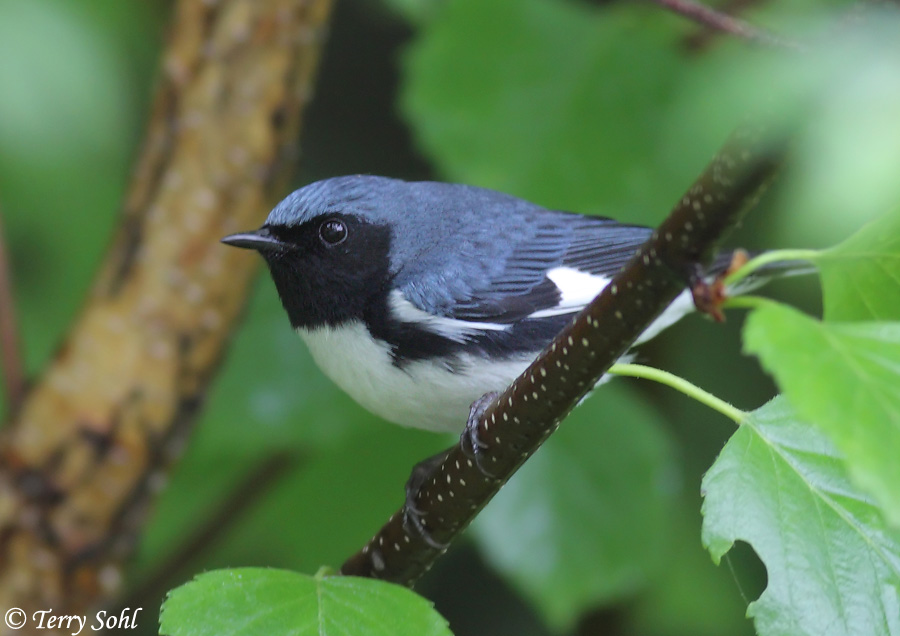
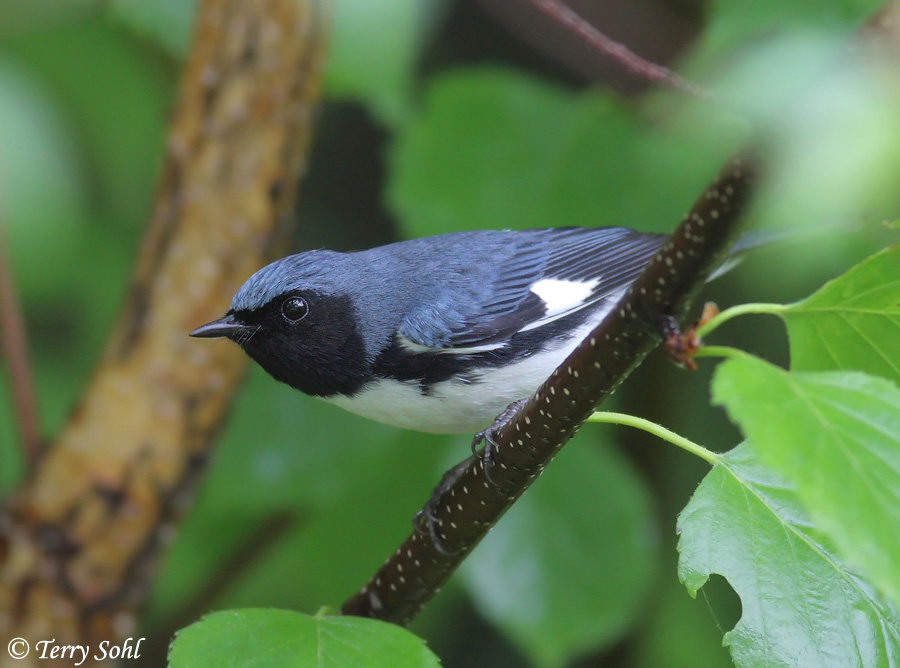
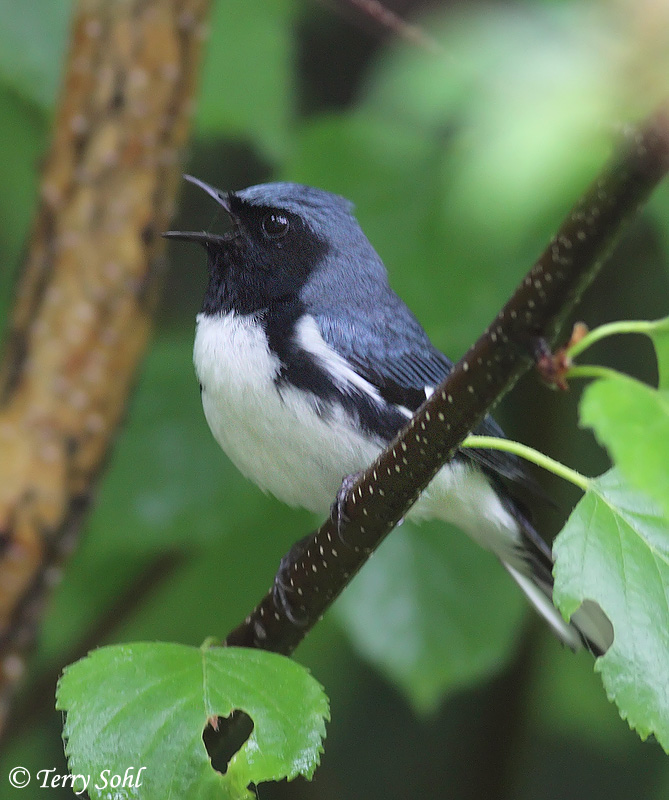
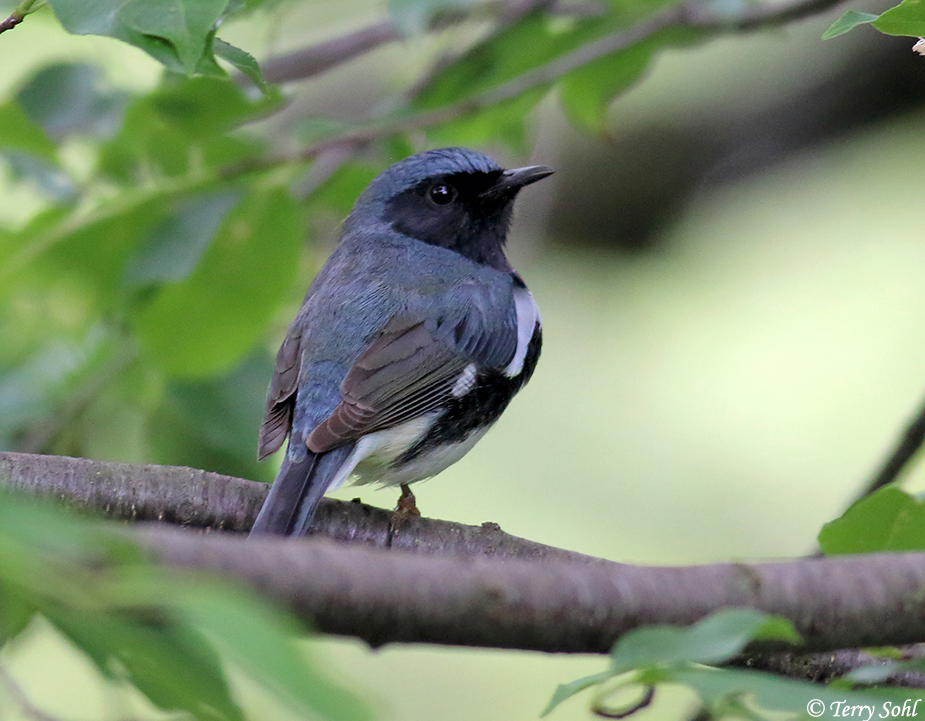
| ID Keys: Male has blue upperparts, a black throat, face and sides, and white underparts with a white wing spot. Females plainer, but also with white wing spot. | ||
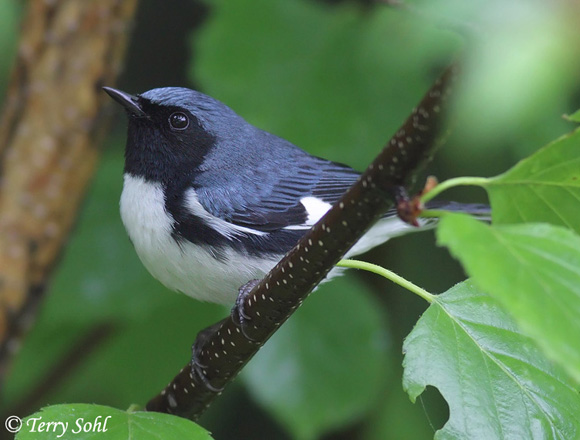 The Black-throated Blue Warbler is a common migrant in the
eastern United States, but is normally only a rare stray west of the
Mississippi. The males are striking and distinctive, with dark bluish
upperparts, a black face and throat, and white underparts. Females are
much plainer, with a olive-gray body. They are often more easily observed
than many warblers due to their tame nature and tendency to forage low in the
forest undergrowth or along forest edges, although that dense undergrowth
sometimes makes spotting a bird difficult.
The Black-throated Blue Warbler is a common migrant in the
eastern United States, but is normally only a rare stray west of the
Mississippi. The males are striking and distinctive, with dark bluish
upperparts, a black face and throat, and white underparts. Females are
much plainer, with a olive-gray body. They are often more easily observed
than many warblers due to their tame nature and tendency to forage low in the
forest undergrowth or along forest edges, although that dense undergrowth
sometimes makes spotting a bird difficult.
Habitat:
Uses large tracts of deciduous and deciduous/conifer mixed forests for breeding, especially if there is a dense shrubby undergrowth. During migration, they also are most often found in forested and brushy locations. In the winter, they are found in dense tropical forests as well as more open areas such as fence rows and suburban areas.
Diet:
In summer, primarily feeds on insects and spiders. In winter, insects still make up a large portion of the diet, but they also will feed on fruits, berries, seeds, and nectar.
Behavior:
Forages deliberately in the canopy, taking insects from the surfaces of leaves and branches, hovering and gleaning insects from vegetation, or occasionally flitting out to capture insects in mid-air.
Nesting:
Non-breeder in South Dakota. On their breeding grounds, Black-throated Blue Warblers nest in dense forest undergrowth, selecting a nest site in a thickly vegetated shrubby site, or small low in a small tree. The nest is a small cup, constructed of grasses, strips of bark, and other vegetative material, often bound with spiderwebs, and lined with finer rootlets, hair, and grasses. The female lays between 2 and 5 eggs, and she alone incubates them. The young hatch after about 12 days, and fledge from the nest about 10 to 12 days after hatching.
Interactive eBird Map:
Click to access an interactive map of Black-throated Blue Warbler sightings
Song:
The song is a buzzy, hoarse zhurr-zhurr-zhurr-zhree, with the last note higher. The call note is a soft tsip.
1Click here to hear the song of a Black-throated Blue Warbler
2Click here to hear the call of a Black-throated Blue Warbler
Migration:
Summers in the Appalachians, New England, the Great Lakes region, and southeastern Canada. Winters in southern Florida and the Caribbean. In South Dakota they are very rare migrants, with sightings in both the spring and fall months.
Similar Species:
Males are generally distinctive, as there are few other small species with a similar color pattern. Female Black-throated Blue Warblers are more likely to be confused with other warbler species, as the female is far less colorful than the male, with a dusky, olivish-gray-brown color overall. The following species are those most likely to be confused with a Black-throated Blue Warbler:
- Cerulean Warbler - Another very rare visitor to South Dakota, and anther warbler where the male at least shares bluish plumage with the Black-throated Blue Warbler. However, male Cerulean Warbler males are a lighter, sky-blue color on their upperparts, and lack the black face and throat of a Black-throated Blue Warbler.
- Tennessee Warblers - Tennessee Warblers have fairly plain plumage overall and could potentially be confused with female Black-throated Blue Warblers. However, Female Tennessee Warblers tend to be more yellowish and "bright", while female Black-throated Blue Warblers are more dusky and grayish-brown. Female Tennessee Warblers also lack a white wing patch that is usually easily seen on a female Black-throated Blue Warbler.
- Orange-crowned Warblers - Like the Tennessee Warbler, Orange-crowned Warblers have relatively basic plumage overall, and could be confused with female Black-throated Blue Warblers. However, they lack the white wing patch of the female Black-throated Blue Warbler, and appear to be more greenish-yellow overall, compared to the dusky, grayish-brown of a female Black-throated Blue Warbler.
Feeders:
Black-throated Blue Warblers have been known to occasionally come to feeders for suet and peanut butter in migration. They also will occasionally feed on nectar offered at hummingbird feeders.
South Dakota "Hotspot":
Black-throated Blue Warblers are a very rare migrant in South Dakota, and thus there's no one place where you can "expect" to find the species. The best places to keep your eye out for them during migration are the large, wooded areas on the far eastern part of the state, including state parks such as Good Earth State Park, the Big Sioux Recreation Area, and Newton Hills State Park, heavily wooded riparian areas such as that along the Big Sioux River, or large wooded parks such as the Outdoor Campus in Sioux Falls.
Conservation Status:
They require large tracts of forest land for breeding, and have declined in parts of their range due to habitat fragmentation, particularly during the early 20th century when vast swaths of eastern forest in North America were cut. As forests have regenerated in many areas in subsequent decades, Black-throated Blue Warbler numbers have been increasing. The IUCN considers the Black-throated Blue Warbler to be a species of "Least Concern".
Further Information:
1) BirdWatcher's Digest - Black-throated Blue Warbler
2) WhatBird - Black-throated Blue Warbler
3) Audubon Guide - Black-throated Blue Warbler
Photo Information:
Photo taken on May 25th, 2012 near Acadia National park in Maine - Terry Sohl
Audio File Credits:
1Christopher McPherson. Recorded in Hillsborough County, New Hampshire on May 26th, 2019. Original recording and information available from xeno-canto.
1Christopher McPherson. Recorded in Hillsborough County, New Hampshire on June 3rd, 2019. Original recording and information available from xeno-canto.
| Click on the map below for a higher-resolution view |
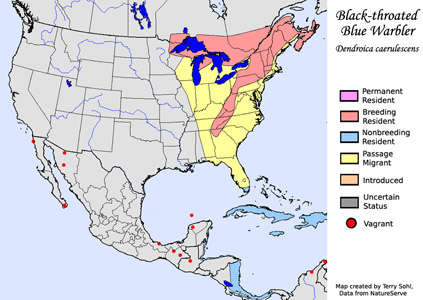 |
| South Dakota Status: Rare migrant in the eastern part of the state, casual in the west. |
Additional Black-throated Blue Warbler Photos
Click for a higher-resolution version of these photos



ALL PHOTOS COPYRIGHTED. Click below if you have interest in any of these photos for:
| Commercial Use |
| Fine Art Print |
| Personal Usage |
SOUTH DAKOTA BIRDS AND BIRDING - LOCATIONS OF WEBSITE VISITORS
Please mail all comments/suggestions/gripes/complaints to: Dakota Birder
Click here for other references used to compile this page