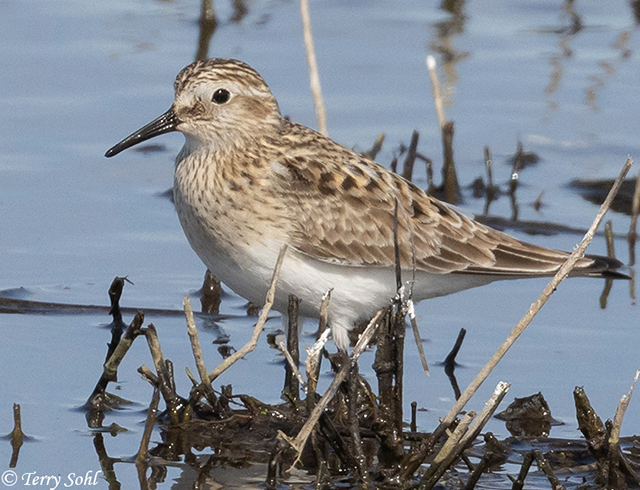
Named after Spencer Fullerton Baird, a Secretary of the Smithsonian Institution in the 1800s, the Baird's Sandpiper is a common migrant in South Dakota in both the spring and the fall. Very long distance migrants, they are one of a very few shorebirds who will stop at high mountain lakes during migration. Unlike many other small sandpipers, they feed by picking items from the mud or water's surface, rather than by probing into the mud.
Habitat
Small pools, shorelines, mudflats, and fields. Can often be found in drier habitat during migration than some other small sandpipers.
Diet
Not well known, but primarily insects, along with spiders and other invertebrates. Will also take amphipods and other small crustaceans.
Behavior
Actively walks along the shoreline or in very shallow water, picking food items from the surface of the water or the ground.
Breeding
Non-breeder in South Dakota. In their breeding range, the nest of a Baird's Sandpiper is a depression on the ground, lined with grasses and leaves. The female usually lays 4 eggs, and she alone incubates them. The young leave the nest soon after hatching and find their own food, but the female stays with them and protects them until fledging. The young fledge at about 3 weeks.
Interactive eBird Map
Click to access an itneractive eBird map of Baird's Sandpiper sightings
Song
A low krrrrt intermingled with other vocalizations is given during display flights. Also has various calls and alarm calls.
1Click here to hear the vocalizations of a displaying Baird's Sandpiper in flight, recorded in Point Barrow, Alaska.
2Click here to hear the calls of a Baird's Sandpiper in a distracting "broken wing" display near a nest, recorded in Point Barrow, Alaska.
Migration
Summers in the Arctic, winters in South America. Unlike many shorebirds which migrate north through the Great Plains but migrate south in the fall along the Atlantic Coast or elsewhere, Baird's Sandpipers are common migrants through South Dakota in both spring and fall.
Similar Species
A medium-sized sandpiper, Baird's Sandpipers are characterized by dark legs, a black, slightly drooping bill, and wingtips that extend noticeably past the end of the tail. The following are the species most likely to be confused with a Baird's Sandpiper:
- White-rumped Sandpiper - The trademark white rump distinguishes it from a Baird's Sandpiper, but that feature is only noticeable in flight. White-rumped Sandpipers have fine streaking on the flanks that is lacking from a Baird's, and also have a bit of orange at the base of the bill (compared with an all black bill on a Baird's).
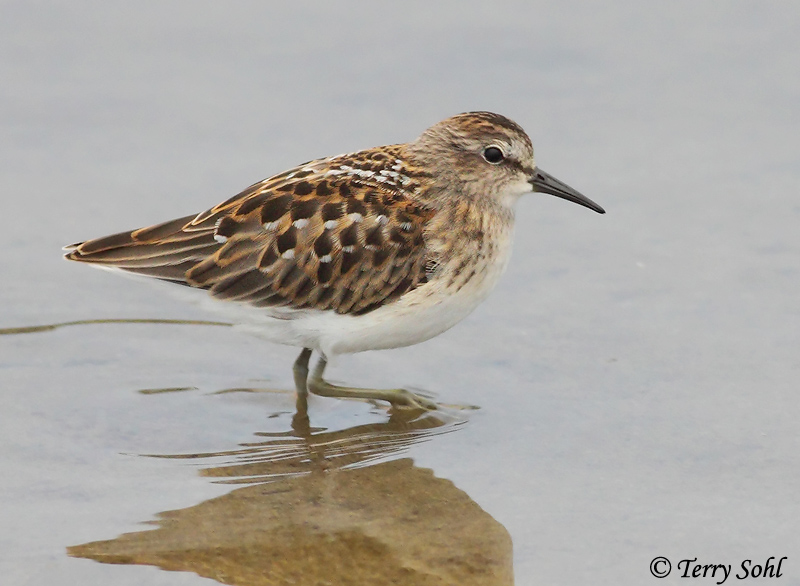
- Least Sandpiper - Smaller than a Baird's Sandpiper, Least Sandpipers have yellow legs, although on mudflats those legs can sometimes appear dark when covered with mud.
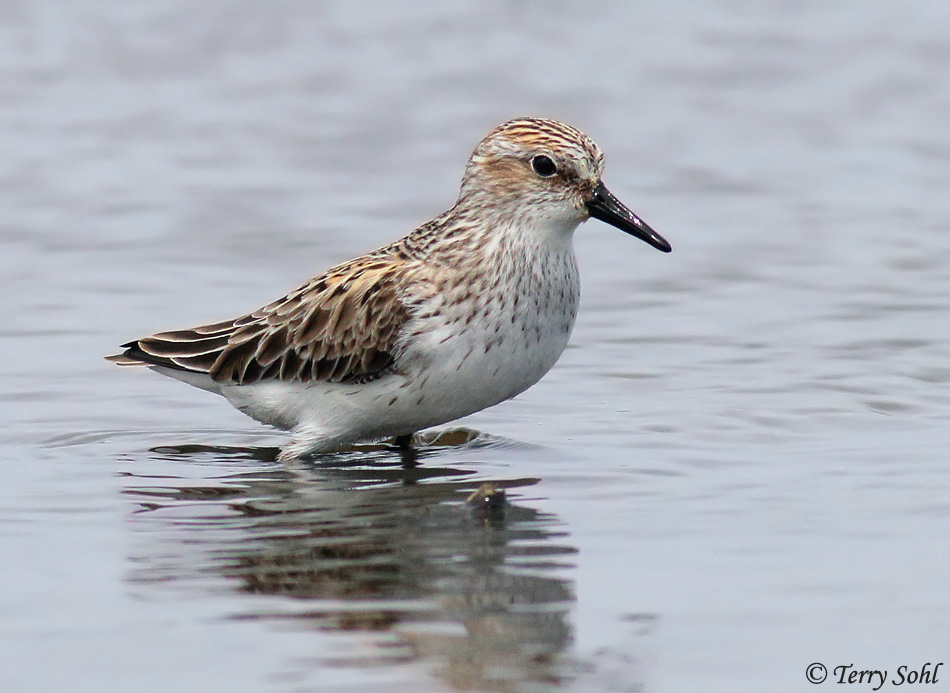
- Semipalmated Sandpiper - Smaller than a Baird's Sandpiper, with wingtips that do not extend beyond the tail.
 |
 |
 |
 |
| White-rumped Sandpiper | Least Sandpiper | Semipalmated Sandpiper | Semipalmated Sandpiper |
Status
Generally stable. They have a broad breeding range and are common in some parts of their range. The IUCN lists the Baird's Sandpiper as a species of "Least Concern".
Further Information
- eBird - Baird's Sandpiper
- Audubon Field Guide - Baird's Sandpiper
- Cornell Lab of Ornithology - All About Birds: Baird's Sandpiper
Photo Information
July 29th, 2007 - Lake Thompson, Kingsbury County, South Dakota - Terry Sohl
Audio File Credits
1Andrew Spencer, XC185621. Accessible at www.xeno-canto.org/185621.
2Andrew Spencer, XC185624. Accessible at www.xeno-canto.org/185624.
