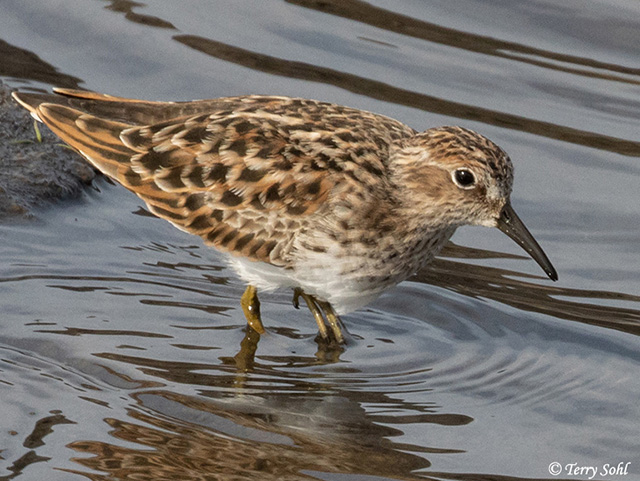
Least Sandpipers are the the smallest of the "peeps", the small sandpipers that migrate through the state. Indeed, they are generally considered the smallest shorebird in the world. Despite their tiny size, they are long-distance migration champs, with many birds making a non-stop flight from southeastern Canada or then northeastern US to wintering grounds in northeastern South America. The most common of the small sandpipers to migrate through South Dakota, a primary identification key are the pale yellow legs, as the other peeps have dark legs.
Habitat
During migration, Least Sandpipers are found on mudflats, shallow marshes, flooded fields, and shorelines. On their breeding grounds in Alaska and Canada, they are found on boggy tundra and wet meadows.
Diet
Variable but primarily consists of insects and other small invertebrates such as snails, spiders, or small worms. They sometimes supplement their diet with the seeds of wetland grasses.
Behavior
Primarily forages on mudflats and shorelines, picking up food items from the ground, occasionally by probing in the mud with its bill.
Breeding
Non-breeder in South Dakota. On their breeding grounds in northern Canada and Alaska, Least Sandpipers nest on the ground, building a shallow scrap on a tuft of higher or drier grass in wetland areas. The male builds multiple scrapes, with the female inspecting them and making the final choice of nesting location. She lays 3 or 4 eggs, and both parents help to incubate them. The eggs hatch after about 3 weeks. The young leave the nest within a day or two of hatching and must feed themselves, but the male typically stays nearby and protects them.
Song
High thin keee-eeet is the most common vocalization heard as they migrate through the United States. Breeding males in Alaska and Canada have a surprisingly complex series of trilled and warbling notes.
- 1Click here to hear alarm calls of a Least Sandpiper near a nest, recorded on the North Slope of Alaska.
- 2Click here to hear the song of a male Least Sandpiper, recorded near Nome, Alaska.
- 3Click here to hear the simple calls of a Least Sandpiper, recorded in New Brunswick.
Migration
Many winter in the Southern United States and near the US coastlines, while others migrate as far away as northern South America.
Interactive eBird Map
Click here to access an interactive eBird map of Least Sandpiper sightings
Similar Species
Least Sandpipers can easily be confused with the other "peeps"...the small sandpipers...that migrate through the state. Compared to the other similarly sized sandpipers, the yellow legs are unique. Species most likely to be confused with the Least Sandpiper include the following:
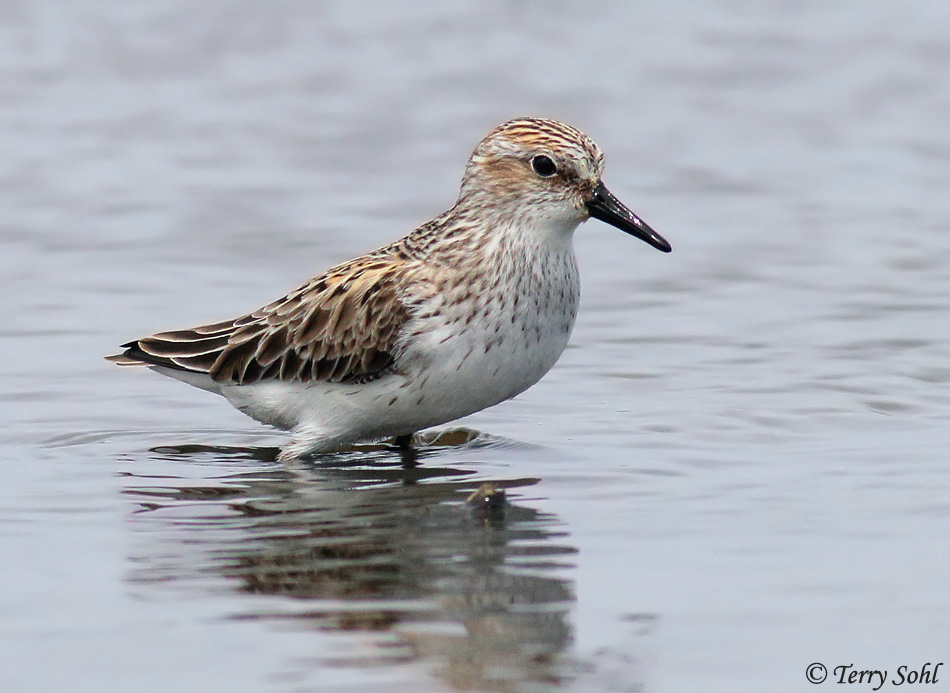
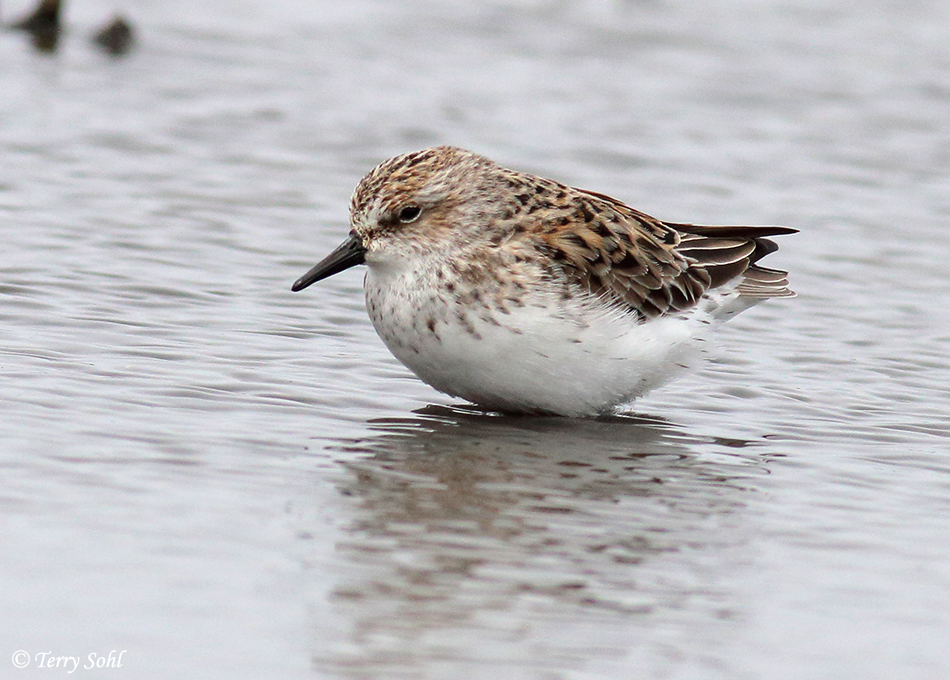
- Semipalmated Sandpiper - The species most often confused with Least Sandpiper in South Dakota, the bill of a Semipalmated Sandpiper is generally thicker and shorter than the Least Sandpiper, with its thinner and slightly drooping longer bill. The legs on a Semipalmated Sandpiper are also dark, compared to the yellow legs of a Least Sandpiper.
- Western Sandpiper - Western Sandpipers are uncommon migrants in the state, as they're typically found closer to the coast. However, they can easily be confused with a Least Sandpiper. The dark legs and slightly thicker bill distinguishes them from the Least Sandpiper.
 |
 |
 |
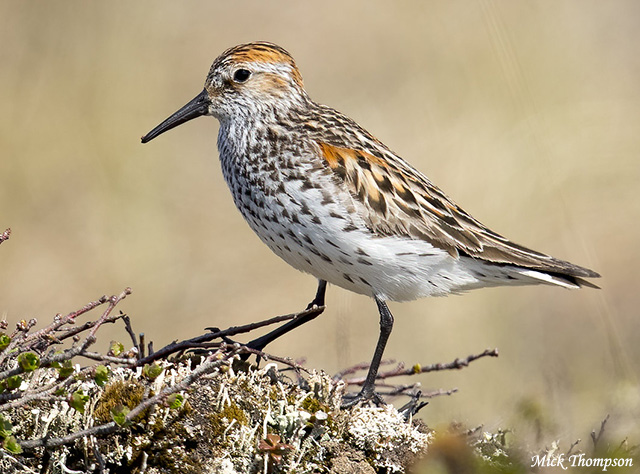 |
| Semipalmated Sandpiper | Semipalmated Sandpiper | Semipalmated Sandpiper | Western Sandpiper |
Conservation Status
Least Sandpipers remain widespread and still occur in large numbers across North America, but recent monitoring indicates moderate declines in portions of their range, leading ornithologists to view the species with increasing caution even though it is not yet considered highly imperiled. The primary conservation issues involve continued degradation and loss of wetlands used during migration and winter, along with broader environmental changes affecting Arctic and boreal breeding habitats that support this tiny shorebird. The IUCN considers the Least Sandpiper to be a species that is "near threatened".
Photo Information
May 3rd, 2020 - Lincoln County, South Dakota - Terry Sohl
Audio File Credits
- 1Andrew Spencer, XC203604. Accessible at www.xeno-canto.org/203604.
- 2Peter Boesman, XC322794. Accessible at www.xeno-canto.org/322794.
- 3Martin St-Michel, XC145676. Accessible at www.xeno-canto.org/145676
