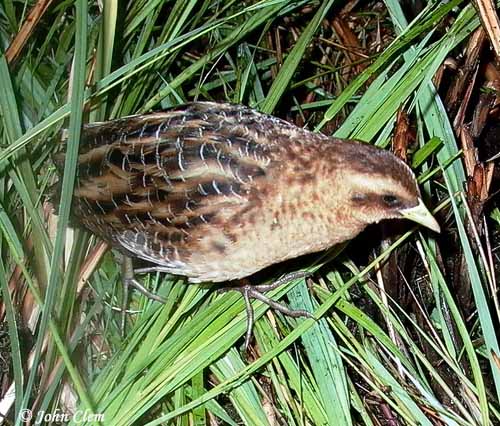
ID Keys: Small with short yellowish/greenish bill, dark brown
upperparts with buff stripes and thin white crossbars
The Yellow Rail has been described as the most
difficult bird to observe in North America. They spend most of their time
in thick marshy vegetation, and even if disturbed, will only rarely flush in
weak, short flights. The species is a regular breeding bird in North
Dakota, but is only considered a rare visitor to South Dakota. It is
possible they are present in the northern part of the state but are largely
unobserved.
Habitat
Prefers large very shallow marshes and
wet meadows during summer breeding, especially those with thick vegetation
of grasses and sedges. Primarily found in coastal salt marsh during
the winter.
Diet
Diet isn't well known, but insects, snails, small
crustaceans, seeds, and earthworms probably make up a large portion of the diet.
Behavior
Rarely ever is found away from thick
wetland vegetation. Strongly prefers to walk or run through vegetation
rather than flying, and appears to be weak in flight if it does flush.
Breeding
Non-breeder in South Dakota
Song
Simple tick-tick-tick-tick, easily
simulated by clicking two coins together.
Migration
Summers throughout much of Canada, the
extreme northern Great Plains, and the Great Lakes region. Winters
along the Gulf and Atlantic coasts.
Has likely greatly declined from
historical numbers due to habitat loss, but due to difficulty in observing
the species, population trends are difficult to determine in most locations.