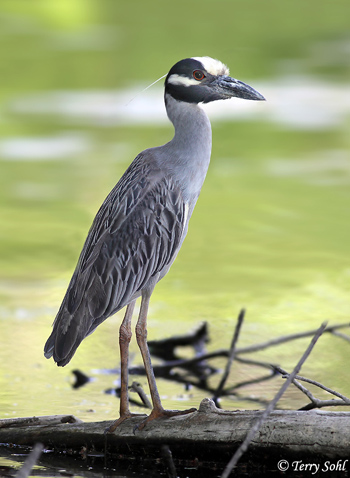
ID Keys: Black and white patterned face, gray body
The Yellow-crowned Night Heron is a rare visitor
to South Dakota, as it is normally found in the southeastern United
States. It is normally a secretive and solitary bird. Despite the
name, it is also active and feeds during the day. It has a very thick
stout bill, well adapted to feeding on crabs and other crustaceans,
leading to it's local name of "crab-eater" in many parts of the South.
Habitat
The Yellow-crowned Night-Heron inhabits swamps, marshes, mangroves, wooded wetlands, ponds, rivers, and coastal estuaries with abundant shallow water and dense cover. It often prefers quieter wooded wetland habitats and shoreline areas where crabs, crayfish, and other aquatic prey are plentiful.
Diet
Feeds heavily on crustaceans, especially
crayfish in the interior of the country. Also will eat fish, insects,
tadpoles, and frogs.
Behavior
Will feed at any time of day, but very
often near dusk and at night. Feeds by either standing still in
shallow water or on a perch overlooking water, or by wading deliberately
through the water in search of prey.
Breeding
No confirmed breeding records in South
Dakota, although several summer observations have occurred in recent
decades. The Yellow-crowned Night-Heron nests in trees or large shrubs, often near wetlands, swamps, mangroves, or wooded shorelines. The nest is a platform of sticks lined with smaller twigs and vegetation, usually placed well above the ground or water. It may nest alone or in loose colonies with other wading birds, and both parents share incubation and care of the young.
Song
The Yellow-crowned Night-Heron gives deep, harsh croaks and barking quock calls, most often heard at dusk, during flight, or around nesting colonies. It is generally quieter than the Black-crowned Night-Heron but becomes vocal during territorial disputes and courtship displays.
Migration
The Yellow-crowned Night-Heron migrates between breeding areas in the southern and eastern United States and wintering grounds farther south in the Caribbean, Central America, and northern South America. Northern populations move south in fall, while birds in tropical and subtropical coastal regions may remain year-round residents.
Black-crowned Night Heron. The Yellow-crowned Night-Heron differs from the Black-crowned Night-Heron by its slimmer build, longer legs, gray body, and distinctive yellowish-white crown with a bold black facial pattern. Black-crowned Night-Herons are stockier with a black cap and back, paler underparts, and shorter legs and neck.
Status
The Yellow-crowned Night-Heron is generally considered a species of low conservation concern, although some local populations are affected by wetland loss, coastal development, pollution, and disturbance at nesting colonies. Protection of wetlands, mangroves, and shoreline habitats has helped maintain stable populations across much of its range. The IUCN considers the Yellow-crowned Night-heron to be a species of "least concern".