
The Spotted Dove is a bird that is native to south Asia. They were introduced in the Los Angeles area of California in 1917, and have become established, with a range that has slowly expanded to include a small part of southern California. The species has also been introduced in other parts of the world, including Australia and New Zealand. They are a species that has become well adapted to a human presence in North America, as they are most often found in suburban settings, where they can be common visitors to suburban feeders.
Habitat
In their small range in North America, they are most often found in suburban settings, areas with landscaping and large lawns. They can also be found in agricultural areas and riparian areas.
Diet
Feeds mostly on seeds.
Behavior
Forages by walking on the ground and searching for seeds.
Nesting
The nest of a Spotted Dove is a platform of twigs, placed in a tree or a tall shrub, sometimes quite high from the ground. The female lays 2 eggs, and both parents help to incubate them. When the eggs hatch, both parents help to feed and raise the young.
Song
The song of a Spotted Dove is a strong, rolling cooing, often with a harsher tone in the middle.
Click here to hear the cooing call of a Spotted Dove1
Migration
Considered a permanent resident in their small North American range. They are also considered non-migratory in their native Asian range.
Interactive eBird map
Click here to access an interactive eBird map of Spotted Dove sightings
Similar Species
If seen well, the black neck with white spots is distinctive. In their small established range in the United States, they are similar in size to some other dove species:
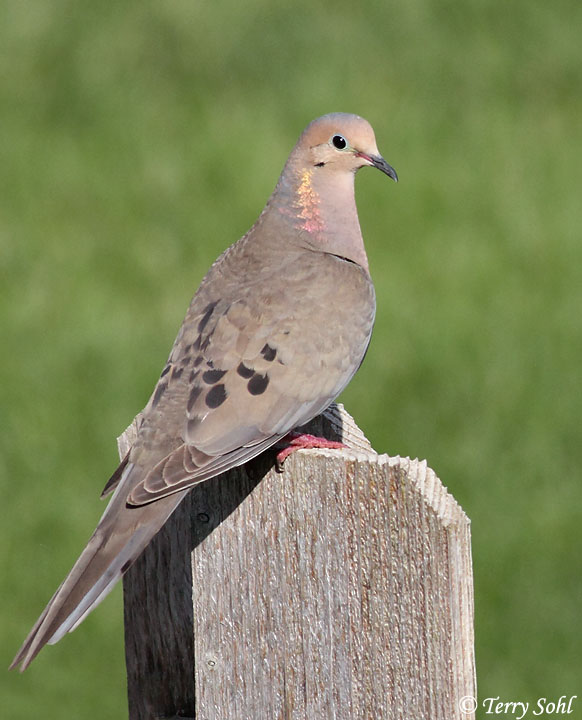
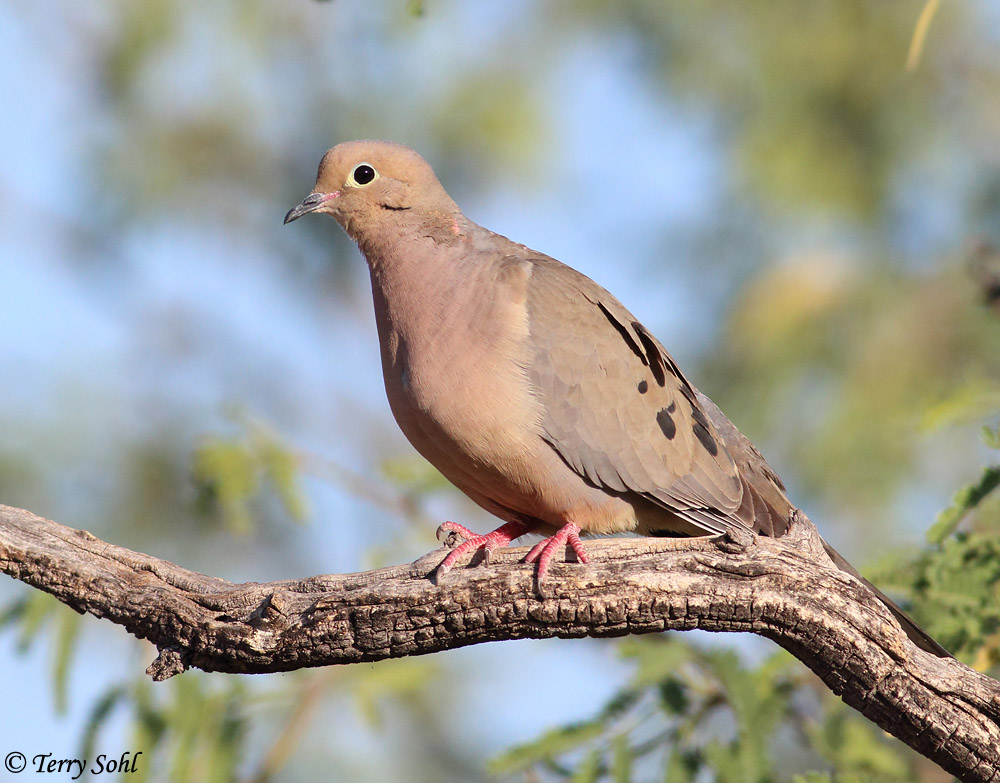
- Mourning Dove - Mourning Doves are another species that have done very well in the presence of human activity, and cross paths with the Spotted Dove in their limited North American Range. Mourning Doves lack the spots on the neck of a Spotted Dove, and have a gray back that matches the rest of their plumage, as opposed to the scaly, brownish back of a Spotted Dove.
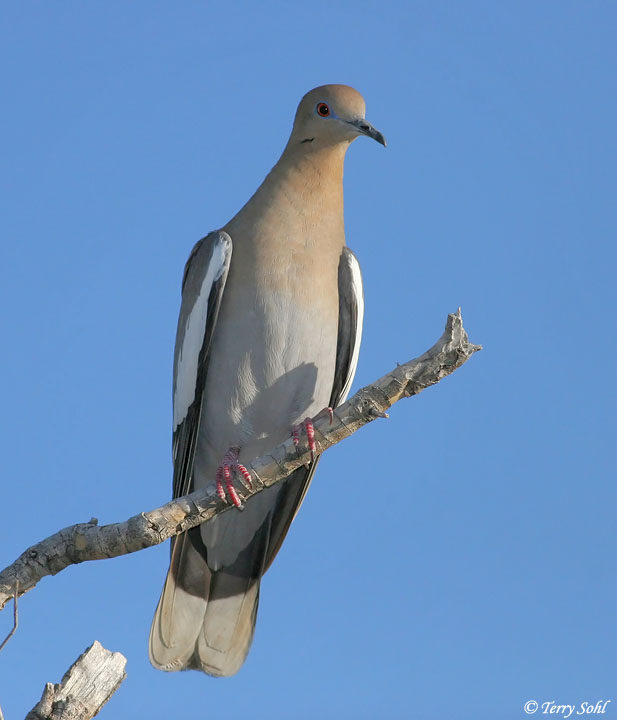
- White-winged Dove - White-winged Doves are another native species that crosses paths with the introduced Spotted Dove in California. White-winged Doves lack the scaly brownish back of a Spotted Dove, and lack the spotted neck. White-winged Doves also have an obvious white wing patch that's lacking from Spotted Doves.
 |
 |
 |
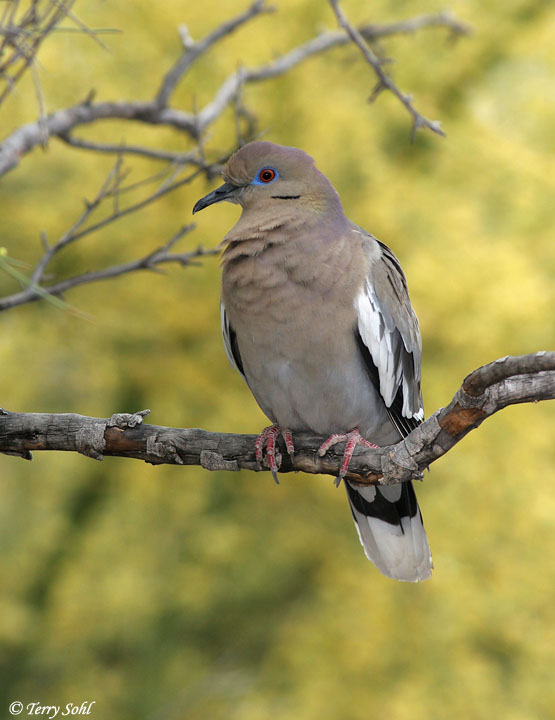 |
| Mourning Dove | Mourning Dove | White-winged Dove | White-winged Dove |
Feeders
Will attend feeders for various seeds.
Conservation Status
Spotted Dove are very well adapted to a human presence, and unlike other species, they actually are expanding as natural habitats are disturbed by human activity. Overall populations are widespread, and they are very common in many parts of their range. The IUCN lists the Spotted Dove as a species of "Least Concern".
Photo Information
Photo take on June 12th, 2019 at Centennial Park, Sydney, Australia - Terry Sohl
Audio File Credits
- 1Peter Boesman. Recorded in Sri Lanka on March 28th, 2016. Original recording and information available on xeno-canto.
