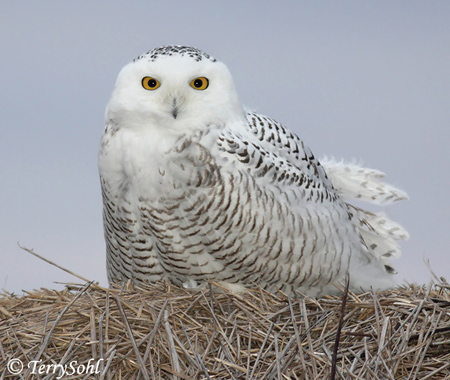
Snowy Owls are irregular winter visitors to South Dakota and to the lower 48 states in general, with numbers varying widely from year to year. In years of low lemming populations in its normal Canada range, numbers of Snowy Owls may be seen well south of the Canadian border. Females and young males show significant dark barring, but older males may be almost completely white.
Habitat
Prairies, fields, marshes, beaches, frozen lakes. In summer on breeding grounds, nests on the open tundra.
Diet
May feed almost exclusively on lemmings in Arctic range. Feeds on rabbits, hares, voles, ground squirrels, and various birds on wintering grounds.
Behavior
Unlike many owls, they very often hunt during the day. Hunts by watching from a perch and swooping down when prey is spotted, or, less frequently, by flying low and surprising prey.
Breeding
Non-breeder in South Dakota. In breeding range, the nest of a Snowy Owl is a raised area, typically a mound or hummock ont he tundra. The nest is a simple depression with no lining. The female lays between 3 and 10 eggs, with more eggs being laid when lemmings are more abundant. The female alone incubates the eggs. When the eggs hatch, the female stays with the young while the male brings food. The young fledge after about 8 weeks.
Snowy Owl Song / Calls
On their breeding grounds, male Snowy Owls have a low hooting call. Females have a call that's more of a smooth clucking sound. When they feel threatened or are defending a nest, they may make hissing calls or snapping sounds with their bill.
- Click here to hear the low hooting call of a male Snowy Owl1
- Click here to hear the call of a female Snowy Owl2
- Click here to hear the various vocalizations of a young bird at a nest site3
Migration
Most live in extreme northern Canada, with some wintering throughout Canada and down into the northern United States.
Interactive eBird Map
Click here to access an interactive eBird map of Snowy Owl sightings
Similar Species
Quite distinctive if seen well, but at a distance or in poor light could possibly be confused with other owl species. The Snowy Owl is a much larger, broader-bodied owl of open tundra-like fields with a round head and no ear tufts, usually appearing strikingly white even at great distance. A pale Barn Owl is slimmer, longer-legged, and buffier underneath with a very obvious heart-shaped face and long narrow wings, often flying with a buoyant moth-like motion at dusk rather than sitting prominently on the ground or posts. Light individuals of the Great Horned Owl can appear pale, but they always show noticeable ear tufts, heavier dark barring, and a more mottled brown-white pattern instead of the cleaner white, rounded-headed look of Snowy Owl.
Conservation Status
In recent years numbers of Snowy Owls have started to decline rather quickly. The causes are not completely understood but are thought to be related to climate change impacts in their northern breeding range and resultant impacts on prey species, as well as increased interactions with human activity. The IUCN now considers the Snowy Owl to be a "vulnerable" species given the recent declines.
South Dakota "Hotspot"
The Fort Pierre National Grasslands south of Pierre often harbor Snowy Owls during the winter months. They are also sometimes found around Lake Oahe, especially when open water attracts waterfowl during the winter months. However, their presence during the winter is unpredictable, both in terms of the numbers of birds seen any one winter, and where in the state they might be found. Typically, however, there is a gradient of increased sightings as you go further north in the state.
Photo Information
December 30th, 2011 - Near Lake Andes, South Dakota - Terry Sohl
Audio File Credits
- 1Tero Linjama. Recorded in Finland on February 27th, 2012. Original recording and information available from xeno-canto.
- 2Tero Linjama. Recorded in Finland on February 27th, 2012. Original recording and information available from xeno-canto.
- 3Patrick Aberg. Recorded in Sweden on July 13th, 2015. Original recording and information available from xeno-canto.
