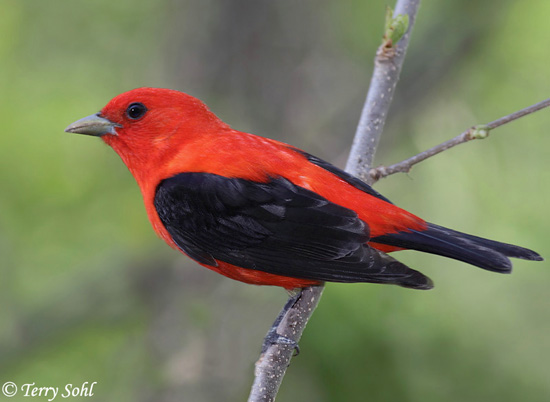
Scarlet Tanagers are a very brightly colored bird of forests and woodlands in the eastern part of South Dakota. Scarlet Tanagers, like the other Tanagers found in the state, are long distance migrants, wintering in South America. The brilliantly plumaged summer male undergoes a molt to the same olive green color as the female, although it retains the black colored wings in all plumages.
In South Dakota, they are most often encountered in the far eastern part of the state, particularly in the riparian forested areas and large parks of far southeastern and far northeastern South Dakota.
Habitat
Forests and woodlands, preferably large unbroken deciduous tracts, although they may use smaller tracts of forest in some parts of their range (particularly in the eastern US). They often seem especially fond of Oak and Pine in many areas.
Diet
Primarily insects, with some worms, snails, fruits, and berries.
Behavior
Primarily forages in tall trees, usually relatively high in the canopy, but sometimes lower (especially in poor weather). Will move slowly through foliage and branches in search of insects, but will also sometimes hover and glean insects from the vegetation, or will fly out to capture insects in mid-air.
Nesting
June and July. Scarlet Tanagers usually nest in deciduous Trees (although they will use select coniferous species in some locations), with the nest constructed on a branch, well away from the trunk. The nest is often placed quite high in a tree, and may be between 15 and 50 feet from the ground. The nest itself is a loose cup, constructed by the female, and consisting of twigs, rootlets, strips of bark, weed stems, grasses, or other vegetative material. The female lays between 2 and 5 eggs, and she alone incubates them. The young hatch after about 2 weeks, and fledge from the nest 10 to 15 days after hatching.
Song
The song of a Scarlet Tanager is often described as a "poor-man's Robin", with similar distinct musical phrases, but with a slightly less melodic tone than a Robin. They also have a distinctive two-part call note, chik-burr.
- Click here to hear the song of a Scarlet Tanager1
- Click here to hear the call notes of a Scarlet Tanager2
Migration
Summers in the eastern half of the United States and parts of far southern and southeastern Canada. Long distance migrants, Scarlet Tanagers overwinter in South America.
Interactive eBird Map
Click here to access an interactive eBird map of Scarlet Tanager sightings
Similar Species
Females are more likely to be confused with other species than are the males, but the males also have one species that is similar in appearance.
- Summer Tanager - Summer Tanagers are the "other" red tanager in much of North America. Males of both species share an overall red coloring, but Summer Tanagers are uniformly red, while male Scarlet Tanagers have black wings and a black tail. Females of both species are yellowish overall, but Summer Tanager females are yellowish overall, while Scarlet Tanager females are more of an olivish-yellow and have darker-toned wings that contrast with the body color.
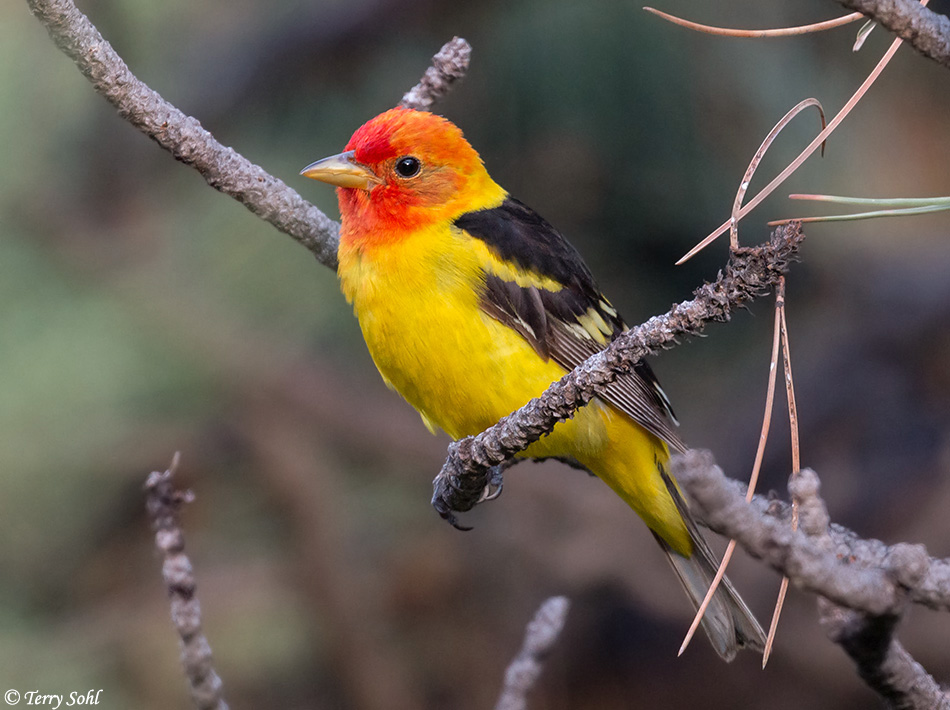
- Western Tanager - The normal range of Western and Scarlet Tanagers alone should differentiate them, as Western Tanagers are found in the western US, while Scarlet Tanagers are found in the East. While their ranges typically do not overlap, note there have been multiple sightings of Western Tanagers in eastern South Dakota in recent years, and thus there's the potential for confusion. Female of both species are yellowish overall with darker wings. However, female Western Tanagers have 2 distinct wingbars, while the female Scarlet Tanager lacks wingbars.
- Northern Cardinal - Listed here because Northern Cardinals are the other bright red bird you may encounter in the forests of eastern South Dakota. Structurally the two species are different, particularly the bill, with Cardinals have a much more stout and short bill than a Scarlet Tanager. Northern Cardinals also have a crest not found on Scarlet Tanagers. The plumage also differentiates them. Although both are red overall, a male Cardinal is almost entirely red with a black throat and face, while a Scarlet Tanager is red overall with black wings and a black tail.
 |
 |
 |
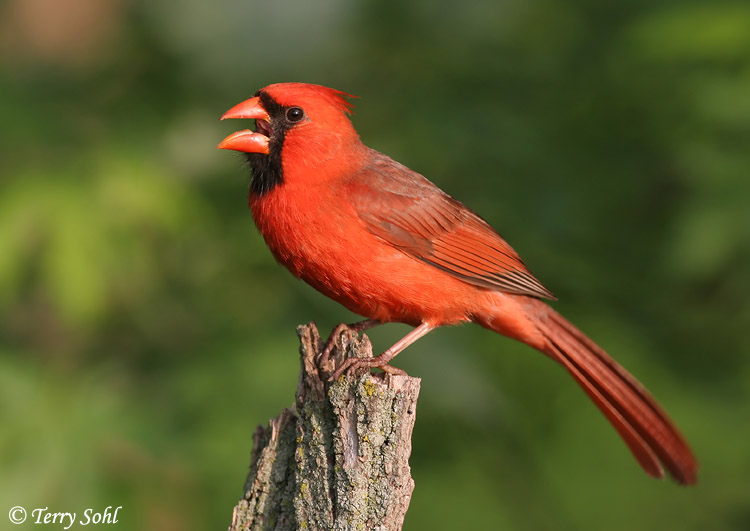 |
| Summer Tanager | Western Tanager | Western Tanager | Northern Cardinal |
Feeders
Scarlet Tanagers will sometimes come to platform feeders for cut fruit, nectar, and baked goods.
South Dakota "Hotspot"
Newton Hills State Park in Lincoln County is an excellent location to find Scarlet Tanagers in the spring and summer. I've also seen them at Good Earth State Park, the Big Sioux Recreation Area, and Beaver Creek Nature Area, but never as consistently and never as many.
Conservation Status
Scarlet Tanagers seem to require large continuous forest blocks for successful breeding, particularly those found in the relatively treeless areas of the MidWest and Great Plains, where they are primarily found along riparian areas and other areas of relict large patches of forest. They've undoubtedly decline in parts of their range due to habitat loss, but they are still found across a broad geographic area, are common in parts of their range, and have a healthy population overall. The IUCN considers the Scarlet Tanager to be a species of "Least Concern".
Photo Information
June 2007 - Newton Hills State Park, South Dakota - Terry Sohl
Audio File Credits
- 1William Whitehead. Recorded in Carbon County, Pennsylvania on June 28th, 2017. Original recording and information available from xeno-canto.
- 2Jonathon Jongsma. Recorded in Fillmore County, Minnesota on May 9th, 2015. Original recording and information available from xeno-canto.
