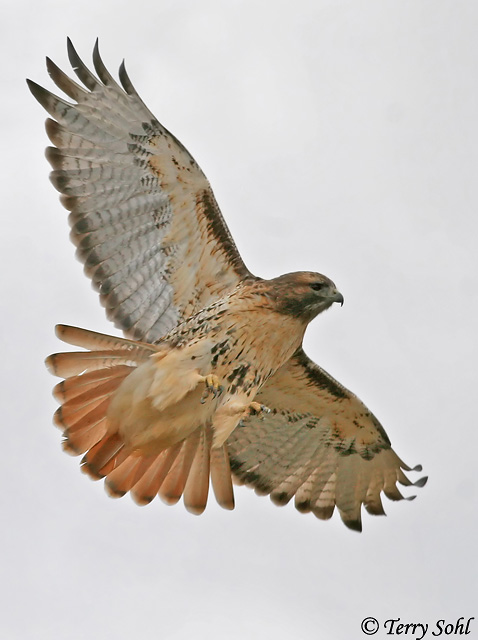
The Red-tailed hawk is probably one of the most well-known hawks, due to it's trademark reddish tail and tendency to perch along the sides of roads. Red-tailed Hawks show a wide variation in plumage, especially in the western United States. "Harlan's Hawk", once considered a separate species, is a very dark morph of the Red-tailed Hawk, with marbled earth and white tones in the tail instead of red. Another distinguishing field mark of most birds is a "belly band" of dark speckled feathers on the bellow below the breast. However, very light colored Red-tailed Hawk morphs may largely lack even this characteristics.
See photos at the bottom of the page (or ) to view the variety of Red-tailed Hawk plumages.
Habitat
Open country, woodlands, prairies, cropland, and plains. Found in nearly any type of habitat that provides some open ground with high perches.
Diet
Will take a wide variety of prey, primarily small mammals, birds, and reptiles. Occasionally eats insects and carrion.
Behavior
Hunts by either watching from a perch and swooping down when prey comes within range, or by soaring over open ground. During courtship, males and females circle together, crying their distinctive cry.
Nesting
March through June. The nest of a Red-tailed Hawk is usually in a tree, often one of the tallest trees in the general vicinity. The nest is large structure built of sticks, lined with finer vegetative material. The female usually lays 2 to 3 eggs, and both parents help to incubate them. Upon hatching, the female initially stays with the young while the male leaves the nest to hunt and bring food back. After a few weeks, both parents leave the nest for periods to hunt.
Song
The call of a Red-tailed Hawk is a classic, screaming KRRreeeeeee. Other vocalizations may be given by courting birds, or by juveniles.
One of the most common dubbed in sounds on film and TV when a raptor call is needed. Most of the time, when Hollywood uses a classic Red-tailed Hawk call, it's not in association with a Red-tailed Hawk! It's very common for them to use a Red-tailed Hawk call when Bald Eagles are shown on the screen, for example. Other
- Click here to hear the classic call of a Red-tailed Hawk1
- Click here to hear the calls of a juvenile Red-tailed Hawk, following a parent (likely begging for food)2
- Click here to hear interaction calls of two Red-tailed Hawks at a nest3
Migration
Most birds in the northern part of their range migrate southward for the winter. However, in much of their range in the United States and Mexico, they are permanent residents. South Dakota represents the northern fringe of their winter range, as numbers definitely dwindle in the state by winter. Good numbers can still often be found in the southern part of the state in winter, with winter sightings more rare as you move northward in the state.
Interactive eBird Map
Click here to access an interactive eBird map of Red-tailed Hawk sightings
Similar Species
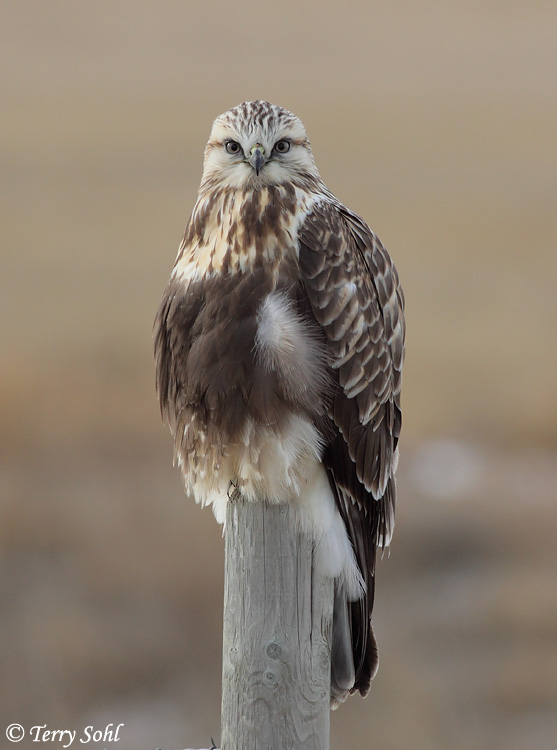
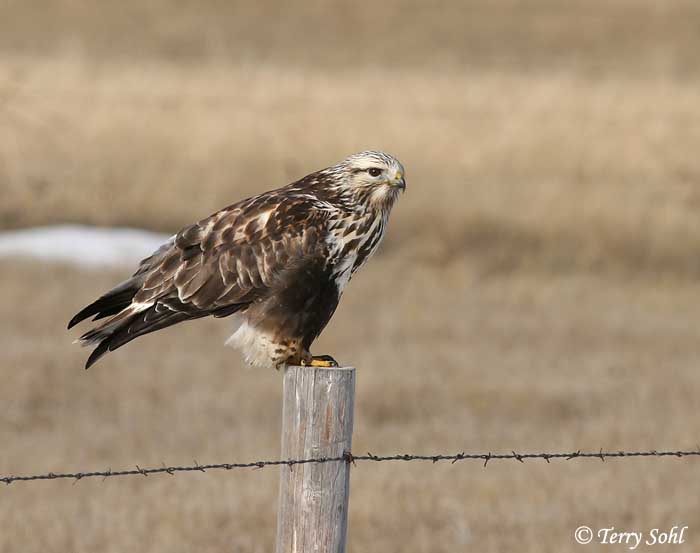
Depending on age and morph, Red-tailed Hawks can appear similar to Ferruginous Hawk, Rough-legged Hawk, or Broad-winged Hawk. Click here for a page that describes differences between the "Buteo" hawk species, and identification keys for each. Click below for comparative photos of each of these species.
 |
 |
 |
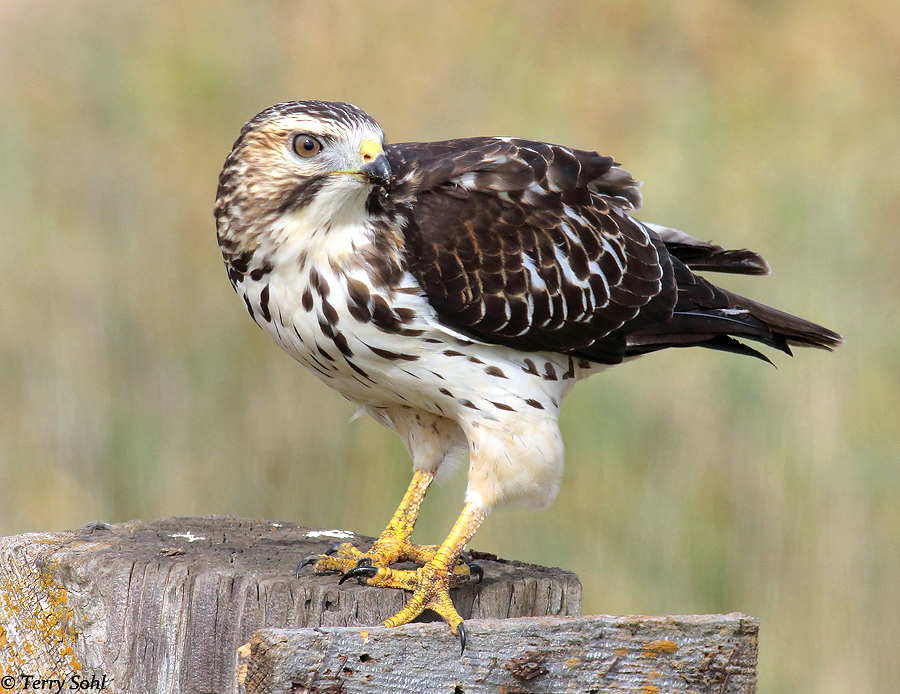 |
| Ferruginous Hawk | Rough-legged Hawk | Rough-legged Hawk | Broad-winged Hawk |
Conservation Status
Numbers have increased substantially in recent decades, according to systematic surveys such as the Breeding BIrd Survey or the Christmas Bird County. They are found across a very broad geographic area, use a huge array of habitats across South Dakota and North America, and are quite common in many parts of their range. The IUCN considers the Red-tailed Hawk to be a species of "Least Concern".
South Dakota "Hotspot"
Any semi-open habitat with even a few trees! The hallmark of Red-tailed Hawks is their adaptability. They inhabit an incredibly wide variety of habitats, including in South Dakota, where they may be found on nearly treeless grasslands in the central and western part of the state, around forest clearings and edges in the rugged, forested terrain of the Black Hills, to the extensive farmland of eastern South Dakota. They can be found in any season as well, although numbers dwindle in winter, particularly in the northern part of the state. Migration is often the best time to find them, as large numbers move through the state. There are times in migration where it seems like one is found every mile or so on roadside telephone poles and fenceposts.
Photo Information
October 22nd, 2006 - Gavin's Point Dam, Nebraska/South Dakota border -- Terry L. Sohl
Audio File Credits
- 1Paul Marvin. Recorded in San Diego County, California on June 4th, 2020. Original recording and information available from xeno-canto.
- 2Russ Wigh. Recorded in Savannah, Georgia on June 18th, 2013. Original recording and information available from xeno-canto.
- 3Richard E. Webster. Recorded in Cochise County, Arizona on May 21st, 2020. Original recording and information available from xeno-canto.
