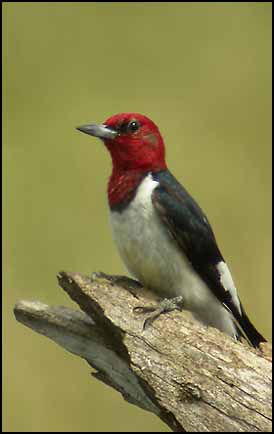
ID Keys: Distinctive, with red head, black back and tail, white underparts.
The Red-headed Woodpecker is one of North America's most striking woodpeckers, recognized by its entirely crimson-red head, bright white body, and glossy black back and wings. Unlike many woodpeckers, it frequently catches insects in flight, often behaving more like a flycatcher than a typical bark-foraging species. It inhabits open woodlands, savannas, shelterbelts, orchards, and areas with scattered dead trees that provide nesting cavities and food-storage sites. Red-headed Woodpeckers are well known for storing acorns, nuts, and insects in tree crevices for later use. Although still widespread, populations have declined in parts of their range because of habitat loss, reduced availability of dead trees, and changes in forest structure.
Habitat
The Red-headed Woodpecker inhabits open woodlands, oak savannas, riparian forests, shelterbelts, orchards, parks, golf courses, and agricultural landscapes with scattered large trees. It prefers habitats that contain standing dead trees (snags) for nesting and open areas that allow it to forage for insects in flight and store food in bark crevices.
Diet
Omnivorous. The Red-headed Woodpecker has one of the most varied diets of any North American woodpecker. It feeds on insects such as beetles, grasshoppers, ants, and caterpillars, but also consumes acorns, beechnuts, seeds, berries, fruits, and agricultural grains. Unlike many woodpeckers, it frequently catches flying insects in midair and is well known for storing food in tree crevices, fence posts, and other structures for later use.
Behavior
Foraging technique depends upon individual birds, seasonality, and opportunities available. Often feeds by clambering through foliage and branches, gleaning insects from vegetation surfaces. They will also flycatch, flying out from an observation perch to catch passing insects in mid-air. They will feed on the ground, hopping after insects or picking up fallen fruit and nuts.
Nesting
June and early July. The Red-headed Woodpecker nests in cavities excavated in dead trees, dead limbs, utility poles, or occasionally fence posts. Both sexes help excavate the nesting cavity, which is usually placed in an open woodland, savanna, or other habitat with scattered trees. Typical clutches contain 4–7 eggs, and both parents share incubation duties and care for the young after hatching.
Song
The Red-headed Woodpecker gives a variety of harsh, scratchy calls often described as queer, churt, or rasping chatter notes. It is generally less vocal than many other woodpeckers, but territorial birds frequently call while displaying, and both sexes use drumming to communicate and defend nesting areas.
Migration
Birds in much of their normal range are permanent residents. In the northern and western edges of their range, individuals do move towards southeastern states in the winter, but usually don't migrate great distances.
Suet, sunflower seeds, cracked corn, nuts, and bread.
Birdhouses
Some will nest in birdhouses built for woodpeckers.
Similar Species
Generally distinctive.
Conservation Status
The Red-headed Woodpecker has experienced significant long-term population declines across much of North America and is considered a species of conservation concern in many regions. Major threats include loss of open woodlands and savannas, removal of dead trees used for nesting, changes in fire regimes, and reductions in mast-producing trees such as oaks. Although still locally common in suitable habitat, conservation efforts often focus on preserving snags, maintaining open woodland structure, and restoring oak savanna ecosystems. Competition with non-native birds such as American Starlings also has contributed to a decline. Despite the declines, the IUCN still considers the Red-headed Woodpecker to be a species of "least concern".
Photo Information
June 28th, 2003 -- Lincoln County -- Terry L. Sohl