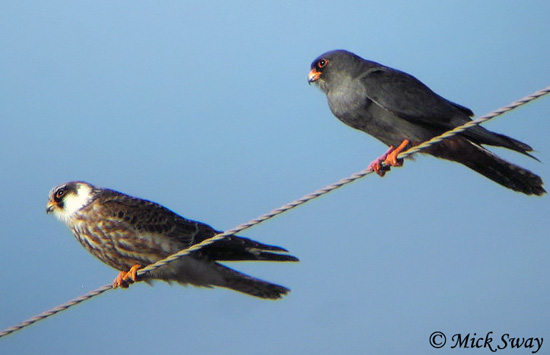
ID Keys: Males dark grey overall, with reddish feet, eye-ring, and
base of bill. Females plumage significantly different.
The
Red-footed Falcon is a rather uncommon raptor of the Old World, wintering in
southern Africa, and spending the northern hemisphere summer in eastern
Europe through central Asia. They are very long-distance migrants, and
vagrants are often found in western Europe, but in August 2004, one
Red-footed Falcon was found in Martha's Vineyard in Massachusetts, marking
the first time the species had been spotted in the Western Hemisphere.
Habitat
On its wintering grounds in Africa, it prefers open grassy habitats with scattered trees and shrubs. During the northern hemisphere's summer, they are often found in semi-open habitats in and around water sources, including open woodlands, savannahs, and agricultural land with vegetation along fencerows.
Diet
Mostly feeds on large insects, but they will also take small birds, small rodents, and other small vertebrates such as lizards or snakes
Behavior
Does most of its foraging while in flight, capturing insects or small birds in mid-air. Red-footed Falcons are capable of hovering while foraging.
Nesting
Often uses stick nests built by other birds, such as Rooks, Magpies, or Crows. eThey typically breed in small colonies, but will also sometimes be found nesting alone.
Migration
Very long-distance migrant. Most birds winter in southern Africa, their breeding grounds, while summering birds can be found from eastern Europe through central Asia.
Interactive eBird Map
Click here to access an interactive eBird map of Red-footed Falcon sightings
Similar Species
Amur Falcon, another Eurasian species.
Conservation Status
The IUCN currently lists the Red-footed Falcon as "Near Threatened". Populations have declined sharply across much of their range in Europe, while Asian populations appear to be more stable.
Photo Information
March 25th, 2011 - Kolosi, Cypress - Mick Sway - Photo licensed under Creative Commons Attributions No-Derivs 2.0 Generic License.