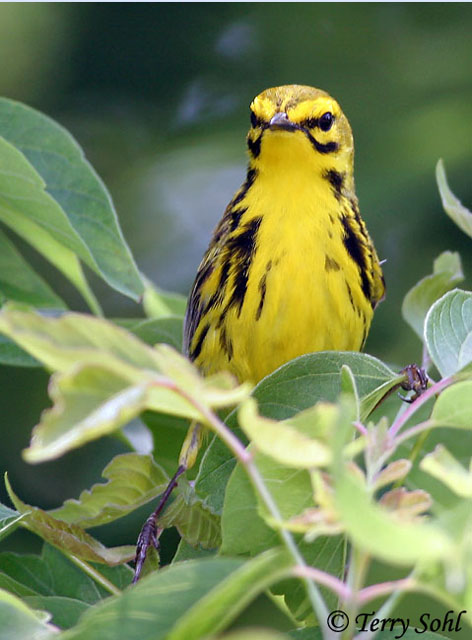
ID Keys: Plain olive upperparts, yellow on chest with dark streaks
on sides, 2 white wingbars.
The Prairie Warbler is poorly named, as they are primarily found
in shrubby dense thickets. Much of their preferred habitat is a result of
forest disturbance or the abandonment of farm fields. As these areas
eventually progress to a mature forest again, they are forced to find new areas
of disturbance to colonize.
Habitat
Prefers brushy habitat and thickets, such as second growth forest, forest edges, shrubby forest undergrowth, and brushy fields. Can also be found in mangrove swamps in Florida.
Diet
The Prairie Warbler feeds mainly on insects and spiders gathered from shrubs, vines, and low tree branches. Its diet includes caterpillars, beetles, ants, flies, and other small arthropods captured while actively moving through brushy vegetation and woodland edges. Will also occasionally take berries or sap from sapsucker wells.
Behavior
Forages by moving through the foliage, gleaning insects from leaves and branches. Will also glean insects from plants while hovering, or fly out to capture flying insects in mid-air.
Breeding
Non-breeder in South Dakota. In range, the Prairie Warbler usually nests in dense shrubs, young trees, or vine tangles in brushy fields, regenerating forests, and woodland edges. The female builds a small open cup nest of grasses, bark fibers, plant down, and spider silk, often well hidden in low vegetation. Typical clutches contain 3–5 eggs, and both parents help feed the nestlings after hatching.
Song
A thin rising zee-zee-zee-zee-zee-zee with the ending notes becoming louder and higher-pitched. Calls include sharp chips and thin tseep notes commonly heard while the bird moves through shrubby vegetation.
Migration
Summers throughout much of the eastern United States, except in the upper Midwest/Great Lakes region, and northern New England. Winters in Florida and the Caribbean, with some Florida birds being permanent residents.
The Prairie Warbler is generally considered a species of low conservation concern, although some populations have declined because of habitat loss and changes in land management. The species depends heavily on shrubby early-successional habitats, so fire suppression, forest maturation, and development can reduce suitable breeding areas. The IUCN lists the Prairie Warbler as a species of "Least Concern ".
Special Note
The photo on this page, and all the photos accessed through the image chips or links below, are of a very misplaced Prairie Warbler who was found by a group of birders at Newton Hills State Park in Lincoln County, Spring 2007. Despite the nearest normal breeding range being found in Missouri, this bird was singing furiously along Sergeant Creek in the Park. It had obviously established territory, singing repeatedly from a series of perches. It was postulated that the bird may be courting female Yellow Warblers. This male Prairie Warbler was found constantly chasing male Yellow Warblers in the area. In June, I found this male Prairie Warbler gathering caterpillars, with several in his mouth at once, as if feeding young.
Photo Information
June 5th, 2007 - Newton Hills State Park, South Dakota - Terry Sohl