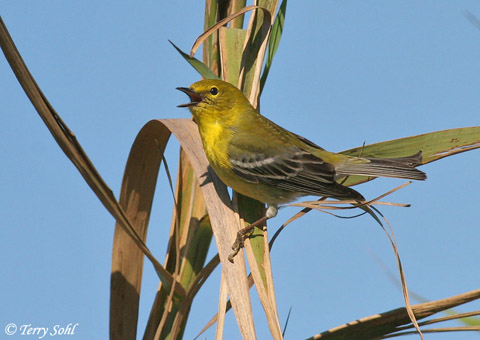
ID Keys: Plain olive upperparts, yellow on chest with dark streaks
on sides, 2 white wingbars.
The Pine Warbler is aptly named, as they strongly prefer pine
forests and woodlands during the summer breeding season. They are more
sluggish than many of the warblers, and can be found slowly foraging at almost
any level of the forest, from the ground to the treetops. Unlike most
warblers who tend to migrate between summer breeding grounds and wintering
grounds, Pine Warblers in much of the southeastern United States are permanent
residents.
Habitat
Is almost always found in pine forests during the summer breeding season, especially sandy pine barrens with a scrubby undergrowth. They can be found in a wider variety of wooded and brushy habitats during winter months.
Diet
Strongly prefers insects and spiders in all seasons, but when not available, will also feed on pine seeds, seeds of weeds and grasses, and berries.
Behavior
Unusual behavior for a warbler in many respects, including its willingness to feed on seeds and berries, and even attend feeders for suet and other offerings, and behaves rather sluggishly compared to most warblers.
Breeding
Non-breeder in South Dakota. In range, the Pine Warbler nests high in pine trees, usually on horizontal branches concealed among needles and cones. The female builds a small cup nest of grasses, bark strips, pine needles, and plant fibers lined with softer material such as feathers or hair. Typical clutches contain 3–5 eggs, and the species often breeds earlier in spring than many other warblers.
Song
he Pine Warbler nests high in pine trees, usually on horizontal branches concealed among needles and cones. The female builds a small cup nest of grasses, bark strips, pine needles, and plant fibers lined with softer material such as feathers or hair. Typical clutches contain 3–5 eggs, and the species often breeds earlier in spring than many other warblers.
Migration
Summers in much of the eastern United States where pine forests are present, and extreme Southeastern Canada. Winters in much of the southeastern United States. Note many birds in the southeastern U.S. permanent residents, as are those in the Caribbean.
Fall plumaged birds similar to fall plumaged Bay-breasted Warblers and Blackpoll Warblers . The Pine Warbler is less streaked and more uniformly olive-yellow than fall-plumaged Bay-breasted Warbler and Blackpoll Warbler. Pine Warblers have a thicker bill, plain face, and usually show little or no streaking on the underparts, while fall Bay-breasted and Blackpoll Warblers are more strongly streaked with contrasting wingbars and a sharper facial pattern. Blackpoll Warblers also tend to show bright orange-yellow legs, a useful field mark lacking in Pine and Bay-breasted Warblers. Also possibly confused with Yellow-throated Vireo .
Bird Feeder
Will attend feeders for suet and other similar offerings.
Conservation Status
The Pine Warbler is generally considered a species of low conservation concern, with populations stable or increasing in many areas of its range. Because it is closely associated with pine forests, large-scale logging, habitat fragmentation, and changes in forest management practices can affect local populations. The IUCN considers the Pine Warbler to be a species of "Least Concern".
Photo Information
February 13th, 2008 - Bon Secour National Wildlife Refuge, Alabama - Terry Sohl