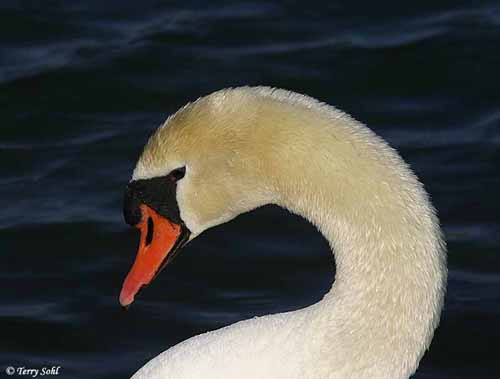
ID Keys: All white plumage, black lores and black knob, orange bill.
The Mute Swan is a large, elegant swan native to Europe and Asia that has become established in parts of North America through introductions and escapes from captivity. It is easily recognized by its all-white plumage, orange bill with a prominent black knob, and graceful curved neck. Mute Swans inhabit lakes, ponds, marshes, rivers, and coastal estuaries where they feed primarily on submerged aquatic vegetation. They are highly territorial during the breeding season and may aggressively defend nesting areas against other birds, mammals, and even people. In some regions of North America, the species is considered invasive because it can damage aquatic plant communities and compete with native waterfowl. In South Dakota sightings are generally considered to be escapees or tame birds.
Habitat
Wide variety of aquatic
habitats, including ponds, lakes, marshes, sloughs, and parks. Even wild
populations are often found in close association with human settlements, but
some are established in remote locations.
Diet
The Mute Swan feeds primarily on submerged aquatic vegetation such as pondweeds, algae, and other aquatic plants gathered by reaching below the water's surface. It also consumes small amounts of aquatic invertebrates, seeds, and agricultural grains, especially when plant foods are limited.
Behavior
Feeds in the water by swimming on the
surface, dabbling for food items on the surface, or reaching its head under
water. Will also forage on land.
Breeding
Non-breeder in South Dakota. The Mute Swan builds a massive nest of reeds, cattails, grasses, and other aquatic vegetation on islands, marshes, shorelines, or floating mats of vegetation near water. The nest may be used and enlarged over multiple years, eventually becoming several feet across. Typical clutches contain 4–8 eggs, and both adults defend the nesting territory aggressively while the female performs most of the incubation.
Song
As the name implies, the Mute Swan is quieter than most swans but is not truly mute. It gives hisses, grunts, snorts, and low hoarse calls, especially during courtship or when defending territory, and its wings produce a distinctive loud throbbing or whistling sound in flight that can be heard from a considerable distance.
Migration
Status unknown in the state, but northern populations
generally do move south in the fall.
Trumpeter
Swan, Tundra Swan. The Mute Swan is easily distinguished from the Trumpeter Swan and Tundra Swan by its bright orange bill with a prominent black knob at the base and its characteristic S-shaped curved neck. Trumpeter and Tundra Swans both have black bills and typically hold their necks straighter. Tundra Swans often show a small yellow spot near the eye on the bill, while Trumpeter Swans are larger and heavier-bodied with an entirely black bill and deeper resonant calls.
Status
The Mute Swan is globally secure and considered a species of low conservation concern within its native range. In North America, however, it is often managed as a non-native invasive species because established populations can damage aquatic vegetation, displace native waterfowl, and alter wetland ecosystems. As a result, some states and provinces actively control or reduce local populations rather than promote their conservation. The IUCN considers the Mute Swan to be a species of "least concern".
Photo Information
May 9th, 2004 -- Arrowhead Park
east of Sioux Falls -- Terry Sohl