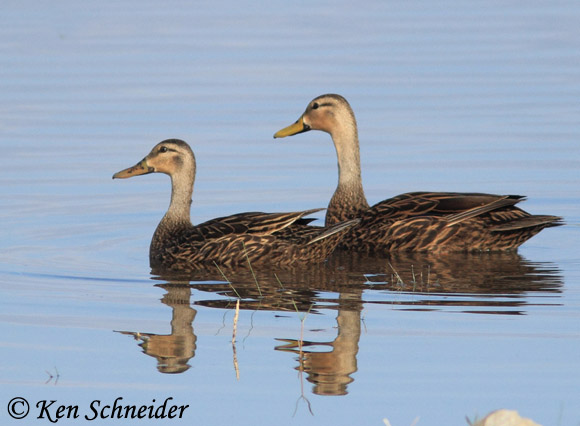
ID Keys: Brownish overall with dark mottled body, lighter head and
neck, yellow bill. Very similar to female Mallard, American
Black Duck.
The
Mottled Duck is a bird of the Gulf Coast in the U.S., found from Florida to
Texas. While they have close relatives in the
Mallard and the American Black
Duck, the Mottled Duck is the only "typical" dabbling duck that summers
and breeds in the far South. Historically, populations were
geographically distinct from the closely related Mallard. However,
with domestication of the Mallard, large numbers of Mallard now also
oversummer in the South, leading to breeding between Mottled Duck and
Mallard populations. Genetically distinct Mottled Ducks are thus
become less common, especially in Florida where Mallard populations are high
in the summer.
Habitat
Found in open marshy habitats, typically
ponds, lakes, or marshes with extensive surrounding vegetation.
Prefers wet habitats without trees.
Diet
Omnivorous, feeding on a variety of plant
and animal matter, including seed and roots of aquatic plants, aquatic and
terrestrial insects and their larvae, small mollusks and crustaceans, and
occasionally small fish.
Behavior
Forages as do other dabbling ducks,
swimming in shallow water and dabbling just below the water's surface with
their bill.
Nesting
The nest of a Mottled Duck is a bowl of
wetland vegetation and grasses, typically built in wetland vegetation or
grassland surrounding a water body. The female alone incubates the
eggs and tends to the young after hatching, but the young find their own
food.
Song
Quacking typical of the genus
Migration
Considered a permanent resident
throughout its range. However, there are some short local movements in
response to habitat conditions, and some birds on the western Gulf Coast may
move southward into Mexico for the winter.