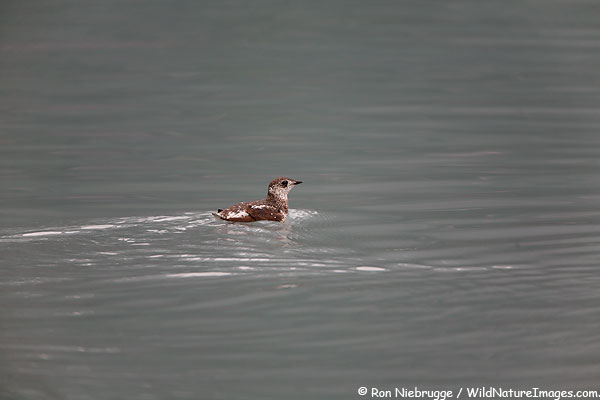
ID Keys: Warm brownish speckling on breeding birds, dark upperparts
and white underparts on non-breeding birds, dark wings at all
seasons
The
Kittlitz's Murrelet is a small seabird found around coastal Alaska at all
seasons. They are similar to the
Marbled Murrelet and are found in many of the same areas, but they are
much less widespread and common. Populations are thought to be in
sharp decline, and
the IUCN lists the species as "critically endangered". Reasons for
the decline aren't perfectly understood, but glacial recession due to
climate change is a strong contender as a threat to the species, given that
they often nest and forage in the vicinity of glaciers. Contamination
with hydrocarbons, loss of forage species, and mortality due to gill-net
fishing are also possible reasons for decline of the species.
Habitat
During the summer breeding season, found
on both islands and mainland Alaska, using steep rocky slopes such as rock
slides and talus slopes for nesting. Outside of the nesting season,
found in cold waters, usually shallow waters close to shore.
Diet
Primarily feeds on small crustaceans, likely
also will feed on small fish.
Behavior
Forages by diving and swimming
underwater, using its feet to propel it as it chases prey.
Nesting
The Kittliz's Murrelet is a rather
mysterious species and there has been little observation of breeding
behaviors. They nest on steep rocky slopes, with the nest site usually
in a protected area such as at the base of a rock. The female lays a single
egg directly on the ground. Details of incubation and parental care
are poorly known.
Song
Has a weak low-pitched groaning.
Migration
Considered a permanent resident in most
of their range. However, birds in the northern part of the breeding
range off of western Alaska move southward short distances for winter, as
the Bering Sea freezes.