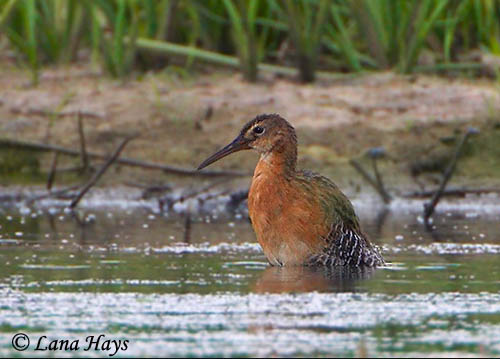
The King Rail is the largest of the North American Rails. They are less shy than many of the rails, and can sometimes be seen boldly foraging in open shallow waters. They are very closely related to the Clapper Rail. While the King Rail is a primarily a bird of fresh water and the Clapper Rail is primarily a bird of salt water, they do often interbreed where the intermix on brackish near-coastal waters.
Habitat
The King Rail inhabits freshwater and brackish marshes, wetlands, and shallow-water areas with dense emergent vegetation, especially cattails, sedges, bulrushes, and grasses. It favors wetlands with a mixture of shallow open water, muddy edges, and thick vegetation for concealment and foraging. During migration and winter, it may also use coastal marshes, flooded fields, rice fields, and other wetland habitats.Diet
The King Rail feeds primarily on crayfish, crabs, aquatic insects, small fish, frogs, snails, and other aquatic invertebrates, with crayfish particularly important in many freshwater habitats. Seeds and other plant material are occasionally eaten but make up a relatively small portion of the diet.Behavior
King Rails are secretive, primarily ground-dwelling birds that spend most of their time walking through dense marsh vegetation or along shallow-water edges. They typically forage by probing mud and vegetation or picking prey from the water, and although capable of strong flight, they usually escape danger by running or slipping into thick cover. During the breeding season, they become territorial and are often detected by their loud calls rather than by sight.Breeding
King Rails build their nests in dense marsh vegetation, usually among cattails, sedges, rushes, or grasses over shallow water or on moist ground. The nest is a shallow cup or platform made of dead grasses and other marsh vegetation, often concealed by surrounding plants and sometimes covered by a canopy of bent vegetation. The female typically lays about 8–12 eggs, and both parents participate in incubation and care of the precocial young.Song
King Rails are highly vocal but often difficult to see, making their calls one of the best ways to detect them in dense marshes. Their most characteristic call is a loud, accelerating series of harsh, clacking kek-kek-kek notes. They also produce grunts, squeals, and softer clicking calls, particularly during courtship and communication between adults and young.Migration
Summers throughout much of the eastern half of the United States. Birds in the northern part of its range move southward to the southeastern U.S. in winter, while those at the southern part of its range are permanent residents.Interactive eBird map
Click here to access an interactive eBird map of King Rail sightingsSimilar Species
- Clapper Rail - Extremely similar in size and shape to King Rail but generally grayer and less richly colored, with less prominent rusty-orange on the breast and flanks. Habitat and range are especially useful: Clapper Rail is strongly associated with coastal salt marshes, whereas King Rail favors freshwater and brackish wetlands.
- Virginia Rail - Much smaller and more compact than King Rail, with a thinner profile, reddish-orange bill, gray cheeks, and strongly barred black-and-white flanks. Its small size and proportionately long, slender bill are useful field marks.
