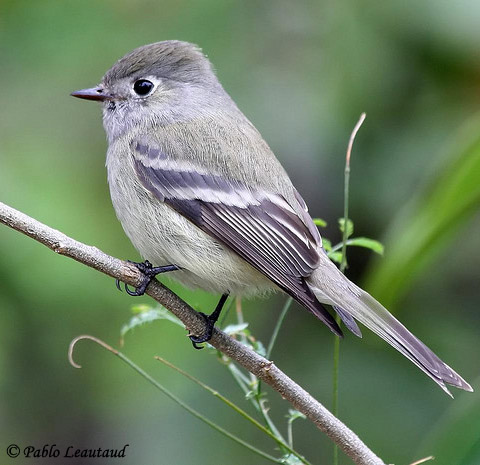
The Hammond's Flycatcher is one of the very similar Empidonax flycatchers, and can be quite difficult to tell apart from it's close relatives, especially the Dusky Flycatcher. The Hammond's even has the same general geographic distribution as the Dusky Flycatcher, but while that species is typically found in low brush and chaparral, the Hammond's Flycatcher is typically found high in conifer stands, typically at higher elevations.
Habitat
Typically found at higher elevation conifer forests, often where conifers mix with deciduous trees such as aspens. Uses mountain woods on its wintering grounds, but typically deciduous forests.
Diet
The Hammond's Flycatcher feeds almost entirely on insects and other small arthropods, including flies, beetles, moths, bees, wasps, ants, and spiders. It typically hunts by sallying from an exposed perch to capture flying insects in midair and also gleans prey from foliage and branches. Small berries and other fruits are occasionally eaten during migration and on the wintering grounds.
Behavior
Forages in typical flycatcher fashion, observing from a perch, and then flying out to snag insects when spotted, returning to its perch to consume them. They will capture flying insects in mid-air, or will glean insects from branches or the foliage.
Nesting
The Hammond's Flycatcher builds a small, neat cup nest of grasses, moss, bark strips, rootlets, and spider silk, usually placed on a horizontal branch of a conifer tree. The female typically lays 3–4 creamy white eggs, often marked with fine reddish-brown spots, and performs most of the incubation. Both parents help feed the nestlings until they fledge.
Song
The Hammond's Flycatcher gives a distinctive, dry song often rendered as see-bik, with the second note typically emphasized. Males sing repeatedly from exposed perches during the breeding season to defend territories and attract mates. The species also produces sharp whit calls that are important for identification among the otherwise similar Empidonax flycatchers.
Migration
The Hammond's Flycatcher is a migratory species that breeds in coniferous forests of western North America and winters primarily in Mexico and Central America. Migration occurs mainly at night, with birds traveling between breeding and wintering grounds each spring and fall. During migration, it may be found in a variety of wooded habitats, including forest edges, riparian corridors, and parks.
Interactive eBird Map
Click here to access an interactive eBird map of Hammond's Flycatcher sightings
Similar Species
Dusky Flycatcher , Gray Flycatcher.
Compared with Dusky Flycatcher: The Hammond's Flycatcher has a shorter bill, longer primary projection, and a larger-headed appearance than the Dusky Flycatcher. Dusky Flycatchers also have a longer tail, a more obvious buff wash on the breast, and typically inhabit brushier mountain habitats.
Compared with Gray Flycatcher: The Hammond's Flycatcher has a shorter tail, shorter bill, stronger eye ring, and longer primary projection than the Gray Flycatcher. Gray Flycatchers frequently dip their tails downward while perched, a characteristic behavior that Hammond's Flycatchers rarely show, and they are more often found in pinyon-juniper woodlands and open dry forests.
Conservation Status
The Hammond's Flycatcher is classified as Least Concern by the International Union for Conservation of Nature because of its large range and stable overall population. Although localized habitat changes and forest management practices may affect some breeding populations, the species remains widespread across western North America and is not currently considered globally threatened.
Further Information
- eBird - Hammond's Flycatcher
- Audubon Field Guide - Hammond's Flycatcher
- Cornell Lab of Ornithology - All About Birds: Hammond's Flycatcher
Photo Information
January 7th, 2009 - Colomos, Guadalajar, JA, Mexico - Pablo Leautaud - Photo licensed under Creative Commons Attribution-NonCommercial 2.0 Generic license .
