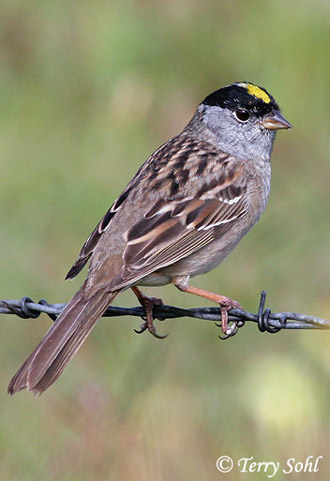
The Golden-crowned Sparrow is a bird of the extreme western portion of North America, breeding in western Canada and Alaska and wintering near the U.S. West Coast. The "Birds of South Dakota" (SDOU -- 2002) only lists two identified occurrences of the species in South Dakota, as the we are quite far from its normal range. A handful of records have occurred since that publication.
Habitat
Breeds in shrubby habitats ranging from willow thickets, stunted spruce along the treeline, and high-elevation shrublands in the mountains of western Canada and Alaska. Also prefers brushy habitat in winter and in migration.
Diet
Primarily seeds and insects, but will also feed on berries and fruits, new buds and shoots, and flowers.
Behavior
The Golden-crowned Sparrow is a generally quiet, ground-feeding sparrow that spends much of its time scratching through leaf litter and low vegetation for seeds, berries, and insects. It often occurs in loose flocks during migration and winter, frequently associating with other sparrow species in brushy thickets, woodland edges, and backyard feeding areas.
Breeding
The Golden-crowned Sparrow nests primarily in shrubby habitats of Alaska and western Canada, especially near dense willow, alder, or conifer thickets. The female builds a well-hidden cup nest on or near the ground using grasses, mosses, bark, and twigs, and typical clutches contain 3–5 eggs.
Song
The Golden-crowned Sparrow is known for its clear, plaintive whistled song often described as “oh-dear-me”, a melancholy series of descending notes. Calls include soft chips and thin tseep notes commonly given while foraging or maintaining contact within flocks.
Migration
Summers in Alaska and near the Pacific Coast in Canada. Winters along most of the U.S. and Canada Pacific Coast.
Interactive eBird Map
Click here to access an interactive eBird map of Golden-crowned Sparrow sightings
Similar Species
White-crowned Sparrow, House Sparrow. The Golden-crowned Sparrow differs from the White-crowned Sparrow by its yellow central crown bordered by dark stripes rather than the White-crowned Sparrow’s bold black-and-white head pattern. Compared to the House Sparrow, Golden-crowned Sparrows are larger, bulkier, and more plainly patterned overall, lacking the House Sparrow’s gray crown, chestnut tones, and heavy black bib. Golden-crowned Sparrows also tend to forage quietly on the ground in brushy habitats, while House Sparrows are strongly associated with buildings and human activity.
Bird Feeders
Will attend feeders for a variety of different seeds.
Conservation Status
The Golden-crowned Sparrow remains relatively common across much of its western North American range and is currently considered a species of low conservation concern. However, localized threats such as habitat alteration, climate change impacts on northern breeding habitats, and collisions with human structures may affect some populations over time. The IUCN considers the Golden-crowned Sparrow to be a species of "Least Concern".
Further Information
- eBird - Golden-crowned Sparrow
- Audubon Field Guide - Golden-crowned Sparrow
- Cornell Lab of Ornithology - All About Birds: Golden-crowned Sparrow
Photo Information
April 19th,2007 - Point Reyes National Seashore in California - Terry Sohl.
