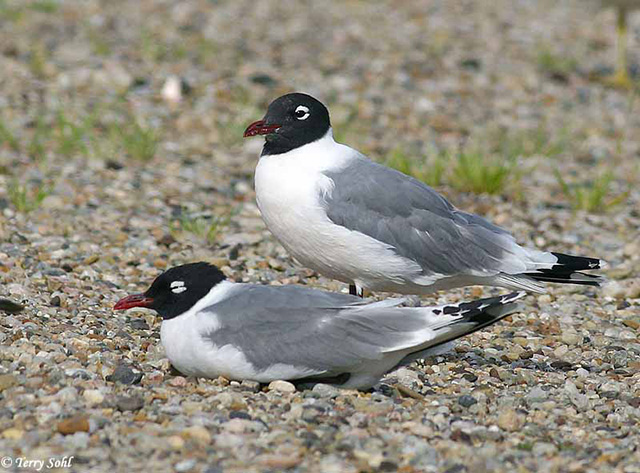
Franklin's Gulls are a long-distance migrant, summering on the northern Great Plains and central Canada, and wintering primarily in the Southern Hemisphere along the western South America coast. In breeding plumage they are a striking bird, with a black hood, white body, and gray wings, with bold white eye arcs and very dark, ruddy red legs and bill. They are breeding birds in South Dakota, although nesting locations may vary from year to year given the often ephemeral or changing conditions of South Dakota's Prairie Pothole wetlands. Commonly seen in migration as well, they can sometimes be seen following plows in farm fields to pick off insects that have been stirred up. Compare to the very similar Bonaparte's Gull which migrates through the state, and also the Laughing Gull (rarely seen in South Dakota).
Habitat
Nests around marshes, sloughs, and wetland vegetation around lake margins. Prefers large continuous areas of such habitat. Also seen feeding around farm fields, pastures and prairies, and flooded fields. On its wintering grounds, they are found near the coast on sandy beaches, estuaries, and shallow bays.
Diet
The Franklin's Gull feeds on a wide variety of foods, including insects, earthworms, small fish, crustaceans, and other aquatic invertebrates. During summer, flying insects such as grasshoppers, beetles, and dragonflies often make up a large portion of its diet, especially in prairie regions.
Behavior
Feeds in a variety of ways, from catching insects in flight, walking on the ground and picking up food items, swimming, or wading in shallow water. The Franklin's Gull is a highly social bird that breeds in large colonies within marshes and wetlands. It is an agile flier, often seen coursing over fields and water while catching insects in midair or following farm equipment to feed on exposed prey. Outside the breeding season, Franklin's Gulls gather in large flocks during migration and on wintering grounds, where they roost and forage communally.
Nesting
May and June. Franklin's Gulls nest in colonies, often quite large (hundreds of pairs or more), and sometimes in association with other wetland species. Given their preference for nesting in areas with extensive cattail and other wetland vegetation, colony locations may change from year to year as ephemeral wetland conditions change over time. The nest itself is a floating platform of reeds and other vegetation, typically lined with finer grasses, hair, or down. While free-floating, the nest is anchored to adjacent vegetation such as cattails. Both parents help to build the nest, and both parents incubate the eggs, with the female typically laying 3. Incubation lasts about 24 days. The young fledge from the nest about 3 weeks after hatching, but typically stay in the vicinity of the nest and under protection of the parents for another week or two before taking flight.
Song
A harsh cuk-cuk-cuk, with occasional interjected screaming keeah-ah keeah-ah.
- Click here to hear the flight call of a Franklin's Gull, recorded in Burke County, North Dakota1
- Click here to hear various calls from a flock of Franklin's Gulls, recorded in Burke County, North Dakota2
Migration
The Franklin's Gull is a long-distance migrant that breeds in the prairie wetlands of central North America and winters primarily along the Pacific coast of South America. During migration, large flocks travel through the Great Plains, often stopping at lakes, reservoirs, wetlands, and agricultural fields. The species undertakes one of the longest migrations of any North American gull, traveling thousands of miles between its breeding and wintering grounds.
Interactive eBird Map
Click here to access an interactive eBird map of Franklin's Gull sightings
Similar Species
There are other "black-hooded" gulls that the Franklin's Gull could potentially be confused with. Click here for identification tips for gulls in general, including Franklin's Gull. Here are the two species most likely to be confused with Franklin's Gull:
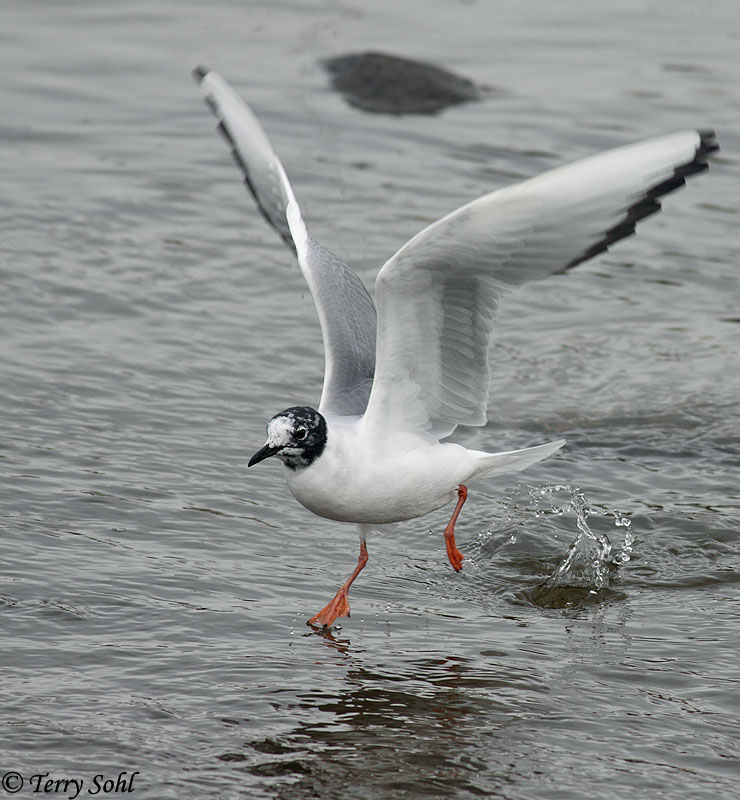
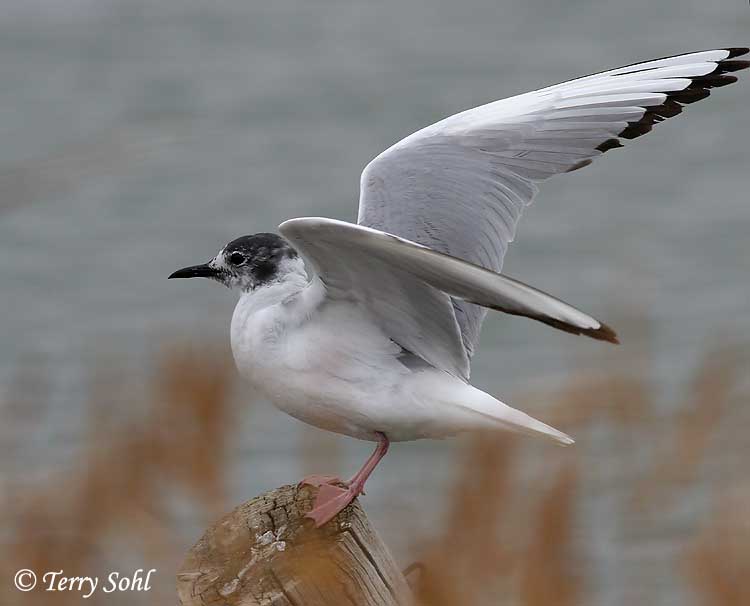
- Bonaparte's Gull - In South Dakota, the species most likely to be confused with a Franklin's Gull is the Bonaparte's Gull. These are the two common, "black-hooded" gulls that can be found in the state. In breeding plumage, both share similar body plumage and a dark hood, but the Bonaparte's Gull lacks the bold white eye arcs found on a breeding plumaged Franklin's Gull. Bonaparte's Gulls are also smaller overall, with a thinner, dark bill, while the bill of a breeding plumaged Franklin's Gull is typically a deep ruddy red. The legs of a Bonaparte's are orange, while those of a breeding plumaged Franklin's Gull are dark with reddish tones. In flight, the two can be distinguished by the upper wing pattern, with Bonaparte's Gulls having an obvious white triangle on the leading edge on the outside half of the upper wing, while Franklin's Gulls have a gray wing with black on the wingtips, ending in a white spot. For non-breeding birds, Bonaparte's Gulls have a distinctive dark "ear" spot with the rest of the head primarily white, while non-breeding Franklin's Gulls have more extensive black that remains from the black breeding "hood".
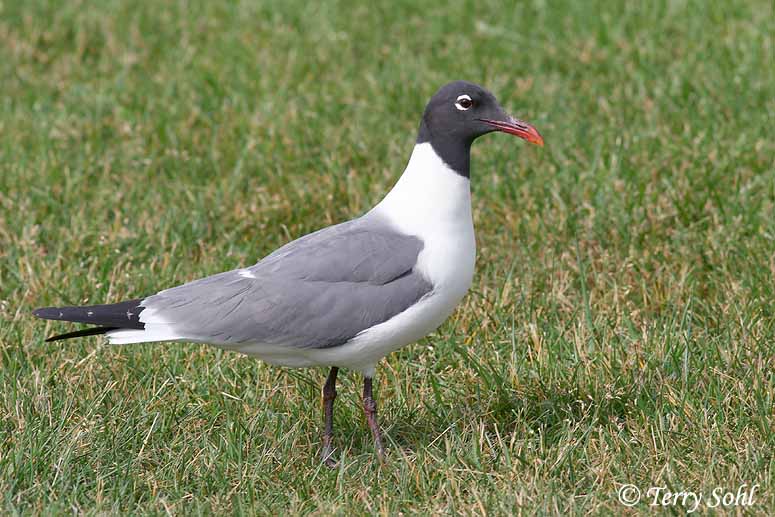
- Laughing Gull - Laughing Gulls are extremely rare visitors to South Dakota, as they are normally found along the eastern and Gulf coasts of the US. Where both are found, breeding plumaged birds are both very similar in appearance. Wingtips are the best identification feature, as Franklin's Gulls have black wingtips with white spots, while the wingtips on a Laughing Gull are almost entirely black. The bill of a Laughing Gull is also larger and more "jointed" looking than on a Franklin's Gull. They are perhaps more easily differentiated in flight, as breeding plumaged Laughing Gulls have rather extensive black on the primary flight feathers that's visible in flight, while Franklin's Gulls have mostly gray underwings, with black wingtips with white spots. For non-breeding birds, the head of a Laughing Gull is more consistently white, while the non-breeding Franklin's Gull still has quite a lot of smudgy black coloring.
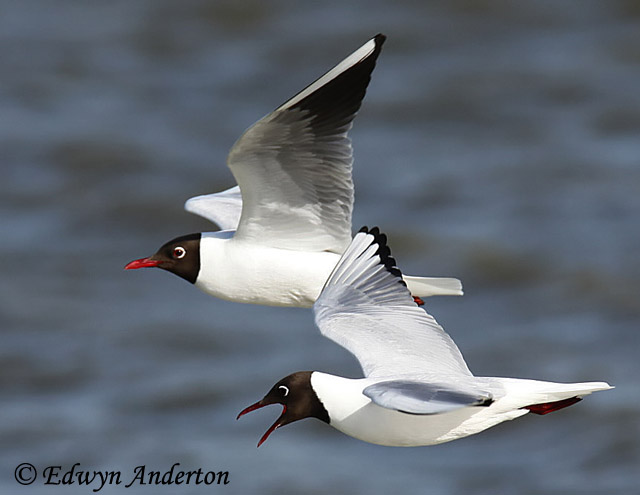
- Black-headed Gull - Black-headed Gulls are extremely rare visitors to South Dakota as well. In good light, breeding plumaged Black-headed Gulls (ironically) have more of a dark bronwish tone to the head, whiel it's more of a pure black on a breeding plumaged Franklin's Gull. A identification key for both breeding and non-breeding plumaged birds are the dark primary feathers of a Black-headed Gull in flight, contrasting with a white leading edge on the wing. Franklin's Gulls have black just on the wing tip, with white spots.
 |
 |
 |
 |
| Bonaparte's Gull | Bonaparte's Gull | Laughing Gull | Black-headed Gull |
Conservation Status
Uncertain status in many areas, but overall, populations are strong, they are common in many parts of their range, and numbers overall are increasing. Habitat loss remains a local concern, but the overall population is not in danger, and the IUCN considers Franklin's Gull to be a species of "Least Concern".
Photo Information
July 18th, 2004 -- Below Oahe Dam -- Terry Sohl
Audio File Credits
- 1Paul Marvin, XC282852. Accessible at www.xeno-canto.org/282852
- 2Andrew Spencer, XC104588. Accessible at www.xeno-canto.org/104588
