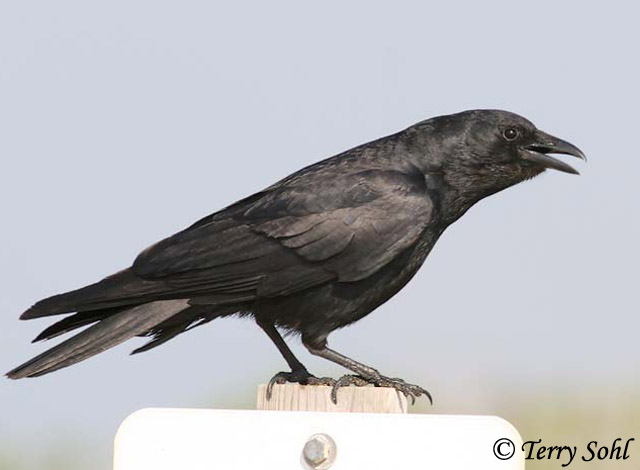
ID Keys: Black plumage. Compared to American Crow , smaller, with longer tail and wings, and shorter
legs.
The
Fish Crow is very similar to the more widespread
American Crow. However, while the
American Crow is found throughout much of North America, the Fish Crow's
range is restricted to the southeastern United States, where they are most
often found along the coast or near large river systems. They can be
extremely difficult to differentiate from the American Crow, although they
are slightly smaller, and have other minor structural differences. The
safest way to tell the two species apart is by voice.
Habitat
The Fish Crow inhabits coastal marshes, estuaries, beaches, river corridors, wetlands, and lakeshores, but it is also common in urban and suburban areas. It is often associated with water and is frequently found near shorelines, docks, landfills, agricultural fields, and residential neighborhoods. The species has expanded inland in recent decades and now occurs in a variety of wooded and developed habitats across much of the eastern United States.
Diet
Omnivorous. Diet depends upon location and seasonality, but may include insects, crustaceans, mollusks, bird eggs, reptile eggs, small vertebrates, carrion, refuse, fruits, nuts, and berries.
Behavior
The Fish Crow is an intelligent and highly adaptable bird that often forages in pairs or small groups. It feeds opportunistically on a wide variety of foods, scavenging along shorelines, searching for prey in wetlands, and taking advantage of human food sources. Like other crows, it is curious, social, and frequently engages in cooperative behaviors such as mobbing predators and communal roosting.
Nesting
The nest of a Fish Crow is a large platform of sticks and pieces of bark, lined with softer materials that may include grasses, weed stems, rootlets, feathers, pine needles, or even refuse. The female lays 4 or 5 eggs, and she likely does most of the incubation. When the eggs hatch, both parents help feed the young and tend to them.
Song
The Fish Crow is most easily identified by its distinctive nasal call, often described as a short, hoarse cah-cah. Unlike the deeper, clearer caw of the American Crow, its voice sounds more clipped and nasal. Fish Crows also produce a variety of rattles, croaks, and other calls used in social interactions and communication within flocks.
Migration
The Fish Crow is generally a short-distance migrant or year-round resident, depending on location. Northern populations may move southward a short distance during winter, while birds in the southern United States remain on their territories throughout the year. Seasonal movements are usually limited, and many individuals return to the same breeding and wintering areas annually.
Very similar to American Crow . They are slightly smaller than the American Crow, with longer wings, a longer tail, and shorter legs. However, they are usually only safely told apart from the American Crow by voice.
Conservation Status
The Fish Crow is classified as Least Concern by the International Union for Conservation of Nature because of its large range, increasing population, and adaptability to a variety of habitats. The species has expanded its distribution in recent decades and remains common throughout much of the eastern United States. No major population declines have been documented at a scale that would currently threaten the species.
Photo Information
Photo taken on June 23rd, 2005 - Assateague Island in Virginia - Terry Sohl