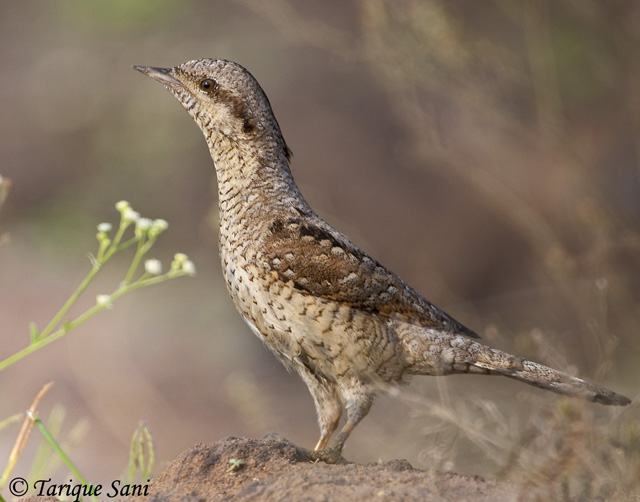
ID Keys: Tannish-gray overall with buffy and brown barring, dark eye
stripe, darker wings. Very well camouflaged.
The
Eurasian Wryneck is a very unusual member of the Woodpecker family, with a
normal range that spans across much of Europe and Asia. In North
America, they are known from a handful of sightings in extreme western
Alaska. Curiously,
in February of 2000, a dead Eurasian Wryneck was found in Indiana.
The source of the Indiana bird is in question, but it is possible it was a
natural lost migrant, given the species strong migratorial tendencies.
The term "Wryneck" refers to their capability to turn their heads 180
degrees, a capability they take advantage of when disturbed, as they will
turn their heads and hiss at threats.
Habitat
Found in open forests, woodland clearings, and brushy areas.
Diet
Feeds heavily on insects, with a very strong preference for feeding on ants.
Behavior
Spends most of its time on the ground, foraging for ants and other insects. They only rarely will forage in trees.
Nesting
Nests in cavities, using existing cavities built by other species rather than excavating its own.
Migration
Breeds across a very large swath of Europe and northern Asia. Highly migratory, with birds wintering in central Africa and southern Asia.
Interactive eBird Map
Click here to access an interactive eBird map of Eurasian Wryneck sightings
Similar Species
Definitely unique compared to any other woodpecker species that has been seen in North America.
Conservation Status
Populations may be in decline globally, but they are still found over a wide geographic range and are relatively common in some areas. The IUCN lists the Eurasian Wryneck as a species of "Least Concern".
Photo Information
Photo taken by Tarique Sani - December 16th, 2009 - Nimji, Maharashtra, India - Photo licensed under Creative Commons Attribution NonCommerical ShareAlike 2.0 Generic License.