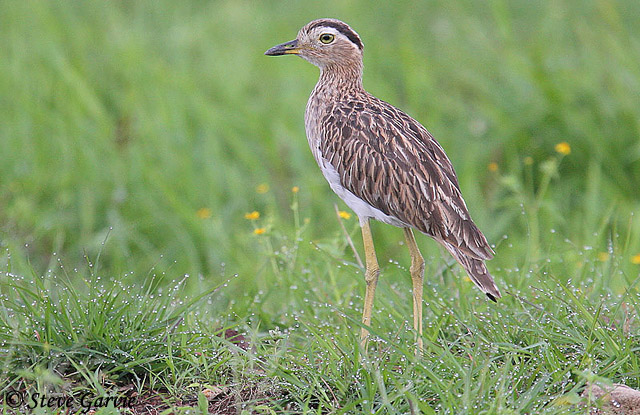
ID Keys: Thick yellow and black bill, large yellow eye, white
supercillium with dark stripe above it, brown plumage above, white
below, long yellow legs.
The
Double-striped Thick-knee is a "shorebird" of southern Mexico, Central
America, and South America. In the United States, they are only
extremely rare vagrants, with a sighting on "King's Ranch" in southern Texas
in 1951. They are a species of open grasslands and savannahs, where
they forage for insects and sometimes small vertebrates.
Double-striped Thick-knees feed using a "stop-and-go" technique, running
quickly along the ground and stopping periodically to pick up prey. A
strongly terrestrial species, they also prefer to run when disturbed or when
danger approaches, rather than fly.
Habitat
The Double-striped Thick-knee inhabits open grasslands, savannas, cattle pastures, dry fields, scrublands, riverbanks, and lightly wooded areas. It favors open ground with short vegetation where its cryptic plumage provides excellent camouflage and is often found near wetlands, ponds, rivers, or seasonal water sources. The species ranges from Mexico through Central America into northern South America and is frequently associated with agricultural landscapes and grazing areas.
Diet
The Double-striped Thick-knee feeds primarily on insects and other small invertebrates, including beetles, grasshoppers, crickets, ants, spiders, and worms. It also takes small reptiles, frogs, and other tiny vertebrates when available. Most foraging occurs at dusk and during the night, when the bird walks slowly across open ground searching for prey.
Behavior
Mostly nocturnal. During the day, Double-striped Thick-knees typically crouch low in vegetation and rest. At night, they forage by quickly running short distances, stopping periodically to pick up prey.
Nesting
The nest of a Double-striped Thick-knee is a shallow depression in the ground. The female lays 2 eggs, and both parents help to incubate them. When the eggs hatch, the young quickly leave the nest. They are tended to by the parents, but are precocial and will find their own food.
Song
The Double-striped Thick-knee is best known for its loud, haunting calls, often heard at dusk and during the night. Its vocalizations include piercing whistles, wailing cries, and repeated kee-kee-ow notes that carry long distances across open grasslands and pastures. These calls are frequently given by pairs and are often the first indication that the species is present.
Migration
The Double-striped Thick-knee is generally nonmigratory and remains year-round throughout most of its range from Mexico through Central America and into northern South America. Most populations are resident, making only local movements in response to rainfall, water levels, food availability, or seasonal habitat conditions. Unlike many shorebirds, it does not undertake regular long-distance migrations..
Generally distinctive compared to other shorebird species found in North America.
Conservation Status
The Double-striped Thick-knee is generally considered a species of low conservation concern and remains widespread across much of Mexico, Central America, and northern South America. It adapts well to open habitats such as cattle pastures, agricultural fields, savannas, and grasslands, which has helped maintain stable populations in many areas. Although local declines may occur because of habitat alteration, disturbance, or nest predation, the species is currently regarded as secure throughout most of its range. The IUCN lists the Double-striped Thick-knee as a species of "Least Concern".
Photo Information
Photo taken by Steve Garvie - July 13th, 2008 in Costa Rica - Photo licensed under Creative Commons Attribution NonCommercial ShareAlike 2.0 Generic License.