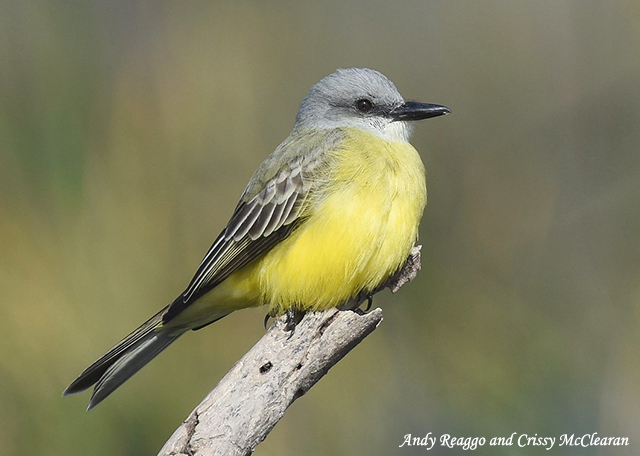
Couch's Kingbird is one multiple, similar Kingbird species of the southwest. They are virtually identical in appearance to the Tropical Kingbird, and until the 1980s, were considered a subspecies of the Tropical Kingbird. The two species are only safely told apart by voice. Range of the two species overlaps in Mexico, but in the United States, Tropical Kingbirds are mostly found in southern Arizona, while Couch's Kingbirds are found in southern Texas. In recent years, however, Tropical Kingbirds have also been found in southern Texas.
Habitat
The Couch's Kingbird inhabits riparian woodlands, river corridors, forest edges, tropical lowland forests, savannas, parks, agricultural areas, and suburban landscapes with scattered trees. In the United States, it is found primarily in southern Texas, where it favors wooded areas near water and mature trees that provide perches for hunting insects.
Diet
The Couch's Kingbird feeds primarily on insects captured in flight, including flies, beetles, wasps, bees, dragonflies, grasshoppers, and other flying insects. It typically hunts from an exposed perch, making short aerial sallies to seize prey before returning to the same perch. Fruits and berries may also be eaten, especially during migration, winter, or periods when insects are less abundant.
Behavior
The Couch's Kingbird typically hunts from exposed perches in trees, shrubs, utility wires, and forest edges, repeatedly flying out to capture insects before returning to a favored lookout. It is strongly territorial during the breeding season and aggressively chases other birds that approach its nesting area. Although often inconspicuous visually in dense riparian woodlands, it is frequently detected by its persistent vocalizations. Outside the breeding season, it may become less territorial and forage more widely in search of insects and fruit.
Nesting
The nest of Couch's Kingbird is a cup of sticks, weed stems, moss, leaves, and bark strips, placed on a tree branch. The female usually lays 3 or 4 eggs, and she alone incubates them. When the eggs hatch, both parents help feed the young. The young fledge after about 16 days.
Song
The Couch's Kingbird is best known for its loud, ringing call, often rendered as a sharp kip-brrrrr . The voice is one of the most reliable ways to identify the species because it is extremely similar in appearance to the Tropical Kingbird. Birds frequently call from exposed treetops and perches, especially during the breeding season.
Migration
The Couch's Kingbird is primarily a short-distance migrant or year-round resident, depending on location. Populations in southern Texas may remain throughout the year or make only limited seasonal movements, while birds breeding farther north in northeastern Mexico often move south after the breeding season. Overall, the species does not undertake the extensive long-distance migrations typical of many North American flycatchers and remains largely within Mexico, Texas, and Central America year-round.
Similar Species
Tropical Kingbird: Couch's Kingbird is extremely similar in appearance, but Tropical Kingbirds usually have a slightly longer bill, brighter yellow underparts, and a greener back. In practice, voice is the most reliable field mark, with Couch's giving a sharp ringing “kip-breeeer” call and Tropical producing very different rolling, chattering vocalizations.
Western Kingbird: Western Kingbirds show a crisp white throat and obvious white outer tail feathers, features lacking in Couch's Kingbird. Couch's appears greener above, more uniformly yellow below, and lacks the strong black-and-white tail pattern of Western Kingbird.
Cassin's Kingbird: Cassin's Kingbirds are grayer overall, with a gray chest that contrasts with a paler yellow belly, whereas Couch's Kingbirds show brighter yellow extending higher onto the underparts. Cassin's also has a heavier, more robust appearance and lacks the greener tones typical of Couch's Kingbird.
Conservation Status
The Couch's Kingbird is generally considered a species of low conservation concern, with populations remaining stable across much of its range in Mexico, Central America, and southern Texas. It adapts well to a variety of wooded habitats, including riparian corridors, agricultural areas, parks, and suburban landscapes. Although local habitat loss and degradation of riparian woodlands can affect some populations, the species remains widespread and secure overall. The IUCN considers the Couch's Kingbird to be a species of "least concern".Photo Information
Photo taken by Andy Reaggo and Crissy McClerran .
Interactive eBird Map
Click to access the interactive eBird species sightings page for Couch's Kingbird
