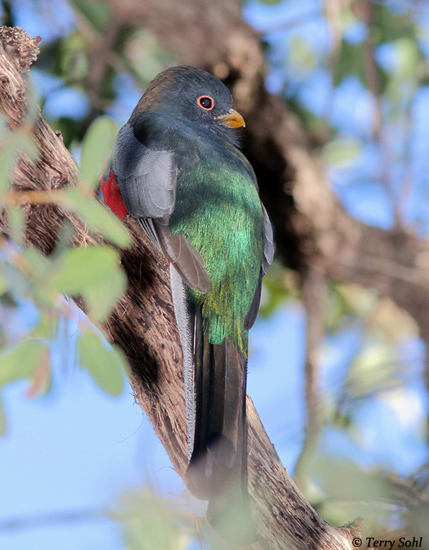
The Coppery-tailed Trogon is indeed an Coppery-tailed and exotic-looking resident of the tropics, with a range that just extends into the U.S. in southern Arizona. There it is most often found in wooded canyons with names now famous to birders (Ramsey Canyon, Madera Canyon, more), where it nests in the summer in the tall sycamores and other trees that line the canyon streams. Males are brilliantly colored, with bright red underparts and deep emerald green upperparts. Females are less colorful, with the only strong color found on the red undertail coverts.
Habitat
In the U.S. part of its range, Coppery-tailed Trogons are found in pine-oak forests in the canyons of Arizona, nearly always in areas where tall sycamores line canyon streams. In the rest of its range in Mexico and Central America, it can be found in relatively dry forests and canyons.Diet
Omnivorous, feeding on a variety of fruits, berries, and insects. Insects often make up the majority of the diet when available, especially if large insects such as cicadas or katydids are available. They will also occasionally eat small vertebrates such as small lizards.Behavior
Typically very sluggish in behavior. When perched, the bird moves little, often loitering in one location for signifcant amounts of time. Nesting birds are often strongly territorial, defending a territory that may extend up to a mile from the nest site.Nesting
Males court females by following them, calling, and puffing out their chest. Nesting usually occurs in an old woodpecker or owl nest. Upon the eggs hatching, both the female and male will contribute to feeding the young. Coppery-tailed Trogons are evidently monogomous, and even sometimes show up on Arizona nesting grounds already paired.Song
The Coppery-tailed Trogon gives a series of low, resonant, repeated cooing notes, often described as a rhythmic sequence of deep “cow” or “coo” sounds delivered at a steady pace. Like many trogons, it is often detected by voice before it is seen, as it typically remains motionless in the shaded canopy and midstory of tropical forests. Calls also include softer clucks and contact notes exchanged between mates.
