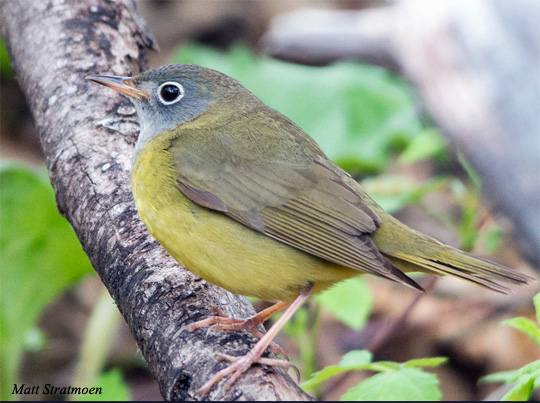
A shy warbler of dense thickets and undergrowth, the Connecticut warbler is generally quite difficult to observe. They also are among the last warblers to migrate in the spring, and the earliest to migrate in the fall, and thus often go unnoticed. Connecticut Warblers forage with a slow and deliberate walk along the ground, a characteristic that by itself can be used to differentiate it from the similar Mourning Warbler.
Habitat
The Connecticut Warbler breeds in dense boreal forests, spruce bogs, tamarack wetlands, and mixed coniferous woodlands of central Canada and the northern Great Lakes region. It favors habitats with thick understory vegetation, shrubs, and ground cover where it can forage and nest near the forest floor. During migration, it occurs in a variety of wooded habitats, shelterbelts, forest edges, and dense thickets, often remaining hidden in low vegetation.
Diet
The Connecticut Warbler feeds primarily on insects and other small invertebrates. Its diet includes caterpillars, beetles, flies, ants, spiders, and various insect larvae that it gathers while walking and hopping through dense ground vegetation and low shrubs. During migration and on the wintering grounds, it also consumes small berries and other fruits.
Behavior
Primarily forages ont he ground, walking around through leaf litter, flipping over leaves in search of insects and other prey. They will also forages low in trees and undergrowth, walking along branches, searching for insects.
Nesting
Non-breeder in South Dakota. In range, the Connecticut Warbler builds a well-hidden cup nest on or very near the ground in dense vegetation, often beneath shrubs, young conifers, grasses, or other thick cover. The nest is constructed from grasses, leaves, bark strips, moss, and other plant materials and is typically concealed within the understory of boreal forests, bogs, or wet woodland habitats. Typical clutches contain 4–5 eggs, and the female performs most or all of the incubation while both parents care for the young after hatching.
Song
The Connecticut Warbler sings a loud, ringing series of clear whistled notes often described as chipity, chipity, chipity, chipity, with a steady, rhythmic quality. Despite spending much of its time hidden in dense vegetation, males frequently sing from exposed perches during the breeding season. Calls include sharp chip notes and soft contact calls given while foraging or during migration.
Migration
The Connecticut Warbler is a long-distance migrant that breeds in the boreal forests and bogs of central Canada and the northern Great Lakes region. After breeding, it migrates south through central North America—passing through areas such as South Dakota during migration—to winter primarily in northern and central South America, especially the Amazon Basin. Unlike many warblers, it follows a relatively narrow migration route through the interior of the continent and is often found skulking in dense vegetation during migration stopovers.
Similar Species
Mourning Warbler. The Connecticut Warbler has a complete, bold white eye ring and noticeably longer legs, giving it an upright, thrush-like posture. Mourning Warblers lack a complete eye ring and typically appear more compact, with a plainer face and shorter-legged stance.
MacGillivray's Warbler. MacGillivray's Warblers show broken white eye arcs above and below the eye rather than the Connecticut Warbler's full white eye ring. They also tend to have a more contrasting facial pattern and are usually found in western breeding habitats, whereas Connecticut Warblers are birds of boreal forests and central migration routes.
Conservation Status
The Connecticut Warbler has experienced long-term population declines and is considered a species of conservation concern in parts of its range. Because it breeds in remote boreal forests and winters in South America, threats may include habitat loss and degradation on both the breeding and wintering grounds, as well as hazards encountered during migration. Although it remains widespread, it is naturally uncommon and often difficult to detect, making population trends challenging to monitor. Continued protection of boreal forest habitats and tropical wintering areas is important for the species' long-term conservation. The IUCN considers the Connecticut Warbler to be a species of "least concern".
Photo Information
Photo by Matt Stratmoen - Licensed under Creative Commons Attribution NonCommercial NoDerivs 2.0 Generic license.
Interactive eBird Map
Click to access the interactive eBird species sightings page for Connecticut Warbler
