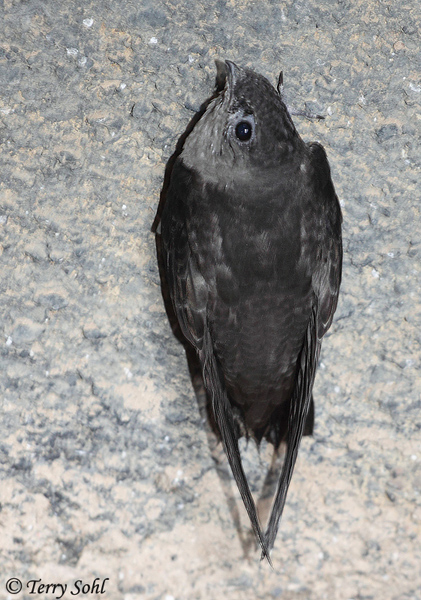
The Chimney Swift is another bird species which has both benefited, and suffered, due to a human presence. Chimney Swifts were once dependent upon tree cavities for nesting. However, introduced species, particularly the House Sparrow and European Starling, have greatly increased competition for natural nesting cavities such as those previously preferred by Chimney Swifts. However, Chimney Swifts have learned to use chimneys and other human construction for nesting, and are now much more common over urban areas than they are over forested areas. They use a sticky saliva to glue together twigs, which are pasted on a vertical surface in a half-saucer shape. Large chimneys may house hundreds of these birds, resulting in spectacular flocks forming overhead near sundown.
Habitat
Feeds in open skies above nearly any terrain. However, with the sharp reduction in mature forests in the East and thus in tree cavity availability, they are now most common over urban areas where they've learned to use buildings for nesting.
Diet
The Chimney Swift feeds almost entirely on flying insects and aerial spiders captured in flight. Its diet includes flies, mosquitoes, beetles, ants, termites, wasps, and other small airborne insects that it sweeps from the air while constantly flying.
Behavior
The Chimney Swift spends much of its life in the air, feeding, drinking, bathing, and even gathering nesting material while flying. It rarely perches on horizontal surfaces, instead clinging vertically to the inside walls of chimneys, hollow trees, caves, or similar structures using its sharp claws and stiff tail feathers for support. Chimney Swifts are highly social, often foraging in groups and gathering in large communal roosts during migration. Their swift, erratic flight and constant aerial activity make them among the most distinctive birds of eastern North America.
Nesting
June and July in South Dakota. The Chimney Swift builds a small half-saucer-shaped nest of twigs glued together with sticky saliva and attached vertically to the inside wall of a chimney or hollow tree. Both parents help construct the nest, incubate the eggs, and feed the young. Before the widespread use of chimneys, the species nested primarily in large hollow trees in old-growth forests.
Song
The Chimney Swift gives a rapid series of high-pitched, chattering calls often rendered as chip-chip-chip-chip. These sharp, twittering notes are commonly heard as birds circle overhead in feeding flocks or gather around communal roost sites, especially during migration and on summer evenings.
Migration
Summers throughout the eastern half of the United States and southern Canada. Winters in eastern Peru and probably elsewhere in the Amazon Basin.
Similar Species
White-throated Swift. The Chimney Swift is smaller, darker, and more uniformly sooty-brown than the White-throated Swift, lacking the bold white throat and white belly patches of that species. Chimney Swifts also have shorter, slightly curved wings and are most often seen over towns, forests, and eastern landscapes, while White-throated Swifts favor rocky cliffs, canyons, and mountainous western habitats with faster, more direct flight.
Conservation Status
The Chimney Swift has experienced significant long-term population declines across much of North America and is considered a species of conservation concern in many regions. Loss of nesting habitat from capped or modernized chimneys, reductions in large hollow trees, and declines in flying insect populations are believed to be major contributing factors. The IUCN considers the Chimney Swift to be a "vulnerable" species.
Photo Information
Photo taken on August 9th, 2012 - Minnehaha County, South Dakota - Terry Sohl
Interactive eBird Map
Click to access the interactive eBird species sightings page for Chimney Swift
