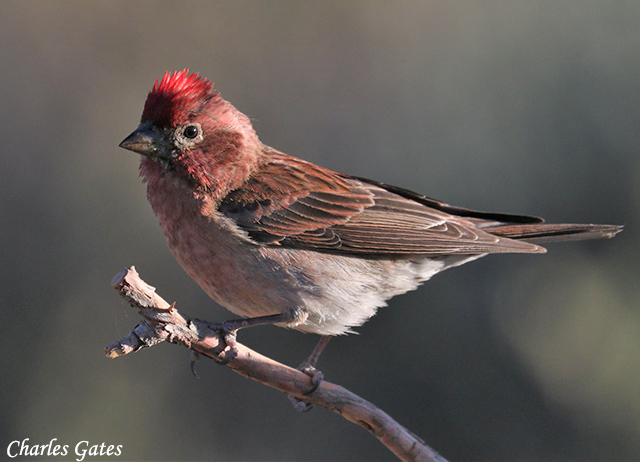
The Cassin's Finch is a medium-sized finch of western North America's conifer forests, mountain woodlands, and forest edges. Males are distinguished by their rosy-pink crown, face, and breast, while females are brown and heavily streaked. In South Dakota, it is an uncommon and localized resident of the Black Hills, where it breeds in ponderosa pine and mixed conifer forests; it is rare elsewhere in the state. The species feeds on seeds, buds, berries, and insects and may visit feeders, especially during winter. Cassin's Finches are somewhat nomadic and may irrupt beyond their normal range when cone crops fail, occasionally appearing in unusual numbers outside their typical distribution.
Habitat
They primarily breed in mountainous conifer forests of western North America, sometimes being found all the way up to the tree line. They are also most often found in conifer forests during the winter, although many times at lower elevations.
Diet
Primarily feeds on seeds, tree buds, berries, and other small fruits. They are very fond of the seeds of conifer trees. When available, they will also take insects.
Behavior
The Cassin's Finch is an active and often social finch that forages in trees, shrubs, and on the ground for seeds, buds, berries, and insects. Outside the breeding season it frequently occurs in small flocks, sometimes mixing with other finches and pine-loving songbirds. In the Black Hills, it is often seen in conifer forests and around feeders, where it can be surprisingly tame. Males commonly sing from exposed treetops during the breeding season, delivering a rich, warbling song while defending nesting territories.
Nesting
June and July in South Dakota. The Cassin's Finch nests primarily in conifer forests, placing its nest on horizontal branches of pines, spruces, firs, or other conifers, usually well above the ground. The female builds a neat open cup of twigs, grasses, rootlets, and plant fibers lined with softer materials such as hair and fine vegetation. Typical clutches contain 3–5 eggs, and the female performs most of the incubation while both parents help feed the nestlings after hatching. In Black Hills breeding habitats, nests are most often found in mature ponderosa pine and mixed conifer stands.
Song
The Cassin's Finch gives a rich, musical, warbling song composed of clear whistles, trills, and varied notes that is often delivered from the top of a conifer tree. Many birders consider its song more complex and sweeter than that of the House Finch. Calls include sharp cheep notes and a variety of conversational contact calls given by flocking birds. In the Black Hills, singing males are most noticeable during spring and early summer when defending breeding territories.
Migration
They are not strictly migratory, but are somewhat nomadic. Birds do irregularly move into lower elevation areas during the winter, and those at the northern end of the range may move southward a short distance for the winter.
Similar Species
House Finch , Purple Finch. The Cassin's Finch can be challenging to separate from the House Finch and Purple Finch, but several field marks are useful. Male Cassin's Finches show a distinctive rosy-red crown that appears brighter and more concentrated than the rest of the head, giving the impression of a red cap. Male House Finches usually have red spread more evenly across the forehead, face, throat, and upper breast, while male Purple Finches appear more extensively raspberry-red, as if they have been "dipped in raspberry juice."
Females and immatures are often more difficult. Female Cassin's Finches have a relatively plain face with only weak facial markings and crisp streaking on the underparts. Female Purple Finches show a bold white eyebrow and dark cheek stripe that create a strongly patterned face, while female House Finches tend to have blurrier streaking and a plainer overall appearance.
Structure also helps. Cassin's Finch is slightly larger and longer-winged than House Finch, with a longer tail and a more peaked crown. In South Dakota, Cassin's Finch is primarily a bird of the Black Hills conifer forests, whereas House Finches are common statewide around towns and feeders. Purple Finch is generally an uncommon migrant and winter visitor in the state and is more often associated with mixed woodlands and forest edges.
Bird Feeders
Will attend feeders for various seeds.
Conservation Status
The Cassin's Finch is generally considered a species of low conservation concern, but populations have shown long-term declines in parts of western North America. Potential threats include habitat changes in conifer forests, drought, insect outbreaks, altered fire regimes, and climate change affecting cone production and food availability. Despite these declines, the species remains widespread across much of its western mountain range, including its localized population in the Black Hills. The IUCN considers Cassin's Finch to be a species of "least concern".
Photo Information
Photo courtesy of Charles Gates .
Interactive eBird Map
Click to access the interactive eBird species sightings page for Cassin's Finch
